Verify your email
Hi Johny, to view the full content, please verify your email address by clicking the link sent to youremail@gmail.com
Resend Verification Email
Explore symmetry, balance, and optical color mixing with a reconfigurable spinning top! Learners assemble wooden parts on a square dowel, test symmetrical and asymmetrical builds to see which spins better, then color primary-colored peanuts and watch their brain optically blend them into secondary colors as the Blendie spins. This Spark weaves motor-skill development, engineering, and art into three linked explorations where every learner takes home a unique spinning creation.
Get the materials that pair with this educator guide.
Get the materials that pair with this educator guide.
Quick Start gets the main resources in hand. The guide below helps with the decisions that happen before, during, and after students build.
What students build and how the activity works.
Prep questions and pro tips.
Classroom sequence and prompts.
Learning goals and curriculum connections.
Fixes, adaptations, and extensions.
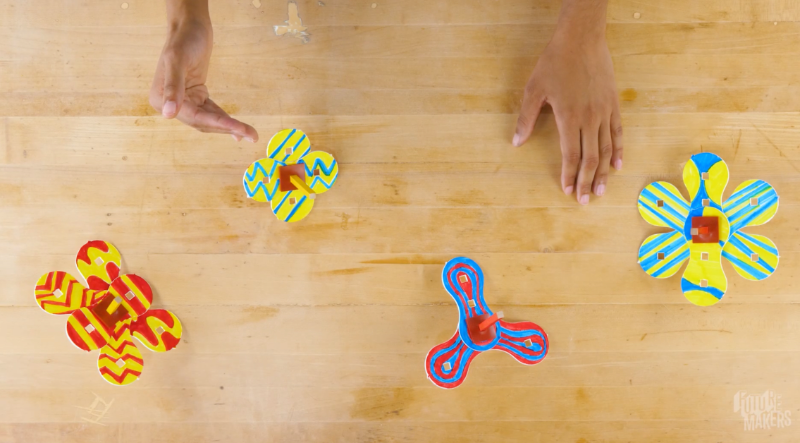
Blendies introduce learners to balance, symmetry, and optical color mixing - the phenomenon where spinning primary colors blur together into a new secondary color faster than the eye can separate them. Each learner receives two rubber stoppers, one square dowel, and one board of wooden Blendie pieces (called “peanuts” and “wings” for their two- and three-lobed shapes). Learners share primary-colored markers (red, yellow, blue) from a set that serves a small group.
The activity unfolds in nine steps across three linked phases. Phase one is the core build: remove pieces from the board, slide a stopper onto the dowel, add two peanuts in a crisscross flower shape, cap with the second stopper, and practice spinning with one-hand and two-hand techniques. Phase two explores symmetry: swap in wings to build a symmetrical blendie, then add a second wing on a side hole to make it asymmetrical, and observe how each one spins. Phase three is color blending: color the front of each peanut a different primary, rebuild the blendie color-side-up, and spin fast enough that the eye can’t separate the two colors. The brain fills in a new secondary color. Extensions invite older learners to draw two-color patterns on both sides of their pieces for more advanced optical blends.

A smooth spinning surface - a flat tabletop or floor area where learners can test their Blendies without obstructions.
Question: What do you notice about the different pieces in your kit? Which ones look the same and which ones look different?
Question: How far down the dowel should the first stopper go so there’s room for the rest of the pieces?
Question: What shape do the two peanuts make when you arrange them so they cross each other on the dowel?
Question: Which of the two spinning techniques works best for you - the one-hand flick or the two-hand push?
Question: If you imagine a line running straight down the middle of your Blendie, is the shape the same on both sides?
Question: What do you think will happen when you make your Blendie not the same on both sides?
Question: Which two primary colors will you choose? What secondary color do you think will appear when you spin them together?
Question: What new color appears when your Blendie spins fast enough that you can’t see the two primary colors separately?
Question: What other patterns or color combinations could you try to change what you see when your Blendie spins?
RI.K-2.7 – Use illustrations and words in a text to describe key ideas: Example: Learners follow the instructional playing cards and slide deck illustrations step-by-step to identify the peanut, wing, stopper, and dowel by name, matching picture diagrams to the physical pieces in their kit before assembling them into a working Blendie.
SL.K-2.1 – Participate in collaborative conversations: Example: Learners take turns describing what happens when they spin their symmetrical and asymmetrical Blendies, using shared vocabulary like “symmetrical,” “wobble,” and “spin” to compare observations with a partner and predict which color combination will blend into orange, green, or purple.
RI.3-5.3 – Explain relationships between ideas in a text: Example: Learners explain the cause-and-effect relationship between symmetry and spin quality by tracing how a balanced build on the dowel leads to smooth rotation while an off-center wing creates wobble - connecting the written build instructions and slide diagrams to the physical result they observe on the spinning surface.
SL.3-5.4 – Report on a topic with descriptive details: Example: Learners present their symmetry experiment results to a partner or small group, describing how the symmetrical Blendie spun, how the asymmetrical one wobbled, and which two primary colors they chose to blend - using descriptive language to explain exactly what their eyes saw at slow versus fast spin speeds.
RST.6-8.3 – Follow a multistep procedure when carrying out experiments: Example: Learners follow the nine-step Blendies build sequence precisely, understanding that the order matters - the first stopper has to be halfway down the dowel before the peanuts are added, and the top stopper must be pressed firmly at the end - because skipping or reversing steps produces a loose build that falls apart mid-spin.
SL.6-8.1 – Engage in collaborative discussions to analyze ideas: Example: Learners debate why the Blendie produces a different secondary color at different spin speeds, bringing their own observations to a group discussion of how human vision processes motion - building scientific argumentation skills by connecting what they see to the concept of optical blending.
K.G.B.4 – Analyze and compare two- and three-dimensional shapes: Example: Learners identify and compare the peanut (two-lobe) and wing (three-lobe) shapes in their kit, describing their similarities and differences and using positional language to arrange them symmetrically on the dowel - placing pieces “across from” and “on top of” each other to make the same shape on both sides of an imagined center line.
1.G.A.3 – Partition shapes into equal shares: Example: Learners imagine a line straight down the middle of their Blendie to check for symmetry, partitioning the whole shape into two halves and checking whether the left half matches the right half - reinforcing the concept of equal shares and the everyday vocabulary of “half” and “same on both sides.”
4.G.A.3 – Recognize a line of symmetry for a two-dimensional figure: Example: Learners identify lines of symmetry on their Blendie builds, testing whether a given arrangement of peanuts and wings can be folded along a line so that matching parts align - then comparing builds with one line of symmetry to a shape like a star that has multiple lines (radial symmetry), directly observing how the type of symmetry affects how the Blendie spins.
3.MD.B.3 – Draw a scaled bar graph to represent a data set and solve problems using it: Example: Learners time how long their symmetrical and asymmetrical Blendies spin across several trials, then draw a scaled bar graph with one bar per build type and use it to answer "how many seconds longer did the balanced one spin?" - turning their own spin data into a graph they can reason from.
8.G.A.1 – Verify experimentally the properties of rotations, reflections, and translations: Example: Learners use their own Blendie as a physical model to verify rotational symmetry, marking the top of a symmetrical build and confirming it lands back in the same spot after a half-turn on the dowel, then repeating the test on an asymmetrical build and confirming it does not - verifying the property experimentally with the spinning top itself instead of a coordinate grid.
6.SP.B.5 – Summarize numerical data sets in relation to their context: Example: Learners collect spin-duration data across multiple symmetrical and asymmetrical Blendie trials, calculate the mean spin time for each build type, describe the variability between trials, and draw a data-backed conclusion about how symmetry affects rotational motion - practicing statistical summary in the context of their own physical experiment.
K-PS2-1 – Motion and Stability: Forces and Interactions: Example: Learners compare how a symmetrical Blendie spins versus an asymmetrical one, feeling how a gentle flick or two-hand push produces a smooth spin on a balanced build and a wobbling, quickly-stopping spin on an unbalanced build - observing firsthand that the same push can change an object’s motion in different ways depending on its shape.
K-2-ETS1-2 – Engineering Design: Develop a simple sketch, drawing, or physical model: Example: Learners plan and test a symmetrical Blendie before building an asymmetrical one, using the imagined center line as a simple mental model of symmetry and iterating their piece arrangement until the shape is the same on both sides - then predicting how the spin will change when the symmetry is broken.
3-PS2-1 – Forces and Interactions: Balanced and Unbalanced Forces: Example: Learners plan and conduct an investigation on how balance affects a spinning Blendie, comparing symmetrical and asymmetrical builds and providing evidence that balanced mass allows smooth rotation while an off-center weight creates an unbalanced force that causes wobble and an early stop.
4-PS3-1 – Energy: Speed and Kinetic Energy: Example: Learners use the two spinning techniques to vary how much energy they put into the Blendie, observing that a harder, faster flick produces a faster spin with more kinetic energy - and that the spin gradually slows and stops as friction between the dowel and spinning surface removes energy from the system.
MS-PS2-2 – Motion and Stability: Effect of Forces on Motion: Example: Learners design an investigation comparing the angular motion of balanced and unbalanced Blendies, planning a fair test that changes only the symmetry of the build while holding the initial push the same - collecting evidence that net unbalanced forces on an off-center mass change the Blendie’s rotational motion and spin duration.
MS-LS1-8 – Gather and synthesize information that sensory receptors send messages to the brain: Example: Learners explain optical color mixing as the eye and brain doing the mixing, not the paint: when a Blendie spins fast enough, light reflected from the red and yellow pieces reaches the retina’s receptors faster than the brain can resolve separate images, so the brain synthesizes the incoming signals into one perceived color (orange). The colors on the wood never touch - the blend happens between receptor and brain.
The top stopper wasn’t pressed down firmly enough, so the peanuts are loose on the dowel and slide apart when the Blendie spins. Have learners remove the top stopper, press all the parts back together, and push the stopper down hard so the stack is tight.
Learners pulling straight out will fight the board. Show them how to twist the piece first, then pull. The lobes release much more easily after a quarter-turn.
This is usually an asymmetry problem - the build is off-balance. Have the learner hold it up and imagine a line down the middle. If the two sides don’t match, guide them to rebuild a symmetrical version and compare the spin quality.
The one-hand flick takes practice. If a learner is struggling with fine motor control, switch them to the two-hand technique: position the Blendie on the surface, wrap both hands around the dowel, and quickly move hands in opposite directions until it breaks free and spins.
Check three things: (1) are both colors on the fronts only, not overlapping? (2) is the Blendie spinning fast enough - a slow spin won’t blend? (3) did the learner use two different primary colors, not the same color twice or a primary plus a pre-mixed color?
Some stoppers arrive in two halves with a middle square. Before building, have learners remove the middle squares so the stopper is ready to thread onto the dowel cleanly.