Crankie Contraptions

What are Crankie Contraptions?

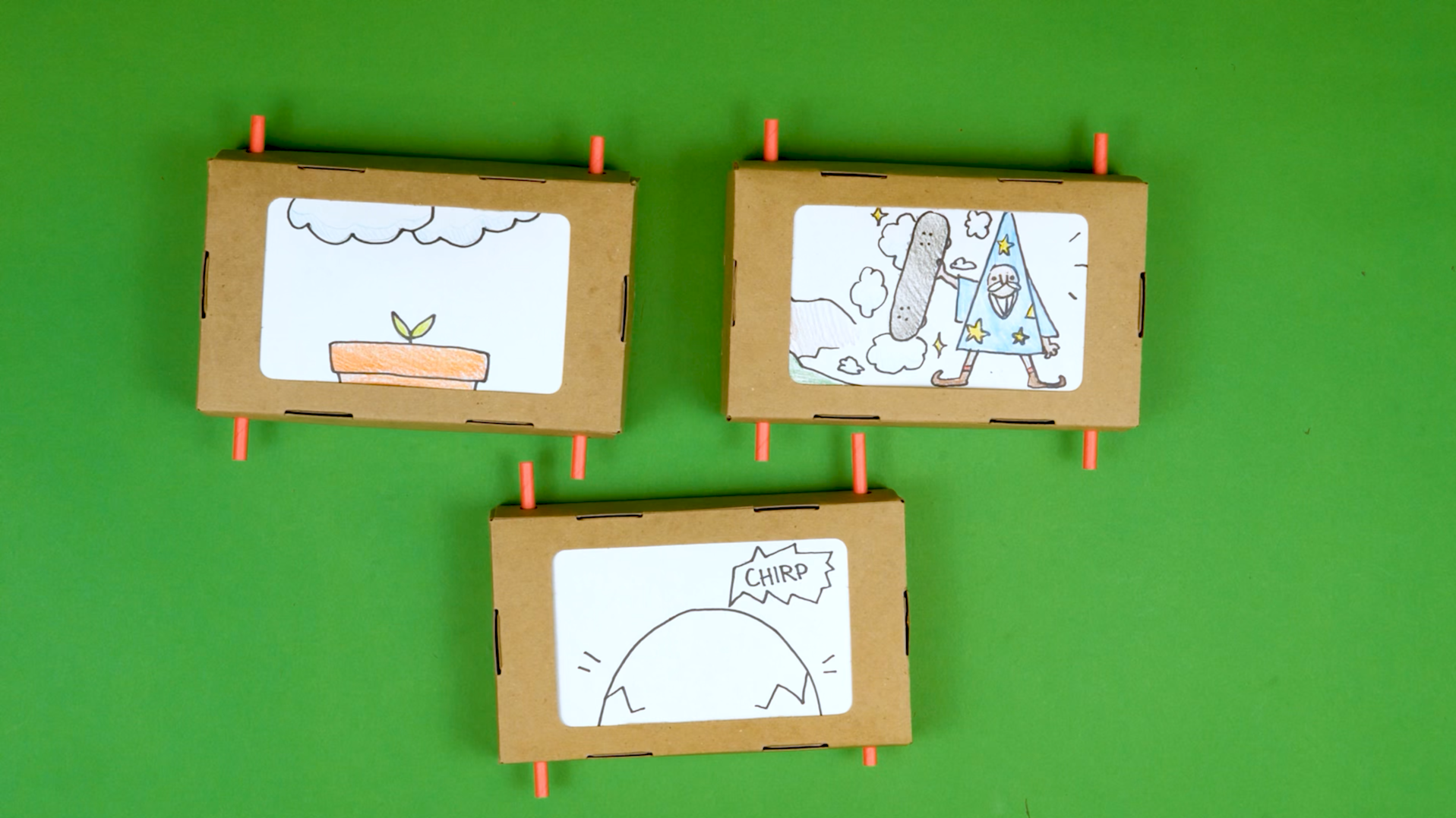
Tell an illustrated story with a folding cardboard screen machine! Learners assemble a die-cut frame, wind a paper scroll around two straws, install the scroll in the frame, then plan and illustrate a story that rolls across the screen like a movie, a theater stage, or a phone display. Crankies come from a long visual-storytelling tradition — this Spark merges engineering, visual art, and language arts into one build that every learner finishes with their own unique story to keep.

Time Needed:
20-minute activity station, or 60 minutes as a full classroom experience. Plan extra time if learners will write and illustrate full stories from scratch.
Grade Level:
Grade K and up
View our slides!
Need more materials?
Click Here
Navigate to
Jump to a section

Overview

Crankie Contraptions is a storytelling engineering challenge. Each learner receives a die-cut cardboard frame, two paper straws, a set of printed stickers, a folded paper scroll, a visual guide, and a reclosable bag. Working from those parts, they build a simple scrolling screen machine and then design and illustrate a story that plays across it.

The build follows ten steps across three big moves. First, learners fold the frame: popping out the interior, locking the short sides, then snapping the long sides into place so the word 'interior' ends up on the inside. Next, they attach stickers to both ends of the paper scroll, wind a straw onto each end, then carefully install the scroll into the frame and test the two-handed turning technique — always rolling toward the center of the box. Finally, learners plan a story (a sequence like a flower growing from a seed, or a narrative with a beginning, middle, and end), sketch it on a story planning worksheet, transfer it to the scroll, and share their finished crankie with peers.

Materials

Each learner recieves
  • A die-cut cardboard crankie frame
  • Two paper straws
  • A set of printed stickers
  • A folded paper crankie scroll
  • A visual instruction guide
  • A reusable reclosable bag
What you need to provide

Scissors for cutting scroll paper and trimming any additional story sheets.

Pencils for sketching story ideas and drafting illustrations on the scroll before committing with color.

Art supplies — markers, colored pencils, or crayons — to finish the story scroll once the pencil sketch is in place.

Optional resources
  • Printable Story Sketch Handout for planning character, setting, and story beats before drawing the final scroll
  • Printable scroll sheet for making additional scrolls when learners fill both sides of the original or want to start over
  • Crankies Extensions Doc for additional story prompts and building variations
  • Tape or extra stickers as backup adhesive for reattaching straws or repairing torn frame corners
  • Simplified Core Communication Board version of the slide deck for learners who use augmentative communication tools

Key Challenges

  1. Fold the cardboard frame accurately. Learners pop out the interior cut-outs, lock the short sides into place, then carefully align and snap the long-side wings so the frame holds its shape with the word 'interior' on the inside.
  2. Wind and install the paper scroll. Stickers fix each end of the scroll to a straw, then learners roll the scroll tight in opposite directions and thread both straws through the holes in the frame by gently flexing the cardboard.
  3. Master the two-handed scrolling technique. Learners turn the straw with the least paper toward the inside of the box — always rolling toward the center — so the scroll moves across the screen instead of unwinding.
  4. Plan and illustrate a complete story. Every crankie is a STEAM challenge: learners plan either a sequence (like a flower growing from a seed) or a narrative (beginning, middle, end with character and setting) and transfer it onto the scroll in pencil before finishing with color.

Learner Goals

MUST
  • Build the cardboard frame so it holds its shape with the word 'interior' facing inward.
  • Attach the paper scroll to both straws and install the scroll in the frame so it can roll left to right or up to down.
  • Outline a simple story with a beginning, a middle, and an end that fits onto the paper scroll.
  • Demonstrate the two-handed scrolling technique by turning toward the center of the frame.
SHOULD
  • Explain the parts of a story — setting, characters, plot, conflict, and resolution — while pointing to the sections of their own crankie scroll.
  • Troubleshoot common problems like a scroll that has come loose from its straw, a torn frame corner, or a scroll turning the wrong way.
  • Describe the difference between a sequence (a linear or time-based cycle) and a narrative (a story with a beginning, change, and ending).
COULD
  • Illustrate a complete story with a clear setting, characters, a conflict, and a resolution — including an unexpected twist at the end.
  • Perform their crankie story for a peer or small group, narrating aloud as they scroll through each scene.
  • Design a second crankie built vertically instead of horizontally and compare how that orientation changes the feel of their story.
  • Cut, connect, and create a brand-new extended scroll using the printable scroll sheet when their first scroll runs out of room.

Extension Activities

  • Vertical Crankie: Rebuild your frame so the scroll travels top to bottom instead of left to right. How does a vertical scroll change the way your story feels? Some stories — like a rocket launching, a seed sprouting, or a waterfall — feel more natural vertically.
  • Extended Scroll: Cut, connect, and create a longer scroll using the printable scroll sheet. Glue or tape sections together to add more scenes when your first scroll fills up. Challenge: can you tell a story that is twice as long as the original?
  • Storytelling Performance: Put on a puppet show! Introduce your crankie's main character, narrate aloud as you turn the scroll, and practice pacing so the audience has time to see each scene. Perform for a neighbor, a small group, or the whole class.
  • Sequence vs Narrative Swap: If you made a sequence (like a flower growing), challenge yourself to remake it as a narrative — add a character and a conflict. If you made a narrative, retell it as a sequence without any characters. What gets lost, and what gets added?
  • Spanish Story Sketch: Use the Spanish Crankies Story Sketch handout to plan a story in Spanish. Share it with a peer who speaks a different language — can they follow along visually even without the words?

Step-by-Step Guide

Pre-Activity Questions
Kindergarten - 2nd Grade
  1. What is your favorite story? Who is in it and what happens at the end?
  2. What do you think a machine that tells a story could look like?
  3. If you could draw a picture of your day, what would be at the beginning, middle, and end?
3rd - 5th Grade
  1. How is a movie or a TV show different from a picture book? What do they have in common?
  2. What is the difference between a sequence, like a flower growing from a seed, and a narrative with characters?
  3. When you plan a story, what comes first — the character, the setting, or the thing that happens?
6th - 8th Grade
  1. Crankies come from a long visual-storytelling tradition. What other 'screen machines' have humans invented to tell stories over time — from theater stages to phone displays?
  2. Why do you think illustrated stories are often easier to remember than stories told only with words?
  3. If you had to turn a sequence (like a plant growing) into a narrative with a conflict and a resolution, how would you do it?
Pro Tips
  • Build one yourself first. Make a Crankie of your own using the slide deck as a how-to guide before you build with learners. Reviewing the slide deck ahead of time will familiarize you with the concepts, vocabulary, and tricky folds so you can coach confidently.
  • It is theirs to keep. Remind learners from the start that this project will belong to them when they are done — watch how their engagement increases when they know they get to take it home and share their story again later.
  • Ask before you fix. Making a crankie might be challenging for your learners. Ask them questions before offering fixes — point out what you see and ask what they think might be causing the problem.
  • Peer power. Invite other learners to offer expert support. Peer feedback during the story-planning step is especially valuable: learners love helping each other add an unexpected twist to the ending.
  • Hands off unless necessary. Avoid getting hands-on with a learner's project unless it is absolutely necessary. The tab-and-slot fold rewards patience, and learners who solve it themselves remember it for years.
  • Double-check the interior. After folding, turn the frame over and confirm the word 'interior' is on the inside of the box. This is the most common place learners get stuck, so build a routine check into the flow.
  • Sketch before you ink. Coach learners to draft their story on the Story Sketch handout in pencil first, then transfer to the scroll, then commit to color. It saves a lot of scroll paper from restarts.
  • Always roll toward the center. The number-one story-stopper is learners turning the straws the wrong way. Remind them: always turn toward the inside of the box. Turning away unwinds the scroll or pulls it off the straw entirely.
  • Use the reclosable bag. The bag is made for learners to store in-progress work between sessions, or take home their finished creation. Tuck a name slip inside each bag to keep projects organized.
  • Try vertical. The frame works horizontally or vertically. Offer vertical as a second-build option for learners who want to remix the format.

Step 1: Explore Your Materials

Question: What do you notice about the different pieces in your kit? How do you think they might work together to tell a story?

  • Have learners open their reclosable bag and lay out everything inside: a die-cut cardboard frame, two paper straws, a set of printed stickers, a folded paper scroll, and a visual guide.
  • Ask learners to identify each piece before you name it — what do they think each part might do once the crankie is built?
  • Point out that they will also need scissors, pencils, and art supplies, which are not included in the kit.
  • Pop all the interior holes out of the cardboard frame. Keep the small center rectangles — they can be used later to make a stand.
  • Remind learners from the start that this project will belong to them when it is done. Watch how their engagement increases once they know they get to keep what they make.

Step 2: Fold the Short Sides of the Frame

Question: How do you think the tabs and slots on the cardboard work together to hold the frame in place?

  • Lay the frame down with the side marked 'interior' facing up. This is the side that will end up on the inside once the frame is fully folded.
  • Point out the two short sides of the frame — they have little folding wings with holes and a tab-and-slot pattern that locks them in place.
  • Fold one short side up and snap its tab into the slot. Repeat on the other short side.
  • When both short sides are folded, the tabs should be sticking straight out from the short ends. Those tabs are what the long sides will grab onto next, so leave them alone.
  • This step rewards patience and care. Avoid doing it for learners — ask them what they notice and let them work through the tab-and-slot puzzle on their own.

Step 3: Lock the Long Sides and Check the Interior

Question: How can you tell from the outside of the frame that you folded it correctly?

  • Here is the tricky part: fold one long side up and carefully align its two wings so they tuck inside the short sides that are already folded. Snap it into place.
  • Do the same with the second long side. Now every tab is locked inside a slot and the frame holds its shape on its own.
  • Turn the frame over and check your work. You should be able to see clear through each hole — and the word 'interior' should be on the inside of the box, not the outside.
  • If 'interior' is showing on the outside, unfold the frame and refold it so that side ends up facing in. This is the most common place learners get stuck, so make the check a routine for everyone.

Step 4: Attach Stickers to the Scroll

Question: Why do you think the scroll paper has a marked 'sticker spot' instead of being ready to install straight out of the package?

  • Set the assembled frame aside and unfold the paper scroll. On each end there is a marked sticker spot — that is where a straw will be anchored.
  • Peel a sticker marked with a '2' and press it onto the spot so about half the sticker is on the paper and half is still exposed.
  • Flip the paper over so the exposed adhesive is facing up, then center one paper straw along it. Press and roll the sticker up around the straw. Adjust the position if the straw is tilted.
  • Repeat on the opposite end with the second straw. There is an extra sticker in the kit, just in case a learner needs another try.
  • Encourage learners to press the stickers down firmly. A loose straw is the most common cause of a scroll that will not turn later.

Step 5: Roll the Scroll

Question: What do you think will happen if you roll both ends of the scroll in the same direction? How is rolling them in opposite directions different?

  • Flip the scroll so any printed lines are facing down toward the table. The side facing up is where learners will eventually draw their story.
  • Roll one of the straws against the table, winding the paper into a tight scroll all the way to the end. Use a flat palm to keep the roll snug and even.
  • Repeat on the other end, rolling tightly in the opposite direction. Both straws should now have paper wound onto them and a short span of paper showing in between.
  • The tighter the scroll, the smoother the crankie will play. If a scroll looks floppy or loose, unwind it and try again before installing it in the frame.

Step 6: Install the Scroll in the Frame

Question: What will happen if you try to push both straws into the frame at the same time? What makes flexing the frame easier?

  • Installing the scroll is the trickiest part of the build — remind learners to take their time and go slow.
  • Keep the printed lines facing down. Insert one end of a straw into a hole on one side of the frame.
  • Gently bend the opposite frame edge just enough to slide the other end of that same straw into its matching hole. Release and the frame pops back into shape around the straw.
  • Repeat with the second straw in the other pair of holes. If a frame corner tears during this step, remind learners it is an easy fix — a small piece of tape or an extra sticker will repair it.

Step 7: Test the Scrolling Motion

Question: If you turn both straws away from the center of the frame, what happens to the scroll? What does that tell you about how the machine works?

  • Use two hands. Turn the straw that has the least paper wound onto it toward the inside of the box — this will roll up the scroll. Watch the opposite straw unwind at the same time.
  • Use this two-handed technique to roll one end of the scroll at a time. Always turn toward the center of the box to make the scroll move across the screen.
  • If a learner turns away from the center, the scroll will unwind — or pop off the straw entirely. Point at the movement and ask what they notice rather than fixing it for them.
  • Once they have tested it, show learners how to reverse the process: remove the scroll one straw at a time by gently flexing the frame. This lets them pull the scroll out to draw on it in Step 9.

Step 8: Plan Your Story

Question: Is your story going to be a sequence that shows something changing over time, or a narrative with a character, a setting, and an ending?

  • Crankies come in two flavors: sequences (linear or time-based cycles, like a flower growing from a seed) and narratives (stories with a beginning, a middle change or action, and an ending).
  • Hand out the printable Story Sketch Handout and have each learner decide which flavor they want to make. Sequence planners sketch a first step, middle steps, and a last step. Narrative planners sketch a character, a setting, and what happens first, next, and last.
  • Invite peer or educator feedback on the plan before committing to the scroll. 'Learners love creating stories that have an unexpected twist at the end' — prompt them to add a surprise if their story feels flat.
  • Explain the story vocabulary as you coach: character (a person in a story), setting (where it takes place), plot (what happens), conflict (what gets in the way), and resolution (how it gets solved).

Step 9: Illustrate and Share Your Scroll

Question: How can drawing in pencil first help you when it is time to add color?

  • Once the plan is approved, learners transfer their sketch onto the paper scroll with pencil. Drawing in pencil first gives them room to adjust the spacing so every scene fits across the width of the frame.
  • When the pencil sketch looks right, have learners finish the scroll with markers, colored pencils, or crayons. Encourage unique styles — every crankie should look different from any example.
  • Reinstall the finished scroll in the frame (flexing it gently as in Step 6) and test that the story scrolls smoothly across the screen. Learners may need to adjust spacing or press down a loose sticker.
  • Invite learners to share their story with a neighbor or small group, narrating aloud as they scroll through each scene.

Step 10: Iterate!

Question: Now that your first crankie works, what is one thing you could change to make the next one feel completely different?

  • Every Crankie Contraption is a unique STEAM project — challenge learners to redesign, remix, and retell.
  • Try building the frame vertically instead of horizontally, or make a second scroll with the printable scroll sheet to tell a brand-new story.
  • See the Extension Activities field for structured challenges including vertical builds, extended scrolls, Spanish-language story sketches, and performance sharing.
Post-Activity Questions
Kindergarten - 2nd Grade
  1. What happens in the beginning, middle, and end of your story?
  2. Who is the main character in your story? Where does the story take place?
  3. Which part of making the crankie was the trickiest for you?
3rd - 5th Grade
  1. Why do you always have to turn the straws toward the center of the frame? What would happen if you turned them the other way?
  2. Is your story a sequence or a narrative? How did you decide?
  3. What is one thing you would change about your crankie if you built a second one?
6th - 8th Grade
  1. How does your crankie compare to other screen machines you know about — like phones, TVs, or theater stages? What do they have in common and what is different?
  2. Where in your story is the conflict, and how does the resolution fit the character you drew?
  3. How could you redesign the frame or scroll to show a longer story without running out of paper?

Standards & Goals

Common Core ELA Standards

RL.K-2.2 – Retell stories, including key details, and demonstrate understanding of their central message: Example: Learners retell the story they illustrated on their crankie scroll by turning the straws and narrating aloud what happens in the beginning, middle, and end — pointing to each scene they drew and naming the main character and what changes by the resolution.

W.K-2.3 – Write narratives in which they recount a well-elaborated event or short sequence of events: Example: Learners plan a short narrative or sequence on the Story Sketch Handout — naming who the main character is, where the story takes place, and what happens first, next, and last — then transfer that planned sequence onto their crankie scroll with pencil before coloring.

RL.3-5.5 – Explain how chapters, scenes, or stanzas provide the overall structure of a story: Example: Learners explain how each panel on their crankie scroll contributes to the structure of the story — identifying which sections are the setup, which show the conflict or change, and which deliver the ending or unexpected twist that resolves the plot.

SL.3-5.5 – Include visual displays in presentations to emphasize main ideas: Example: Learners perform their crankie for a peer or small group, using the hand-cranked illustrated scroll as a visual display while they narrate the story aloud — pacing the scroll so each scene stays on screen long enough for the audience to see the character, the setting, and the key action.

RL.6-8.5 – Analyze how a particular sentence, chapter, scene, or stanza fits into the overall structure of a text and contributes to the development of theme: Example: Learners analyze how the ordering of scenes on the crankie scroll builds meaning — arguing why they placed the conflict in the middle panels and why the final scene delivers the intended theme or unexpected twist, connecting the visual structure of the scroll to narrative craft.

W.6-8.3 – Write narratives to develop real or imagined experiences using effective technique, relevant descriptive details, and well-structured event sequences: Example: Learners develop a multi-panel illustrated narrative for their crankie scroll with a clear character, setting, rising action, and resolution — revising their Story Sketch plan based on peer feedback so each panel contributes a well-chosen detail to the overall sequence.

Common Core Math Standards

K.MD.A.1 – Describe measurable attributes of objects, such as length or weight: Example: Learners compare the length of the unrolled paper scroll to the width of the cardboard frame and describe how many scenes they can fit across the 'screen' at one time — using positional language like longer, shorter, and between as they plan where each panel of their story will land.

1-2.OA.A.1 – Use addition and subtraction to solve one- and two-step word problems: Example: Learners count the number of scenes in their story plan and the number of spaces on the scroll, using addition and subtraction to figure out how many more panels they can fit or how many they need to remove so the story fits the length of the paper.

3.MD.B.4 – Generate measurement data by measuring lengths using rulers marked with halves and fourths of an inch: Example: Learners measure the width of the frame's viewing window and the length of their scroll paper, then divide the scroll into equal sections for each panel of their story — generating a measurement plan that ensures every scene is the same size as it scrolls across the screen.

4-5.OA.C.5 – Generate and analyze patterns: Example: Learners observe the inverse pattern of the two straws as they test their crankie — when the receiving straw gains paper, the feeding straw loses the same amount. They describe this as a consistent one-to-one inverse relationship and predict where on the scroll the story will be after a given number of turns.

6-8.RP.A.1 – Understand the concept of a ratio and use ratio language to describe a ratio relationship: Example: Learners describe the ratio of scenes to scroll length in their crankie — if the scroll holds six scenes across its full length, what ratio describes 'three scenes per half of the scroll'? They use this ratio to plan scene spacing before drawing.

7-8.G.A.1 – Solve problems involving scale drawings of geometric figures: Example: Learners treat the Story Sketch Handout as a scale drawing of the final scroll — measuring how each planned panel on the handout will translate to full size on the paper scroll, so characters and settings fit properly inside the frame's viewing window when the finished story plays back.

Next Generation Science Standards (NGSS)

K-2-ETS1-2 – Engineering Design: Develop a simple sketch, drawing, or physical model to illustrate how the shape of an object helps it function as needed to solve a given problem: Example: Learners sketch their story plan on the Story Sketch Handout before folding the frame, then use their sketch to guide how many scenes will fit across the crankie's viewing window — iterating on their drawing when a panel is too wide or too tall to display cleanly inside the frame.

K-PS2-1 – Motion and Stability: Plan and conduct an investigation to compare the effects of different strengths or different directions of pushes and pulls: Example: Learners investigate what happens when they turn the straws in different directions — rolling toward the center scrolls the story forward, turning away unwinds the paper or pulls the scroll off the straw. They compare the two directions and describe the rule: always turn toward the center.

3-5-ETS1-2 – Engineering Design: Generate and compare multiple possible solutions to a problem based on how well each is likely to meet the criteria and constraints of the problem: Example: Learners compare a horizontal crankie build to a vertical build for a story about a plant growing or a rocket launching, evaluating which orientation better matches the story's direction of motion and which is easier to hand-crank smoothly during a performance.

3-5-ETS1-3 – Engineering Design: Plan and carry out fair tests to identify aspects of a model or prototype that can be improved: Example: Learners test their crankie before adding final illustrations, rolling through the full scroll to identify failure points: a loose sticker attachment, a torn corner, a scroll that binds inside the frame, or a scene that sits too high to be visible. They fix each issue and re-test — the engineering design cycle in miniature.

MS-ETS1-2 – Engineering Design: Evaluate competing design solutions using a systematic process to determine how well they meet the criteria and constraints of the problem: Example: Learners evaluate competing scroll designs — a standard single-length scroll, a printable extended scroll glued into multiple sections, or a vertical crankie — scoring each against criteria like story length, ease of turning, and audience visibility during a performance. They justify the choice with evidence from their test runs.

MS-ETS1-4 – Engineering Design: Develop a model to generate data for iterative testing and modification of a proposed object, tool, or process: Example: Learners use their finished crankie as a model to generate iteration data: timing how long each scene stays on screen, counting scroll wraps per turn, and noting which panels confuse the audience — then redesigning the scene spacing, sticker placement, or scroll length for a second iteration that tells the story more clearly.

Troubleshooting & Pro Tips

Interior Ends Up on the Outside

The most common build error is finishing the fold with the word 'interior' showing on the outside of the box. If this happens, unfold the frame and refold it so the side marked 'interior' ends up facing in. Build the flip-and-check into your coaching routine for every learner.

Scroll Will Not Turn

If the scroll will not turn, it may have come loose from the straw. Use the extra sticker (or a piece of tape) to firmly reattach the straw and wind it tight. Always roll toward the center of the box — turning away unwinds the scroll or pulls it off the straw entirely.

Out of Paper

If a learner has used up both sides of their scroll, pull out the printable scroll sheet. They can cut, connect, and create a new scroll to keep drafting. Coach them to sketch in pencil first so less paper gets wasted.

Broken Frame

The cardboard corner can tear when learners flex the frame to install the scroll. Repair it with an extra sticker or a small piece of tape — a torn corner does not stop the crankie from working.

Stuck Scroll or Floppy Fold

If the fold comes loose because a tab worked out of its slot, ask the learner what they see before offering a fix. Re-seat the tab firmly, press the long-side wings all the way in, and check that every hole is clear before trying again.
Book a quick support session via Calendly
Book here