Mazes

What are Mazes?

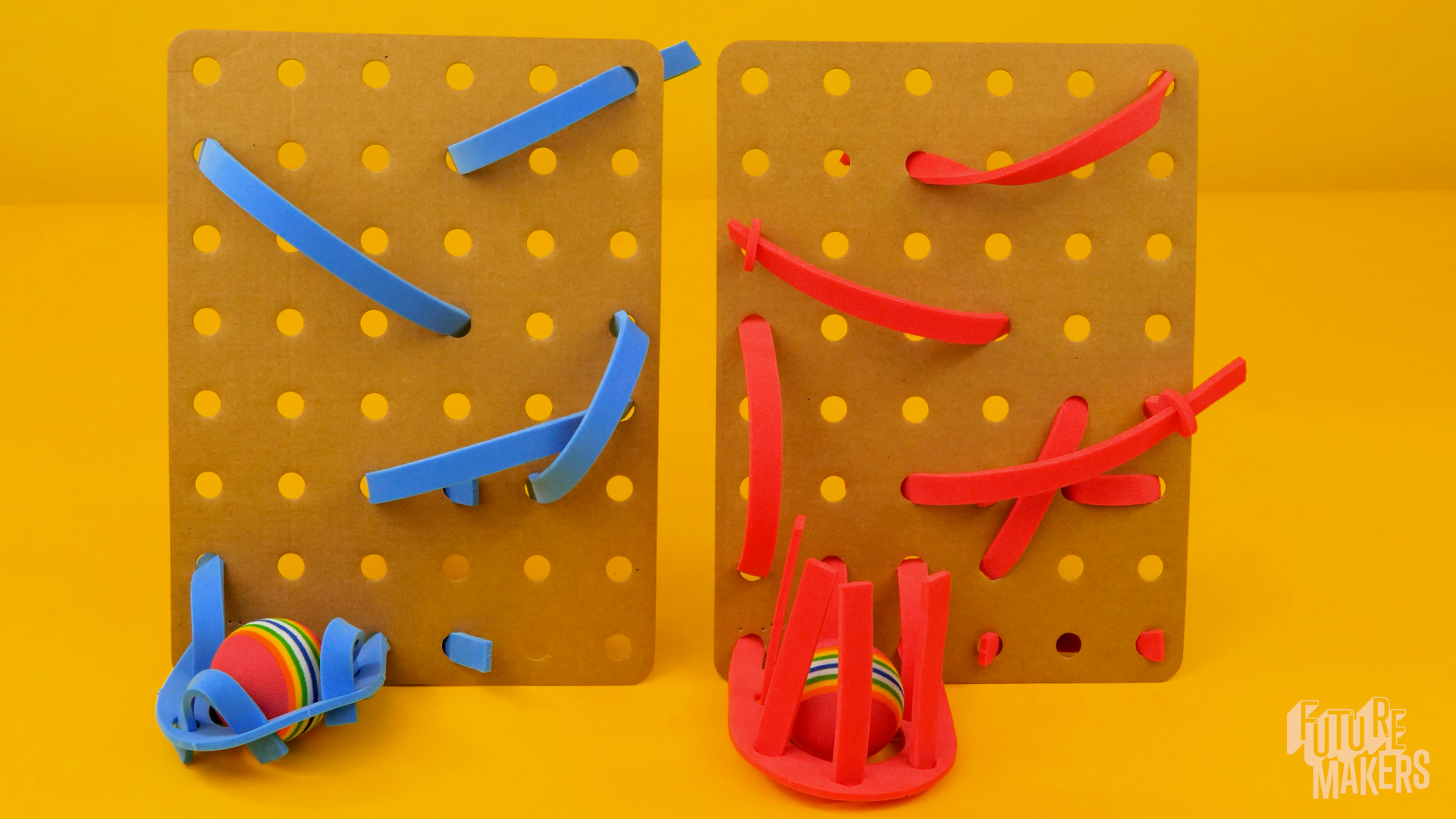
Build ramps and pathways on a reconfigurable board so a ball rolls through a custom track to a final hoop — then connect your maze to a partner's and extend the play. Learners use reverse engineering to design from the finish to the start, testing and adjusting ramps until the ball zigs, zags, and zooms into the hoop. The spark grows naturally from a solo build into a cooperative challenge where two or more boards become one shared path.

Time Needed:
15-60 minutes. The build works as a 15-minute quick activity station or a 60-minute full classroom session with iteration and collaboration time.
Grade Level:
Grade 1 and up
View our slides!
More resources
Need more materials?
Click Here
Navigate to
Jump to a section

Overview

Mazes introduce learners to gravity, ramps, pathways, and reverse engineering through a hands-on design challenge. Each learner receives two die-cut cardboard wall boards, two sheets of die-cut foam components (ramps, stoppers, extenders, and a hoop piece), a lightweight ball, a cardboard triangle kickstand, an instruction sheet, and a reusable reclosable bag.

The build follows nine steps: learners explore and name their parts, prepare the boards and foam components, assemble a triangle stand so a board can stand upright, attach the hoop at the bottom, then add ramps and extenders working upward from the finish to the start. Testing happens at every stage — rolling the ball, adjusting ramp angles, and adding stoppers where the ball rolls off. When three ramps make a zig-zag-zoom path into the hoop, learners connect their boards with a partner so the hoop of one maze becomes the start of another. Extensions scale the cooperative challenge up to four-board pair builds and six-board whole-group mazes with a single ball traveling through every section.

Materials

Each learner recieves
  • Two die-cut cardboard wall boards
  • Two sheets of die-cut foam components (ramps, stoppers, extenders, and hoop piece)
  • A lightweight plastic ball
  • A cardboard triangle kickstand
  • An instruction sheet
  • A reusable reclosable bag for storage and reuse
What you need to provide

Nothing. Everything learners need to build the Mazes Spark is included in the kit.

Optional resources
  • A taller surface or wall to lean larger multi-board mazes against if they get too tall to stand on the triangle alone
  • Extra tables pushed together so two or more learners can connect their boards into a shared cooperative maze
  • Space on the floor or a low bench for whole-class combined builds (four or six boards joined together)

Key Challenges

  1. Use reverse engineering to design a maze path. Learners plan backwards from the hoop at the bottom of the board up to the starting point at the top, making every ramp decision in reverse order.
  2. Build a working ball path from ramps, stoppers, and extenders. Learners thread long ramps through the board holes, add extenders to hold ramps farther off the surface, and use stoppers to stop the ball from rolling off the path.
  3. Test and iterate a three-ramp minimum. Learners roll the ball after every addition, adjust ramp angles when the ball misses, and add stoppers where the ball exits the path — the maze is not done until the ball zigs, zags, and zooms into the hoop.
  4. Connect two or more mazes into a cooperative path. Pairs join boards so one hoop becomes the next maze's starting point; older learners scale up to four- and six-board combined builds where a single ball travels through every section.

Learner Goals

MUST
  • Remove the dots from both wall boards and remove all foam shapes from the foam sheets before assembling.
  • Assemble the triangle kickstand and attach it to a wall board so the board stands upright on its own.
  • Attach the hoop piece to the board near the bottom as the maze's finish line.
  • Add at least one ramp above the hoop and test the ball rolling down into the hoop.
SHOULD
  • Use reverse engineering — designing backwards from finish to start — to build a maze with at least three ramps.
  • Test the ball after each ramp is added and adjust ramp angles or placements when the ball misses.
  • Add stoppers anywhere the ball rolls off the edge or goes in an unintended direction.
  • Explain that gravity is what pulls the ball down the ramps from top to bottom.
COULD
  • Connect two boards together using foam parts so their hoop becomes their partner's starting point and the ball travels through both mazes as one.
  • Use both of their own wall boards to build a taller maze with a longer ball path.
  • Join a pair's two-board maze with another pair's two-board maze to create a four-board combined cooperative build.
  • Work as a larger group to connect four, six, or more boards with different colored foam, sending a single ball through the entire combined maze.

Extension Activities

  • Pair Up, Connect Up. Have two learners connect their boards so the hoop of one maze becomes the starting point of the other. They use spare foam parts (stoppers or extenders) to bridge the two boards and adjust the first board's hoop so the ball rolls cleanly out onto the second board's top ramp. This is the first cooperative step and the most powerful social-learning moment in the build.
  • Use Both of Your Boards. Each kit contains two wall boards. Encourage learners to use both of their own boards stacked vertically to build a taller maze with a longer ball path. This is a good middle ground between the single-board zig-zag-zoom target and the full cooperative challenge.
  • Four-Board Pair Combined. Two pairs of learners join their two-board mazes together so four boards form one continuous path. Each pair has to negotiate which side their hoop ends on and how the neighboring pair's ramp angles into it.
  • Six-Board Whole-Group Maze. For an older-learner extension, challenge a group of six learners to join all of their boards so a single ball travels from the top of board one through every section and lands in the bottom hoop of board six. Let them pick different colored foam for each section so they can see the whole chain.
  • Lean Against a Wall. When a combined maze gets too tall to stand on the triangle alone, have learners lean it against a vertical surface — a wall, a book stack, or the side of a bookshelf — so the build stays upright for testing.
  • Custom Components. Hand back the parent foam sheets and invite learners to cut new shapes with scissors to create custom stoppers, funnels, or ball catchers — a good extension for learners who finish the three-ramp target early.

Step-by-Step Guide

Pre-Activity Questions
Kindergarten - 2nd Grade
  1. What happens when you drop a ball? Which way does it go — up, down, or sideways?
  2. If you made a ramp on a table, do you think the ball would roll up or roll down it? Why?
  3. Have you ever built something where you had to start at the end instead of the beginning?
3rd - 5th Grade
  1. What is gravity? What does it do to things on Earth?
  2. If you had a ball rolling down a ramp and it kept rolling off the edge, what could you add to keep it on the path?
  3. What does it mean to "design backwards" — to start at the finish and work back to the start?
  4. If two people connect their mazes together, whose hoop should come first and whose should come last?
6th - 8th Grade
  1. How does the steepness of a ramp change the speed of a ball rolling down it?
  2. Why do engineers use reverse engineering — starting with a working example and taking it apart — as a design strategy?
  3. If a single ball has to travel through six connected mazes, what has to be true at every connection point for the system to work?
  4. What is the difference between tweaking an existing design and scrapping it to start over? When is each one the right call?
Pro Tips
  • Trust the process. It is normal for things to go wrong. Remind learners to take their time and keep practicing — the first ramp angle almost never works on the first try, and that is the point of the design loop.
  • Small changes matter. Tiny adjustments in ramp angle or how far the ramp sticks through the hole make big differences in how the ball rolls. Encourage learners to make one small change at a time instead of rebuilding the whole maze.
  • Let someone else test your maze. When a group is ready, have each learner hand their board to a partner and watch the ball roll — without feeling the urge to fix it right away. Watching a peer drop the ball is one of the most powerful moments in this build.
  • Design backwards. Always place the hoop at the bottom first, then work up the board one ramp at a time. Starting from the finish is the core of reverse engineering, and learners who start at the top almost always have to tear it down.
  • Three ramps, zig-zag-zoom. The video calls it out explicitly: your maze should have three ramps at minimum so the ball goes "zig, zag, zoom" into the hoop. Use this as your simple success target for younger learners or quick activity stations.
  • Use stoppers the moment the ball escapes. If the ball rolls off the end of a ramp, immediately add a stopper at that spot instead of rebuilding. Stoppers can also sit at the opening of the hoop to stop the ball bouncing out.
  • Ask questions, don't fix. When a learner is frustrated, ask what they notice is happening before offering advice. Point at the ball's path and ask where it went sideways — let them diagnose the failure point.
  • Lean tall mazes against a wall. When learners combine boards into a taller collaborative maze, the triangle stand may not be enough. Rest the top of the maze against a wall, a book, or a vertical surface so the build stays upright for testing.
  • Save and reuse. This project is fully reusable. At cleanup time, learners pull the foam parts out and return everything to the reclosable bag so the maze can be rebuilt next session.
  • Success looks different by age. For younger learners, success is one wall board with a zig-zag-zoom. For older learners, success is multiple wall boards with longer paths or a connected partner build.

Step 1: Explore Materials and Meet Gravity

Question: What makes a ball roll downhill by itself? What do you think pulls it down?

  • Have learners open their kit and lay out everything inside: two cardboard wall boards, two foam part sheets, a lightweight ball, a triangle kickstand, the instruction sheet, and the reclosable bag.
  • Name the foam parts out loud so learners know the vocabulary: the long straight pieces are ramps, the short straight pieces are stoppers, the pieces with circles at the top are extenders, and the largest piece is the hoop.
  • Ask learners what makes a dropped ball fall toward the ground. Introduce gravity as an invisible force that pulls everything down toward the Earth — that force is what will make the ball roll all the way through the maze they are about to build.
  • Tell learners from the very beginning that the maze will be theirs to keep and rebuild as many times as they want. Reusability is one of the best things about this spark.

Step 2: Remove the Dots from the Wall Boards

Question: Why do you think the boards have holes all over them? What will the holes be used for?

  • Take one cardboard wall board. Gently push out all of the small circular dots from the die-cut holes. The dots can go in the recycling or trash — they are not needed for the build.
  • Repeat on the second wall board so both boards are fully prepared with open holes.
  • Explain that the holes are where ramps and other parts will thread through to build a path for the ball. More holes open = more options for ramp placement during the design.
  • Learners who want to save the small dots are welcome to, but do not let that slow the build down.

Step 3: Prepare the Foam Parts

Question: How many different shapes do you see in the foam sheets? How do you think each one will be used?

  • Take one foam sheet and gently pop every shape out of the parent sheet, including any small dots inside the shapes. Learners keep the shapes and can recycle or save the parent sheets.
  • Do the same with the second foam sheet so all shapes are free and ready to use.
  • Spread the shapes out and name them: long straight pieces are ramps, short straight pieces are stoppers, pieces with a circle at one end are extenders, and the largest piece is the hoop.
  • Store the shapes near the build area in the reclosable bag or in loose piles so learners can grab what they need without the parts getting mixed up with the dots.

Step 4: Make the Board Stand

Question: How will you make the wall board stand upright by itself so a ball can roll down it?

  • Pick up the cardboard triangle kickstand and two short straight foam pieces (stoppers).
  • Insert one stopper into the hole at the narrowest corner of the triangle, then thread it into a matching hole near the bottom of a wall board. Repeat with the second stopper through the other triangle hole and another wall-board hole.
  • Adjust the triangle until the board stands upright on its own. The triangle can be oriented in either direction — find what balances best.
  • Press all the stoppers firmly so the stand does not flop. If the board still leans, shift the triangle position or pull the stoppers slightly to reset the balance.

Step 5: Start with the Hoop

Question: If the hoop is the finish line of your maze, where should it go on the board — the top, middle, or bottom?

  • Take the hoop piece and attach it to the board near the bottom. This is the finish line — where the ball will end up after rolling through every ramp above it.
  • Explain the core idea of reverse engineering: learners will design the maze backwards, starting from the finish (the hoop) and working up the board one ramp at a time toward the start.
  • Starting backwards is the secret to this build. Learners who try to start at the top and work down almost always have to tear apart and rebuild. Starting at the hoop means every ramp decision is made in the order the ball will travel, but in reverse.
  • Let learners trace the path they want with a finger above the hoop before adding any ramps — this is their physical sketch for the maze they are about to build.

Step 6: Add Your First Ramp

Question: If the ball has to land in the hoop, how should you aim this first ramp?

  • Take a long straight foam piece — a ramp — and position it above the hoop so one end will drop the ball right into the hoop.
  • If the ramp is too short to reach, grab an extender (the piece with a circle at one end). Insert the end of the extender into a hole on the board so the circle sticks out in front, then slide the ramp end into the extender. Extenders hold ramps farther off the board surface and let you reach longer distances.
  • Thread the other end of the ramp through a hole higher on the board, pulling it through so enough sticks out for the ball to roll onto.
  • Press the ramp firmly so it grips in the hole — floppy ramps drop the ball before it reaches the hoop.

Step 7: Test and Improve

Question: When you roll the ball from the top of this ramp, what happens? Does it land in the hoop?

  • Place the ball at the top of the first ramp and let it go. If it lands cleanly in the hoop, celebrate — the first section works and the maze is born.
  • If the ball misses, this is where the reverse-engineering loop begins. Change one thing at a time: pull the top of the ramp out by a single hole to change its angle, or shift where it threads into the board. Test again.
  • If the ball rolls off the side of the ramp, add a stopper on that side — a short straight piece slotted into the nearest hole to block the ball's escape.
  • Every maze is different. Expect several small adjustments before the first ramp drops the ball cleanly into the hoop. Remind learners that small changes make big differences — do not rebuild the whole section unless you have to.

Step 8: Zig-Zag-Zoom!

Question: How many ramps do you need before the ball has enough room to really pick up speed?

  • Add a second ramp above the first, angled in the opposite direction so the ball zigs from one ramp to the next.
  • Add a third ramp above the second, angled back the other way. Your maze should have at least three ramps so the ball goes zig — zag — zoom into the hoop.
  • Test the ball after each new ramp is added. If the ball rolls off between ramps, add a stopper at that exact spot before moving on. Use extenders wherever you need a ramp to reach farther off the board or span a bigger gap.
  • Keep going until the ball rolls from the very top of your board all the way through every ramp and lands in the hoop. When it does, the maze is done — and ready to share.

Step 9: Iterate!

Question: Now that your maze works, how would it change if you connected it to a partner's?

  • This is where Mazes becomes cooperative. Connect your board to a partner's so the hoop of one maze becomes the starting point of the next, and a single ball travels through both builds as one shared path.
  • Scale up to bigger combined builds — two pairs together, or a whole group of six learners sharing one maze — see Extension Activities for the full set of cooperative challenges.
Post-Activity Questions
Kindergarten - 2nd Grade
  1. What pulls the ball down the ramps in your maze?
  2. What did you do when the ball rolled off the side? What did you add?
  3. Can you show someone else how your maze works?
3rd - 5th Grade
  1. Why is it easier to build a maze backwards — from the hoop up — than from the top down?
  2. What was the smallest change you made that had the biggest effect on how the ball rolled?
  3. When you connected your maze to a partner's, what did you have to change at the seam between the two boards?
  4. How did you decide when the maze was "done"?
6th - 8th Grade
  1. Gravity is an invisible force. How would you prove to someone that gravity is what is making the ball roll, not something else?
  2. Describe a failure point in your maze and how you isolated it. What did you change first, and why?
  3. If you combined your maze with three other mazes to make a six-board build, what engineering trade-offs would you have to negotiate with your teammates — on ramp angle, ball path, and connection points?
  4. Reverse engineering asks you to start from the solution and work backwards. Where else in the real world is this a useful strategy?

Standards & Goals

Common Core ELA Standards

RI.K-2.7 – Use illustrations and words in a text to describe key ideas: Example: Learners read the Mazes instruction sheet and the slide-deck visuals to identify which foam pieces are "ramps," "stoppers," "extenders," and "hoop," using both the printed words and the labeled pictures to name each part before they start building.

SL.K-2.1 – Participate in collaborative conversations: Example: Learners explain to a partner where their hoop is and how the ball rolls into it, using vocabulary like "ramp," "hoop," and "gravity" as they show their maze, and take turns rolling the ball through each other's designs before deciding how to connect the two boards.

RI.3-5.3 – Explain relationships between events, concepts, or steps in a text: Example: Learners explain the cause-and-effect relationship between ramp angle and ball speed, describing how shifting the top end of a ramp by one hole changes whether the ball makes it into the hoop or rolls off the edge — tracing the reverse-engineering build sequence in the order it actually happened.

SL.3-5.1 – Engage effectively in collaborative discussions: Example: Learners negotiate where to connect their board to a partner's, discussing which hoop becomes the start of the next maze and what adjustments each of them needs to make so the ball passes cleanly from one board to the next without any adult intervention.

RST.6-8.3 – Follow a multistep procedure when carrying out experiments: Example: Learners follow the reverse-engineering sequence precisely — hoop at the bottom first, then one ramp, test, adjust, next ramp, test, adjust — understanding that the order matters because adding three ramps at once and then testing hides which ramp caused which failure.

SL.6-8.1 – Engage in collaborative discussions with diverse partners: Example: Learners negotiate a six-board combined maze with a team, debating how the ball should transition between each pair's section, arguing from evidence (the ball rolled off here, we adjusted and it worked) rather than preference, and building collective ownership of the shared path.

Common Core Math Standards

K.MD.A.1 – Describe measurable attributes of objects: Example: Learners compare the length of their ramps to the space between board holes, describing whether a ramp is long enough to span two, three, or four holes and how far its end sticks out — using "longer," "shorter," "higher," and "lower" to talk about how the ramp is positioned on the board.

K.G.A.1 – Describe objects using names of shapes and relative positions: Example: Learners identify the triangle kickstand as a triangle and describe spatial relationships during the build — "the hoop is at the bottom," "the ramp is above the hoop," "the extender is next to the ramp" — using positional language like above, below, next to, and between.

3.MD.B.4 – Generate measurement data by measuring lengths: Example: Learners test different ramp angles and record which angle drops the ball cleanly into the hoop versus which angle sends it off the edge, generating their own data on the relationship between steepness and ball path and making adjustments one hole at a time.

4.OA.C.5 – Generate and analyze patterns: Example: Learners notice the zig-zag-zoom pattern across three ramps and predict where the ball will travel next based on the angle of the ramp above it — recognizing that the whole path is made of one repeating rule: gravity always pulls the ball toward the next ramp below.

6.RP.A.3 – Use ratio and rate reasoning to solve real-world problems: Example: Learners reason about the ratio between ramp angle and ball speed in their maze — observing that a ramp tilted just a little steeper roughly doubles the ball's momentum into the next ramp — and use that rate reasoning to predict whether a new ramp angle will overshoot or undershoot the hoop.

6.EE.A.2 – Write, read, and evaluate expressions in which letters stand for numbers: Example: Learners describe the relationship between ramp angle and ball travel as an expression — if increasing ramp angle by one hole is a and the resulting change in ball distance is d, they reason about how a combined six-board maze becomes a chain of a-to-d relationships they have to tune in sequence.

Next Generation Science Standards (NGSS)

K-PS2-1 – Motion and Stability: Forces and Interactions: Example: Learners explore how gravity pulls the ball down the ramps regardless of where they place the ball on the board — observing that a push is not needed, the ball rolls on its own because of an invisible force pulling it toward the ground, and noticing that steeper ramps make the ball move faster.

K-2-ETS1-2 – Engineering Design: Develop a simple sketch, drawing, or physical model: Example: Learners plan their maze by tracing a path with their finger on the board before adding any ramps, deciding where the hoop goes, where the first ramp enters, and how the ball will travel across the board — building a physical model of their design one ramp at a time and revising it when the ball misses.

3-PS2-1 – Forces and Interactions: Cause and Effect: Example: Learners investigate how ramp angle and stopper placement cause changes in the ball's path, testing a shallow ramp versus a steep ramp and observing the cause-and-effect link between how steep a ramp is and how quickly and where the ball exits into the next section of the maze.

3-5-ETS1-3 – Plan and carry out fair tests to identify failure points: Example: Learners systematically isolate which ramp is causing the ball to roll off by rolling the ball, watching exactly where it leaves the path, and changing only that one ramp's angle or adding a single stopper — fair-testing one variable at a time instead of rebuilding the whole maze.

MS-PS2-4 – Gravitational Interactions: Construct and present arguments using evidence: Example: Learners argue from evidence that gravity alone drives the ball through their maze, pointing to the fact that every ramp tilts downward, the ball never moves uphill without external force, and a flat ramp stops the ball completely — using their own build as the evidence for gravitational attraction.

MS-ETS1-3 – Analyze data from iterative tests to improve a solution: Example: Learners compare the performance of their first three-ramp maze against their iterated version, identifying which specific adjustments (ramp angle, extender position, stopper placement) improved the ball's path and which did not, then applying that pattern of improvement to the connection points in a pair or six-board combined maze.

Troubleshooting & Pro Tips

Ball Rolls Off the Ramp

When the ball keeps running off the side of a ramp, the ramp is either too steep, not threaded through the holes far enough, or there is no stopper to keep the ball on the path. Have learners adjust the ramp angle first, then add a stopper on the side where the ball escaped. Small adjustments make big differences — rebuild as little as possible.

Ball Bounces Out of the Hoop

If the ball reaches the hoop but bounces out instead of landing inside it, add a stopper at the hoop opening to absorb the bounce and keep the ball from rolling back out. This is a single-piece fix that learners can solve themselves.

Ramp Won't Stay in the Board

If a ramp keeps popping out of the board holes, press one end a little further through the back so there is more length poking through. If the ramp is still loose, try a different hole position or swap in a shorter foam piece so the ramp fits more tightly.

Maze Keeps Falling Over

The triangle kickstand is designed for one board at a time. When learners combine boards for a taller collaborative build, the stand alone won't hold it up. Have them lean the maze against a wall, a bookshelf, a book stack, or any vertical surface so the build stays upright while they test and iterate.

The First Ramp Angle is Wrong

When the very first ramp above the hoop does not drop the ball cleanly into the hoop, learners often want to tear down the whole board. Instead, coach them to change only the angle of that one ramp — pull one end out by a single hole, test, and pull again. Reverse engineering is iterative; rebuilding resets progress.

Learners Rush Past the Test Step

Some learners will add three or four ramps in a row without testing the ball. Slow them down with a simple rule: after each new ramp, roll the ball. This catches design mistakes before they cascade through the whole build.

Groups Aren't Collaborating Well

If a pair is struggling to connect their mazes, stop them before they argue about who's "right" and have each partner hand their board to the other to test. Watching a peer roll the ball through their design — without touching the build — usually unsticks the conversation faster than any adult intervention. This is the Pro Tip slide deck's most important prompt for cooperative groups.
Book a quick support session via Calendly
Book here