Verify your email
Hi Johny, to view the full content, please verify your email address by clicking the link sent to youremail@gmail.com
Resend Verification Email
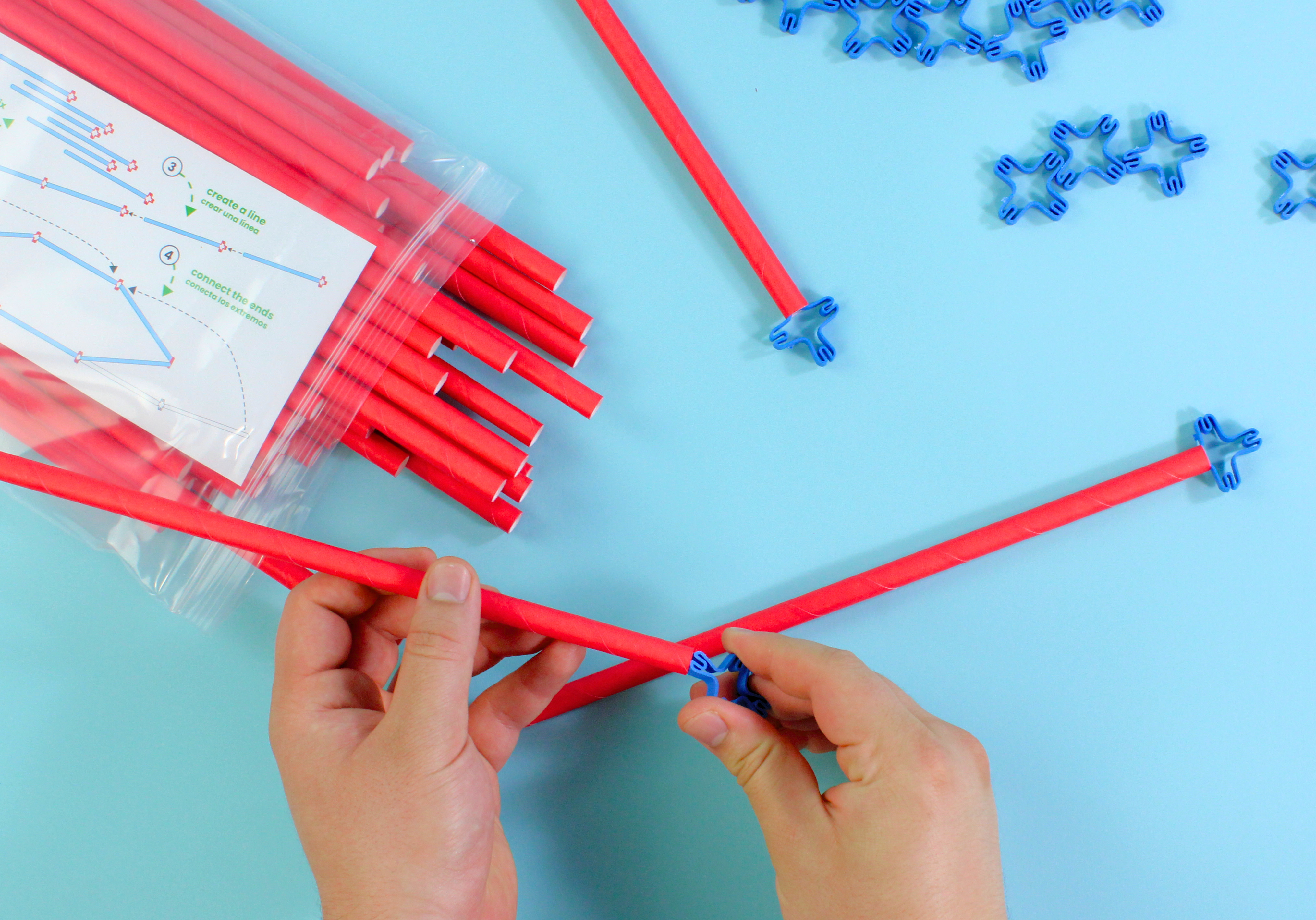
Explore the geometry hiding in plain sight. Connect sturdy paper straws with flexible connectors to transform line segments into shapes and shapes into towering three-dimensional forms. Learners engineer and rebuild structures that reach the ceiling, building perseverance and teamwork along the way.
Get the materials that pair with this educator guide.
Get the materials that pair with this educator guide.
Quick Start gets the main resources in hand. The guide below helps with the decisions that happen before, during, and after students build.
What students build and how the activity works.
Prep questions and pro tips.
Classroom sequence and prompts.
Learning goals and curriculum connections.
Fixes, adaptations, and extensions.
Straw Structures is a hands-on construction kit designed to help learners build understanding of how line segments become two-dimensional shapes and shapes become three-dimensional forms called prisms. Using sturdy jumbo paper straws and flexible connectors, learners create multi-segment bases, build upward to form structures, and take on progressively bigger design challenges - from building a structure as tall as they are to combining with partners to reach the ceiling or create structures big enough to fit inside.
The kit is sturdy enough for teams to build collaboratively and affordable enough for every learner to take home. Through iterative building and rebuilding, learners discover how base width affects stability, how cross pieces reinforce structures, and how geometric choices determine the form they create - whether it's a rectangular prism, a pentagonal prism, or an octagonal prism.

Scissors for learners to trim or shorten straws if needed - tubes sometimes bend or their ends become smushed.
Ruler or measuring tape for reference, estimation, and comparing structure heights.
Question: What shapes do you think you could build with these straws and connectors?
Question: How do you think these connectors and straws fit together? What happens when you squeeze the connector?
Question: Why do you think we start with a long line instead of building a shape one corner at a time?
Question: What happens when you roll your long line into a loop and connect the ends? What shape did you create?
Question: Your shape is flat - two-dimensional. What do you need to add to make it three-dimensional?
Question: What do you think would happen if you only built upward without adding horizontal connections? How can layers make your structure stronger?
Question: Now that you know how to build structures from shapes and forms, what else could you create? What would you design differently next time?
RI.K-2.7 – Use illustrations and words in a text to describe key ideas: Example: Learners refer to the visual guide included in their Straw Structures kit to identify each base shape - triangle, square, pentagon, hexagon - and match the diagram to the number of straws needed, using both the picture and the shape name to plan their build before assembling.
SL.K-2.1 – Participate in collaborative conversations: Example: Learners describe to a partner how they rolled their connected line of straws into a shape, using vocabulary like "line segment," "connector," and "shape" to explain how a flat line of five straws became a pentagon when they attached the last connector back to the first straw.
RI.3-5.3 – Explain relationships between concepts in a text: Example: Learners explain the relationship between their two-dimensional base shape and the three-dimensional form it becomes by describing how adding vertical straws to a flat hexagon and then connecting a second hexagon on top transforms the 2D shape into a hexagonal prism - tracing the concept of shape-to-form transformation from the visual guide to their physical build.
SL.3-5.4 – Report on a topic using appropriate facts and details: Example: Learners present their structure to the class and explain their design decisions - why they chose a hexagonal base over a square one, how they added cross pieces through connector centers for reinforcement, and what they would change to make it taller - using specific structural vocabulary like "prism," "cross piece," and "line segment."
RST.6-8.3 – Follow a multistep procedure when carrying out experiments: Example: Learners follow the sequential Straw Structures build process precisely - first counting out the correct number of straws for their chosen shape, then creating line segments by connecting straws end-to-end, then rolling the line into a closed shape, then building upward with vertical segments - understanding that skipping the base-building step and going straight to vertical construction results in an unstable structure.
SL.6-8.1 – Engage in collaborative discussions with diverse partners: Example: Learners compare the structural stability of wide versus narrow bases during the design challenge, discussing why a hexagonal base with six points of contact supports more vertical height than a triangular base with three - and debating whether adding cross pieces to a narrow base could compensate for fewer ground contact points.
K.G.A.1 – Describe objects using names of shapes and relative positions: Example: Learners identify and name each base shape they build - triangle, square, pentagon, hexagon - and describe spatial relationships during vertical construction: "the square is on the bottom," "the vertical straws go up from each corner," and "the top square sits above the bottom one."
K.CC.B.5 – Count to answer "how many?": Example: Learners count out the exact number of straws needed for their chosen base shape - four straws for a square, five for a pentagon, six for a hexagon - and then count the vertical straws needed to connect two layers, practicing one-to-one correspondence as they sort straws by color and match each straw to a connector.
3.MD.B.4 – Generate measurement data by measuring lengths: Example: Learners use the known 12-inch length of each straw as a measurement unit to estimate and measure the height of their growing structure - counting vertical segments to calculate total height (three vertical straws = 36 inches = 3 feet) and comparing their tower's height to their own body height during the "build as tall as you" challenge.
3.G.A.1 – Understand that shapes in different categories may share attributes: Example: Learners observe that all their base shapes - squares, pentagons, hexagons - share the attribute of being closed polygons made from straight line segments, and discover that when they build upward from any of these bases with vertical segments and a matching top shape, every resulting form is a prism - connecting shared geometric attributes across different shapes.
6.G.A.1 – Find the area of polygons by composing and decomposing into known shapes: Example: Learners calculate the base area of their hexagonal structure by decomposing the hexagon into six equilateral triangles, using the 12-inch straw length as the side measurement - and compare this base area to a square base's area to reason about why the hexagon provides more ground coverage and greater stability for tall builds.
6.RP.A.1 – Understand ratio concepts and use ratio reasoning: Example: Learners explore the ratio of base perimeter to structure height as they build taller - observing that a structure with a 4-straw square base (48-inch perimeter) becomes unstable at 5 straws tall (60 inches) while a 6-straw hexagonal base (72-inch perimeter) remains stable at the same height, reasoning about the ratio between base width and height that determines structural stability.
K-2-ETS1-3 – Analyze data from tests of two objects to compare strengths and weaknesses: Example: Learners build two structures with different base shapes and compare how each performs - testing whether a triangle base or a hexagon base stands taller before it wobbles, and which one resists tipping when gently pushed. Comparing the two builds side by side gives them evidence for which design better solved the "build as tall as you" challenge, and why a wider base wins.
K-2-ETS1-2 – Engineering Design: Develop a simple sketch, drawing, or physical model: Example: Learners build a physical model of a prism by first creating a flat base shape, then adding vertical straws, then connecting a matching shape on top - iterating on their design when they realize a triangle base is too narrow and switching to a square or hexagon base to create a structure tall enough to meet the "build as tall as you" challenge.
3-5-ETS1-1 – Define a simple design problem reflecting a need or want that includes criteria for success and constraints: Example: Learners define the constraints of the "reach the ceiling" challenge - they must build tall enough to touch the ceiling using only straws and connectors, cannot stand on chairs, and must work with a partner - identifying that the success criteria (ceiling height) and constraints (no chairs, limited materials) require them to plan their base width, structural reinforcement, and partner coordination strategy before building.
3-5-ETS1-3 – Plan and carry out fair tests to identify failure points: Example: Learners systematically test why their tall structure keeps leaning to one side by checking whether the issue is uneven connector pressure at the base, missing cross pieces on the leaning side, or misaligned vertical straws - isolating one variable at a time by adding a single cross piece and observing whether the lean corrects before trying the next fix.
MS-ETS1-1 – Define the criteria and constraints of a design problem: Example: Learners analyze the "fit people inside" collaborative design challenge by defining quantitative criteria - the structure must be wide enough for a person to stand inside (minimum ~24-inch interior diameter) and tall enough to reach above their head - then calculating how many hexagonal base segments they need and how many partner structures must be combined to achieve the required interior volume.
MS-ETS1-2 – Evaluate competing design solutions using a systematic process: Example: Learners compare the structural performance of triangular-prism, cubic, and hexagonal-prism towers by building all three to the same height and testing which withstands gentle lateral force - evaluating trade-offs between the triangle's rigidity with less interior space, the cube's simplicity with moderate stability, and the hexagon's superior base coverage with higher material cost.
As structures get larger, connections tend to loosen. Encourage learners to press connectors in completely and squeeze the straw end slightly before inserting. Have them double-check all their connections periodically as they build upward.
A narrow base makes a tall structure unstable. Have learners widen their base by using more segments - a six-segment hexagon base (over six feet across) is much more stable than a four-segment square. Ask them to compare their base width to their structure height.
Right angles and corners create a challenge when adding the first vertical straw because connector slots are already occupied. This is why multi-segment lines should come first - they provide plenty of open connection points for building upward.
Straw ends sometimes get bent or smushed during building. Use scissors to trim the damaged end so the straw fits snugly into a connector again. Shortened straws can be repurposed as cross pieces or reinforcement - don't throw them away.
When a structure grows taller than learners can reach, have them lay it on its side, attach additional tubes and layers horizontally, then carefully stand it back up as a team. Never allow climbing on chairs, furniture, or people.