Verify your email
Hi Johny, to view the full content, please verify your email address by clicking the link sent to youremail@gmail.com
Resend Verification Email
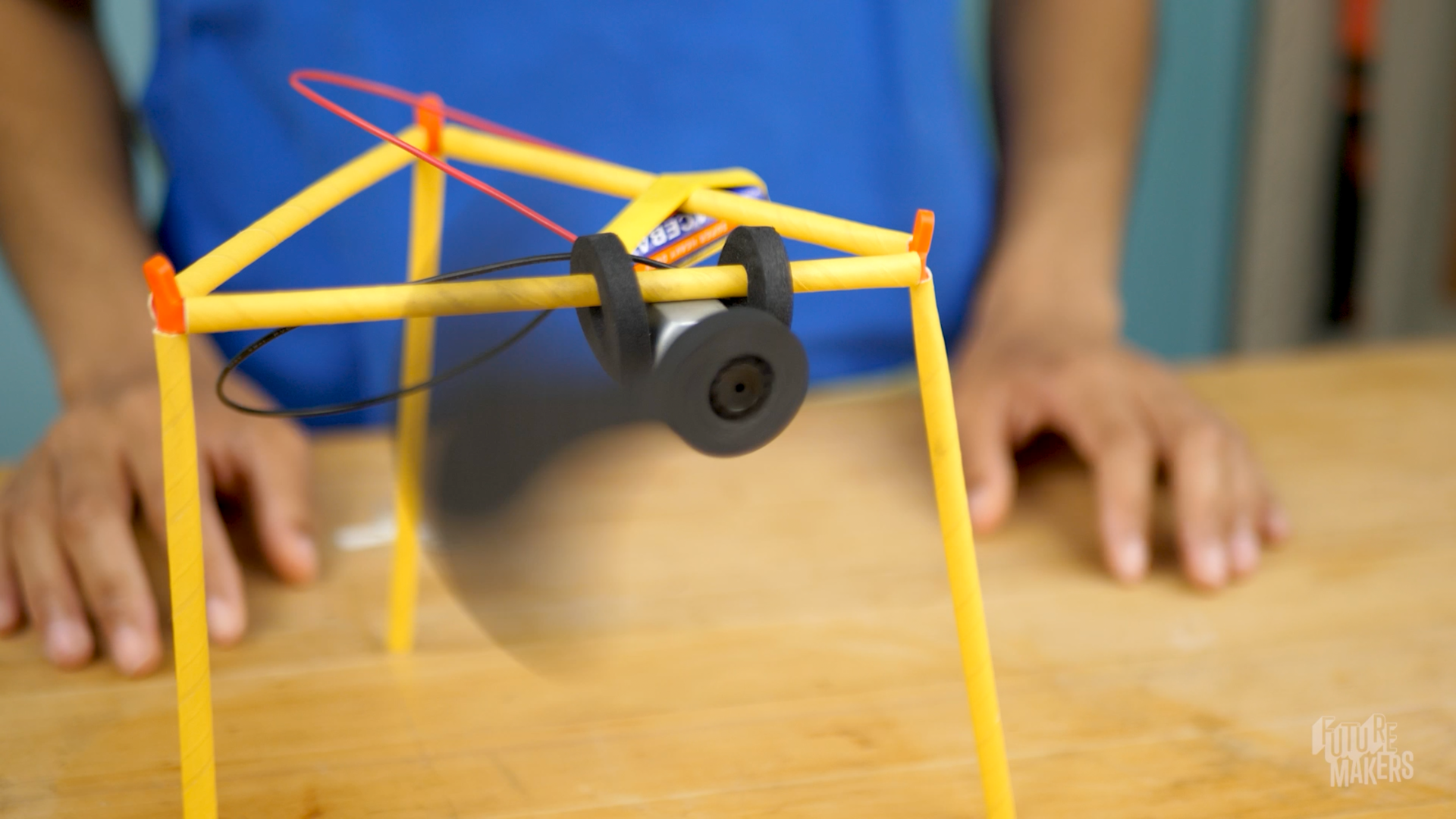
Explore balanced and unbalanced forces in a motorized wiggling machine! Learners build a Strawbot from straws, connectors, a battery, and a hobby motor - then watch it shake, shimmy, and skitter across the table. Along the way they close a real circuit, discover how an offset weight creates mechanical vibration, and iterate on their design to change the way it moves. It’s hands-on engineering that feels like play.
Get the materials that pair with this educator guide.
Get the materials that pair with this educator guide.
Quick Start gets the main resources in hand. The guide below helps with the decisions that happen before, during, and after students build.
What students build and how the activity works.
Prep questions and pro tips.
Classroom sequence and prompts.
Learning goals and curriculum connections.
Fixes, adaptations, and extensions.
Each Strawbot kit includes everything learners need: twelve straws, eight connectors, a motor with wire leads, a battery, foam mounting pieces, and a rubber band. No extra materials are required - just open the bag and start building. The kit is designed so every component has a clear purpose in the final motorized machine.
Learners begin by testing a simple circuit, then construct a straw frame, attach the motor and battery, and add an unbalanced foam weight that makes the whole structure vibrate and move. From there they can reshape their Strawbot, adjust leg angles, experiment with weight placement, and even transform it into a Straw Creature with eyes, horns, and a personality all its own.

No additional materials required. The Strawbot kit is self-contained - everything learners need is in the bag.
Tape can be helpful for securing straws to connectors or reinforcing joints.
Scissors are useful for trimming straws or cutting out creature parts from the printable extension sheets.
Question: What do you think each of these parts does?
Question: Why do you think we need the rubber band on the battery?
Question: What do you think will happen when this weight spins on the motor?
Question: What did you feel when you connected the wires and the motor spun?
Question: How could you build a structure that moves using vibration?
Question: Where on the straw line do you think the battery should go?
Question: Why do you think we use foam to hold the motor instead of just taping it?
Question: Why do you think a triangle shape might work well for a moving structure?
Question: What makes your Strawbot move? Hint, it's not the motor or the battery!
Question: How could you redesign and improve your Strawbot to make it unique?
SL.K-2.1 – Participate in collaborative conversations: Example: Learners describe to a partner what happens when they connect the circuit by inserting the motor wires under the rubber band on the battery terminals, using vocabulary like “circuit,” “vibration,” and “motor” to explain what they see spinning, hear buzzing, and feel vibrating during the testing phase.
RI.K-2.7 – Use illustrations and words in a text to describe key ideas: Example: Learners refer to the visual instruction sheet and diagrams in their Strawbots kit to identify which component is the motor, which is the AA battery, and how the foam harness and rubber band connect them to the straw structure - using both pictures and labels to understand the circuit before assembling it.
RI.3-5.3 – Explain relationships between concepts in a text: Example: Learners explain the cause-and-effect relationship between connecting the circuit and the Strawbot vibrating by tracing how electricity flows from the battery through the motor wires, spins the offset foam weight, and creates the mechanical vibration that makes the entire straw structure shake and move across the table.
W.3-5.2 – Write informative/explanatory texts: Example: Learners document their Strawbot design changes in journals, writing what they modified - leg angle, base shape, or weight placement - and explaining why each change affected the Strawbot’s movement pattern, speed, or stability during the iteration phase.
RST.6-8.3 – Follow a multistep procedure when carrying out experiments: Example: Learners follow the Strawbots build sequence precisely, understanding that the order matters - testing the circuit first by connecting the motor wires to the battery before building the straw structure, because verifying the motor spins and the foam weight vibrates before assembly prevents rebuilding later.
SL.6-8.1 – Engage in collaborative discussions with diverse partners: Example: Learners compare different Strawbot designs across their group, debating whether a triangle base or square base produces better movement and discussing which structural choices - leg length, weight placement, connector angles - create the most stable and interesting motion patterns.
K.G.A.1 – Describe objects using names of shapes and relative positions: Example: Learners identify triangles and squares in their Strawbot’s straw structure and describe spatial relationships during assembly - “the motor sits on top of the straw,” “the legs connect below the base,” and “the battery is between two connectors” - using positional language like above, below, and between.
K.MD.A.1 – Describe measurable attributes of objects: Example: Learners compare the lengths of straws used for legs versus the base and observe how longer or shorter legs affect the Strawbot’s height, balance, and movement pattern - describing the relationship between leg length and how smoothly the Strawbot travels across the surface.
3.MD.B.4 – Generate measurement data by measuring lengths: Example: Learners measure straw lengths and leg angles on their Strawbot and compare how different measurements affect balance and motion, generating data about the relationship between leg length, angle of attachment, and the distance the Strawbot travels in a set time.
4.G.A.1 – Draw and identify geometric shapes based on attributes: Example: Learners recognize triangles and squares as structural bases for their Strawbot and discuss which geometric shape provides better stability - observing that a triangular base with three legs distributes vibration differently than a square base with four legs, and testing which configuration moves more effectively.
6.RP.A.1 – Understand ratio concepts and use ratio reasoning: Example: Learners count their kit’s parts and express them as a ratio - 12 straws to 8 connectors, or 3:2 - and use that ratio to reason about how many connectors they would need if they wanted to build a six-legged Strawbot instead of the standard design.
6.EE.C.9 – Use variables to represent two quantities that change in relationship to one another: Example: Learners name leg length as the independent variable and travel distance as the dependent one, then test several leg lengths, record the pairs in a table, and describe the relationship in words and as an equation - finding out whether longer legs really do carry the Strawbot farther, and where the pattern breaks down.
K-PS2-1 – Motion and Stability: Forces and Interactions: Example: Learners observe how the motor’s spinning offset weight creates an unbalanced force that pushes and pulls the Strawbot in unpredictable directions, feeling the vibration in the straw structure and discovering firsthand that unbalanced forces - not balanced ones - are what cause the Strawbot to move across the table.
K-2-ETS1-2 – Engineering Design: Develop a simple sketch, drawing, or physical model: Example: Learners design and iterate on their straw structure by changing leg angles, switching from a triangle to a square base, and adjusting where the foam weight sits on the motor gear - testing each modification to see how it changes the Strawbot’s movement pattern and direction.
3-PS2-1 – Forces and Interactions: Cause and Effect: Example: Learners investigate how the unbalanced foam weight on the motor causes vibration and how changing the weight’s position on the gear changes the movement pattern - testing different placements to observe that a weight farther from center creates stronger vibration and more dramatic Strawbot movement.
3-5-ETS1-3 – Plan and carry out fair tests to identify failure points: Example: Learners systematically troubleshoot a Strawbot that won’t move by testing one change at a time - first checking whether the motor wires contact the battery terminals, then whether the foam weight is secured to the gear, then adjusting leg angle or base shape - isolating one variable per test to identify what improves movement.
MS-PS3-5 – Energy Transfer: Construct an explanation of energy transfer: Example: Learners trace the energy conversion chain in their Strawbot - chemical energy stored in the AA battery converts to electrical energy flowing through the motor wires, then to mechanical energy as the motor spins, then to kinetic energy as the offset foam weight creates vibration that transfers through the straw structure and moves the entire Strawbot across the surface.
MS-ETS1-2 – Engineering Design: Evaluate competing design solutions: Example: Learners compare triangle versus square base configurations and different leg arrangements across their group’s Strawbots, evaluating which design trade-offs - three legs versus four, short legs versus long, weight near center versus edge - produce the best balance of stability and movement, and presenting evidence for why one design outperforms another.
Both motor wires must make firm contact with the battery terminals. Slide the wires under the rubber band so they press tightly against each end of the battery. If the motor still does not spin, try flipping the battery or re-stripping the wire ends.
The foam weight must be pressed firmly onto the motor gear so it stays in place during vibration. If it keeps slipping, check that the gear teeth are engaged and consider a small piece of tape for reinforcement.
Movement depends on the interaction of leg position, motor placement, and weight distribution. Try adjusting the leg angles, repositioning the motor along the straw, or changing the base shape from a triangle to a square.
Pinch the straw ends lightly before inserting them into the connectors. A gentle squeeze compresses the end just enough for a smooth fit without splitting the straw.
Check that all connectors are pushed in firmly. If joints remain loose, wrap a small piece of tape around the connection point. Make sure leg straws are fully seated in their connectors before testing.