Sparks in Clinical Practice: Answers for BCBAs, Therapists, and Child Life Specialists
Sparks in Clinical Practice: Answers for BCBAs, Therapists, and Child Life Specialists
FutureMakers Sparks are playful engineering project packs that BCBAs, RBTs, play therapists, counselors, psychologists, child life specialists, OTs, and SLPs use as a motivating activity toward a client's own goals. A Spark isn't a stand-alone program; a clinician builds their own goals into it as the client works. Two Sparks, Blendies and Art Machines, now come with a clinician Playbook that maps the build to real ABA targets such as requesting, following directions, and imitation.
Last reviewed September 24, 2026
How to buy
What does it cost to try Sparks in a clinical setting through the pilot?
Nothing. FutureMakers' clinician pilot ships packs and shipping free, one build per client, along with the Playbook for each Spark sent. In exchange, the pilot asks for a 60-day trial period and one 20-minute conversation about what worked, for which FutureMakers sends a $25 gift card. The pilot is open to BCBAs, BCaBAs, speech-language pathologists, occupational therapists, and clinical directors working with clients ages 5 to 12.
How do I use the order form on the website?
The order form is FutureMakers' quote builder at kidsmakethingsbetter.com/quote. Tell it about your program, adjust quantities in a line-item editor, and get a PDF quote to forward to purchasing. See the full how to buy FAQ for the complete step-by-step and every payment option.
How does a practice request packs or start a conversation with FutureMakers?
A practice can apply to the clinician pilot for free Blendies or Art Machines packs and the Playbook, or buy packs directly through the Blendies and Art Machines product pages. A purchasing admin can also get a PDF quote with purchase-order terms for a larger order, and nonprofits or public agencies can apply for tax-exempt status: check "Our organization is tax-exempt" in the quote builder and enter a tax ID number, or submit a tax ID number and a tax-exempt certificate through a free store account if buying directly.
Can a clinic get a W-9 before buying?
Yes. FutureMakers' quote builder has a "We need a W-9 from FutureMakers" checkbox that sends the W-9 along with your PDF quote, and the same W-9 is a direct download from the site footer. It doesn't require naming your clinic or any client. See the full how to buy FAQ for purchase order terms, vendor paperwork, and every payment option.
What a Spark is, in clinical terms
What is a FutureMakers Spark, in clinical terms?
A Spark is a playful engineering project pack: a client builds a small working object, such as a spinning top or a lever puppet, from a picture-based sequence and keeps it when they finish. For a clinician, a Spark is an activity a client works through toward whatever is already on their plan, not a stand-alone program. Building it together is how the client gets to the goal; it is not the goal itself. See the clinician pilot page for the two Sparks built out for clinical use so far, and the Blendies build guide for one in full.
Isn't a build activity really a school product dressed up for clinics?
Sparks did start in classrooms and libraries, but the clinician version is built differently. FutureMakers' clinician Playbooks leave out the school framing entirely: a clinician picks goals from the client's own plan, not from any pre-set outline. The activity itself, a build with a payoff at the end, is the same object; what changes is who chooses the target and why. Read the full clinician pilot overview for how the two versions differ.
Have clinicians actually used Sparks before this pilot?
Yes, informally. Clinicians have used Sparks in sessions for several years, on their own initiative, well before any clinical materials existed, though that's our own account rather than a documented count. That informal use is what prompted a formal pilot: building a Playbook around two Sparks, Blendies and Art Machines, with a practicing behavior analyst, to learn how Sparks can support client goals for BCBAs and their teams. Nothing about the pilot itself has produced results yet; it is still in its outreach stage.
What comes with a Spark that a clinician can use directly in a session?
Blendies and Art Machines, the two Sparks with clinical support today, each come with a clinician Playbook. It includes example goals sorted by domain, a one-page picture task analysis, a point-of-view video model for staff, a communication board, and a data sheet. The Blendies Playbook is a first working draft; the Art Machines Playbook is still being written, since the pilot itself is how FutureMakers is testing and revising them.
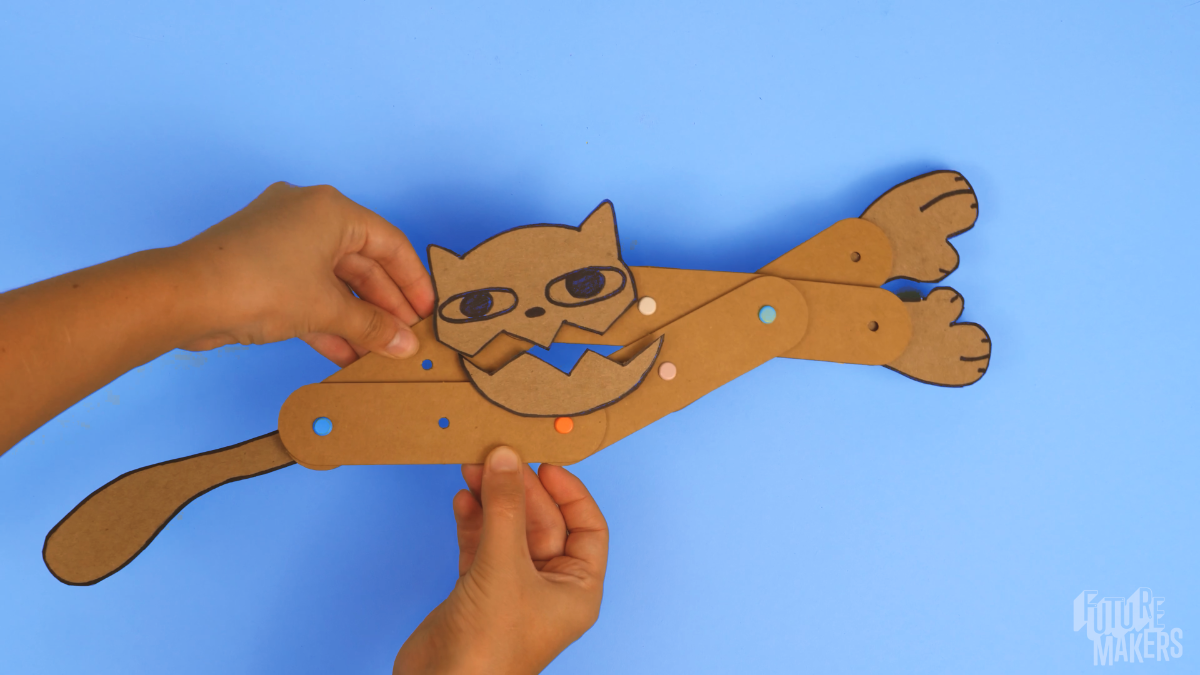
A finished Art Machines build, one of the two Sparks with a clinician Playbook today.
What a session looks like
What does a Blendies session look like from start to finish?
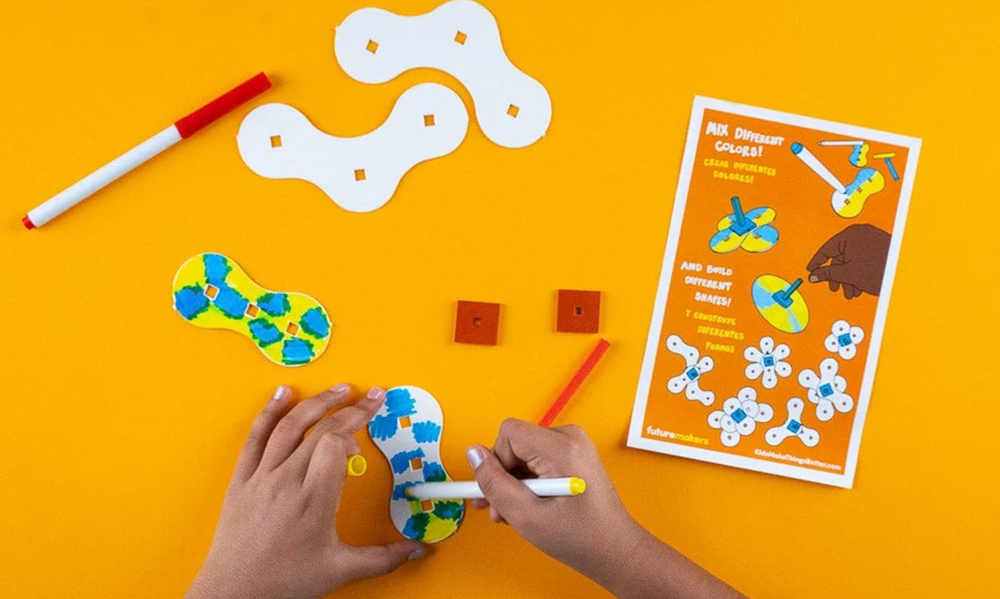
A Blendies build runs through nine steps, from exploring the pieces to coloring and rebuilding to blend two colors into a new one. Along the way the client adds a stopper and two peanut-shaped pieces to the dowel, practices spinning, and can try a second, more complex version before the final rebuild. The full build takes 5 to 10 minutes to prep and fits inside a single session; the steps below show the sequence a clinician can drop a target into at nearly any point.
How long does a session take, including prep?
Both pilot Sparks take 5 to 10 minutes to prep, and Blendies runs 30 to 45 minutes as a general activity in FutureMakers' product listing. A clinician can also use a shorter piece of the build inside one session and pick it back up later, since it does not need to be finished in one sitting. Ages in the pilot run 5 to 12, and a client can work through one step, several steps, or the full sequence depending on the plan for that day.
Can a session run one on one, in a small group, or during NET?
Yes. The Blendies Playbook is built for four formats: one-on-one sessions, small groups, social skills groups, and NET, where the clinician builds a target into a motivating, everyday-feeling activity rather than a set of separate demands. The same build works across formats because the clinician chooses what to target and when to prompt; the object and the steps do not change.
What does the clinician need to supply besides the kit?
Blendies needs a smooth floor or a large table so the piece has room to spin; nothing else in the pilot Playbook is required beyond the kit itself. Art Machines needs scissors and crayons or markers on hand, since the client draws and cuts a face for the finished piece. Neither Spark needs a screen, Wi-Fi, or any equipment beyond ordinary session supplies.
One Blendies session, start to finish
The same nine-step build a clinician can use to embed a target at nearly any point, from the pilot Playbook.
1Explore the materials
The client finds the two peanut-shaped pieces, the two wing pieces, two stoppers, and the dowel, twists each one free of the board, and pops the middle square out of each stopper.
2Add the first stopper
The client threads the dowel through the stopper's square hole and slides it about halfway down.
3Add two peanuts and the second stopper
The client stacks two peanut pieces crisscross into a four-lobed shape, then presses the top stopper down firmly.
4Practice spinning
The client tries a one-hand flick or a two-hand wrap-and-push to get the piece spinning on a flat surface.
5Build a symmetrical version (optional)
The client adds a peanut through its side hole and a wing centered on top, presses the stopper tight, and checks that both halves match.
6Build an asymmetrical version (optional)
The client removes the top stopper, adds a second wing through a side hole, presses the stopper back down, and spins.
7Take it apart and color the peanuts
The client colors the front of each peanut piece a different color and leaves the backs uncolored.
8Rebuild with the colored sides up
The client presses the stopper firmly and spins fast enough to see the two colors blend into a new one.
9Try a new arrangement (extension)
The client changes the pieces, colors, or pattern and spins again, in the same session or a later one.
Goals and targets
What ABA domains can a single build activity target?
A single Blendies build creates natural opportunities across mands, tacts, listener responding, motor imitation, independent play, social attention, vocal behavior, and intraverbals, all inside one activity. The table below maps specific moments in the build, like asking for a stopper or naming a color, to the domain and skill they set up. Everything in this section is what the build sets up, not a promise about what your client will actually do.
Can a build activity work on requesting without turning into a string of demands?
Yes. A multi-step build gives a clinician repeated, natural reasons for a client to request a missing piece, an action, or help, because the next step genuinely depends on it. That structure lets a clinician capture requesting inside a motivating activity instead of stacking one discrete trial after another. The same build also carries opportunities for following directions, choices, and waiting, without any of them needing to be staged separately.
How does a build activity create opportunities for joint attention and imitation?
The payoff moment, when the two colors blend or the piece spins fast, gives a client something worth watching and reacting to. That is where joint attention and spontaneous vocalizing show up in the Playbook's goal table. Motor imitation comes earlier: the clinician spins their own piece first and the client copies the motion.
Can a hands-on build activity be used in an ABA social skills group?
Yes. Sharing one set of markers, building side by side, and taking turns on the spin give a group genuine reasons to wait, ask a peer for something, or comment on someone else's build, using the same kit with no extra materials. FutureMakers' Playbook lists a separate, longer set of group goals, covering joint attention, social play, conversation, and social problem solving, mapped to the same Blendies build.
Is a FutureMakers Spark itself an evidence-based ABA intervention?
No, and FutureMakers does not claim that it is. The kits themselves have not been studied; that is the point of running a pilot instead of shipping a finished clinical product. What the Playbook is built around, a picture task analysis and point-of-view video modeling, are described by the pilot's clinical partner as established practices within applied behavior analysis, but that description applies to the methods, not to Sparks as a product.
Does the Playbook map to VB-MAPP, ABLLS-R, or Socially Savvy targets?
No, not yet: FutureMakers hasn't mapped the Playbook's goal tables to VB-MAPP, ABLLS-R, or Socially Savvy targets. Until a mapping exists, a clinician comparing a Playbook target to an assessment item is doing that translation themselves.
Is there any outcome data from clinicians who have used Sparks?
No. FutureMakers hasn't collected outcome data, even informally, from clinicians who have used Sparks on their own before the pilot. The pilot itself is built to start gathering that kind of feedback: a 60-day trial and one structured conversation per participating clinician, not a study, and no results exist yet.
What a Blendies build sets up, by ABA domain
From the clinician Playbook's per-client goal table. These are opportunities the build creates, not measured outcomes for any client.
Domain
Target skill
Foundational example
Expanding example
Mand / request
Requesting preferred items
"Marker," "blue," "piece"
"I want the blue marker," "Can I have the stopper?"
Mand / request
Requesting actions
"Open," "spin," "help"
"Let's push it together," "Spin it on the table!"
Tact / label
Labeling objects and actions
"Marker," "piece," "table"
"Spinning," "building," "coloring"
Tact / listener
Prepositions
"Where is the Blendie?" (on the table)
"Spin the Blendie under the table"
Listener responding
Following directions
"Pass me the blue," "Put your piece on the table"
"Pick up the stopper, put it on, then spin the Blendie"
Listener responding
Identifying items
"Find the marker," "Touch the stopper"
"Find the longer piece," "Which one is shorter?"
Match to sample
Matching identical items
"Match the wings," "Match the peanuts"
"Match the lid to the blue marker"
Motor imitation
Imitating motor actions
"Spin the Blendie like me"
"Do this" (push the stopper on, then spin)
Independent play
Engaging with the activity longer
Builds, spins, and explores for 1 minute or more
Builds, spins, and explores for 3 minutes or more
Social
Attending to another person's actions
Responds to a "look" prompt
Watches when a peer takes a turn
Vocal behavior
Spontaneous vocalizations
"Whoa!" "Spin!"
"It's spinning!" "Look at it!"
Intraverbal
Answering WH questions, fill-ins
"3, 2, 1..." "Ready, set..."
"What are you using?" "What else spins?"
Staff, training, and motivation
Can an RBT run a structured build activity without the BCBA in the room?
Yes, with the BCBA's training and supervision behind it. The BCBA still picks the targets and decides how the activity fits the client's plan; the picture task analysis and the point-of-view video model just make it easier for an RBT to deliver the build correctly once trained. Since one BCBA typically oversees several clients, each with their own RBT doing direct delivery, an activity only holds up if it works well without the BCBA present for every session.
How does the Playbook help train staff to deliver the activity correctly?
The Playbook pairs a one-page visual task analysis with a point-of-view video model, filmed from the angle a client would actually see. An RBT can watch the video once, then follow the same picture sequence during the session. A communication board and a data sheet round it out, giving staff a consistent set of vocabulary and a place to record what happened. Nothing in the Playbook replaces the BCBA's own training and sign-off.
How do clinicians contrive motivation inside a build activity?
The clinician can hold a piece the client needs until they ask for it, or model a step first so there is something worth copying. Sharing one marker across a group gives clients a reason to wait or ask a peer instead of reaching for their own. None of this requires extra materials: the build's own sequence, where each step needs something the client does not already have in hand, is what creates the opening.
Assent, safety, and scope
What happens if a client doesn't want to do the activity that day?
Then it isn't the right activity that day. Our guidance for clinicians treats a client's choice as the deciding factor, not a hurdle to work around: if a build doesn't land, the clinician picks something else and tries again another time. Nothing about a Spark requires finishing a build in one sitting, and a client can stop partway through and pick it back up later.
Is it safe to use small-parts build activities with clients who mouth objects?
Both Blendies and Art Machines contain small parts, and FutureMakers tells clinicians to check the fit for any client with pica or a mouthing behavior before using either kit. No other age-based choking threshold is documented for these two Sparks beyond that direct check, so a clinician should apply their own program's usual precautions and supervise use directly, the same as with any other small-parts material already in the room.
Does using a build activity in ABA count as academic instruction?
No. A Spark used in a session is designed and presented as play, a build with a payoff, not letters, numbers, or standards-style content, so a clinician picks communication, social, or motor goals from the client's own plan instead of an academic outline. What counts as billable content and how to code a session are questions for the clinician's own payer and their BCBA judgment; FutureMakers doesn't advise on billing or coding.
Can a build activity support parent or caregiver training hours?
Yes. The Blendies Playbook includes a caregiver connection piece: a one-page handout meant to show a family how the activity works so a BCBA can fold it into required caregiver training hours. Because the client takes the finished piece home, there is a concrete object to walk a caregiver through, which gives a caregiver session something specific to point to instead of a general conversation. This caregiver piece is still in development for the pilot.
Which settings, and after the pilot
Which Sparks have clinician-specific goal mapping right now?
Only two: Blendies, which has a full draft Playbook with both individual and group goal tables, and Art Machines, which is in the pilot but does not have its opportunity table written yet. FutureMakers has not built clinical goal mapping for its other 15 Sparks, so a clinician working with a different kit today is applying their own clinical judgment rather than a documented target list. Start with the Blendies guide if a mapped example matters for your program.
What happens to pricing and access after the pilot ends?
You keep everything FutureMakers sends during the pilot, and pilot clinicians hear first about what FutureMakers builds next for this audience. FutureMakers has not set pricing or availability for clinician-specific Playbooks after the pilot ends; that decision is still open. Buying Blendies or Art Machines outside the pilot at the prices listed above works the same either way.
How much does it cost to buy Sparks outside the pilot, per client?
Blendies runs $6.95 per client in a Small Group Pack of 10, or $4.88 per client in a Class Pack of 25. Art Machines runs $5.95 per client in a pack of 10, or $4.20 per client in a pack of 25. A clinic that only needs a handful of units can buy single kits at $8.95 each instead of a full pack; these are FutureMakers' live listed prices, not pilot pricing, which is free.
<script type="application/ld+json">{"@context": "https://schema.org", "@type": "FAQPage", "mainEntity": [{"@type": "Question", "name": "What does it cost to try Sparks in a clinical setting through the pilot?", "acceptedAnswer": {"@type": "Answer", "text": "Nothing. FutureMakers' clinician pilot ships packs and shipping free, one build per client, along with the Playbook for each Spark sent. In exchange, the pilot asks for a 60-day trial period and one 20-minute conversation about what worked, for which FutureMakers sends a $25 gift card. The pilot is open to BCBAs, BCaBAs, speech-language pathologists, occupational therapists, and clinical directors working with clients ages 5 to 12."}}, {"@type": "Question", "name": "How do I use the order form on the website?", "acceptedAnswer": {"@type": "Answer", "text": "The order form is FutureMakers' quote builder at kidsmakethingsbetter.com/quote . Tell it about your program, adjust quantities in a line-item editor, and get a PDF quote to forward to purchasing. See the full how to buy FAQ for the complete step-by-step and every payment option."}}, {"@type": "Question", "name": "How does a practice request packs or start a conversation with FutureMakers?", "acceptedAnswer": {"@type": "Answer", "text": "A practice can apply to the clinician pilot for free Blendies or Art Machines packs and the Playbook, or buy packs directly through the Blendies and Art Machines product pages. A purchasing admin can also get a PDF quote with purchase-order terms for a larger order, and nonprofits or public agencies can apply for tax-exempt status: check \"Our organization is tax-exempt\" in the quote builder and enter a tax ID number, or submit a tax ID number and a tax-exempt certificate through a free store account if buying directly."}}, {"@type": "Question", "name": "Can a clinic get a W-9 before buying?", "acceptedAnswer": {"@type": "Answer", "text": "Yes. FutureMakers' quote builder has a \"We need a W-9 from FutureMakers\" checkbox that sends the W-9 along with your PDF quote, and the same W-9 is a direct download from the site footer. It doesn't require naming your clinic or any client. See the full how to buy FAQ for purchase order terms, vendor paperwork, and every payment option."}}, {"@type": "Question", "name": "What is a FutureMakers Spark, in clinical terms?", "acceptedAnswer": {"@type": "Answer", "text": "A Spark is a playful engineering project pack: a client builds a small working object, such as a spinning top or a lever puppet, from a picture-based sequence and keeps it when they finish. For a clinician, a Spark is an activity a client works through toward whatever is already on their plan, not a stand-alone program. Building it together is how the client gets to the goal; it is not the goal itself. See the clinician pilot page for the two Sparks built out for clinical use so far, and the Blendies build guide for one in full."}}, {"@type": "Question", "name": "Isn't a build activity really a school product dressed up for clinics?", "acceptedAnswer": {"@type": "Answer", "text": "Sparks did start in classrooms and libraries, but the clinician version is built differently. FutureMakers' clinician Playbooks leave out the school framing entirely: a clinician picks goals from the client's own plan, not from any pre-set outline. The activity itself, a build with a payoff at the end, is the same object; what changes is who chooses the target and why. Read the full clinician pilot overview for how the two versions differ."}}, {"@type": "Question", "name": "Have clinicians actually used Sparks before this pilot?", "acceptedAnswer": {"@type": "Answer", "text": "Yes, informally. Clinicians have used Sparks in sessions for several years, on their own initiative, well before any clinical materials existed, though that's our own account rather than a documented count. That informal use is what prompted a formal pilot: building a Playbook around two Sparks, Blendies and Art Machines, with a practicing behavior analyst, to learn how Sparks can support client goals for BCBAs and their teams. Nothing about the pilot itself has produced results yet; it is still in its outreach stage."}}, {"@type": "Question", "name": "What comes with a Spark that a clinician can use directly in a session?", "acceptedAnswer": {"@type": "Answer", "text": "Blendies and Art Machines, the two Sparks with clinical support today, each come with a clinician Playbook. It includes example goals sorted by domain, a one-page picture task analysis, a point-of-view video model for staff, a communication board, and a data sheet. The Blendies Playbook is a first working draft; the Art Machines Playbook is still being written, since the pilot itself is how FutureMakers is testing and revising them."}}, {"@type": "Question", "name": "What does a Blendies session look like from start to finish?", "acceptedAnswer": {"@type": "Answer", "text": "A Blendies build runs through nine steps, from exploring the pieces to coloring and rebuilding to blend two colors into a new one. Along the way the client adds a stopper and two peanut-shaped pieces to the dowel, practices spinning, and can try a second, more complex version before the final rebuild. The full build takes 5 to 10 minutes to prep and fits inside a single session; the steps below show the sequence a clinician can drop a target into at nearly any point."}}, {"@type": "Question", "name": "How long does a session take, including prep?", "acceptedAnswer": {"@type": "Answer", "text": "Both pilot Sparks take 5 to 10 minutes to prep, and Blendies runs 30 to 45 minutes as a general activity in FutureMakers' product listing. A clinician can also use a shorter piece of the build inside one session and pick it back up later, since it does not need to be finished in one sitting. Ages in the pilot run 5 to 12, and a client can work through one step, several steps, or the full sequence depending on the plan for that day."}}, {"@type": "Question", "name": "Can a session run one on one, in a small group, or during NET?", "acceptedAnswer": {"@type": "Answer", "text": "Yes. The Blendies Playbook is built for four formats: one-on-one sessions, small groups, social skills groups, and NET, where the clinician builds a target into a motivating, everyday-feeling activity rather than a set of separate demands. The same build works across formats because the clinician chooses what to target and when to prompt; the object and the steps do not change."}}, {"@type": "Question", "name": "What does the clinician need to supply besides the kit?", "acceptedAnswer": {"@type": "Answer", "text": "Blendies needs a smooth floor or a large table so the piece has room to spin; nothing else in the pilot Playbook is required beyond the kit itself. Art Machines needs scissors and crayons or markers on hand, since the client draws and cuts a face for the finished piece. Neither Spark needs a screen, Wi-Fi, or any equipment beyond ordinary session supplies."}}, {"@type": "Question", "name": "What ABA domains can a single build activity target?", "acceptedAnswer": {"@type": "Answer", "text": "A single Blendies build creates natural opportunities across mands, tacts, listener responding, motor imitation, independent play, social attention, vocal behavior, and intraverbals, all inside one activity. The table below maps specific moments in the build, like asking for a stopper or naming a color, to the domain and skill they set up. Everything in this section is what the build sets up, not a promise about what your client will actually do."}}, {"@type": "Question", "name": "Can a build activity work on requesting without turning into a string of demands?", "acceptedAnswer": {"@type": "Answer", "text": "Yes. A multi-step build gives a clinician repeated, natural reasons for a client to request a missing piece, an action, or help, because the next step genuinely depends on it. That structure lets a clinician capture requesting inside a motivating activity instead of stacking one discrete trial after another. The same build also carries opportunities for following directions, choices, and waiting, without any of them needing to be staged separately."}}, {"@type": "Question", "name": "How does a build activity create opportunities for joint attention and imitation?", "acceptedAnswer": {"@type": "Answer", "text": "The payoff moment, when the two colors blend or the piece spins fast, gives a client something worth watching and reacting to. That is where joint attention and spontaneous vocalizing show up in the Playbook's goal table. Motor imitation comes earlier: the clinician spins their own piece first and the client copies the motion."}}, {"@type": "Question", "name": "Can a hands-on build activity be used in an ABA social skills group?", "acceptedAnswer": {"@type": "Answer", "text": "Yes. Sharing one set of markers, building side by side, and taking turns on the spin give a group genuine reasons to wait, ask a peer for something, or comment on someone else's build, using the same kit with no extra materials. FutureMakers' Playbook lists a separate, longer set of group goals, covering joint attention, social play, conversation, and social problem solving, mapped to the same Blendies build."}}, {"@type": "Question", "name": "Is a FutureMakers Spark itself an evidence-based ABA intervention?", "acceptedAnswer": {"@type": "Answer", "text": "No, and FutureMakers does not claim that it is. The kits themselves have not been studied; that is the point of running a pilot instead of shipping a finished clinical product. What the Playbook is built around, a picture task analysis and point-of-view video modeling, are described by the pilot's clinical partner as established practices within applied behavior analysis, but that description applies to the methods, not to Sparks as a product."}}, {"@type": "Question", "name": "Does the Playbook map to VB-MAPP, ABLLS-R, or Socially Savvy targets?", "acceptedAnswer": {"@type": "Answer", "text": "No, not yet: FutureMakers hasn't mapped the Playbook's goal tables to VB-MAPP, ABLLS-R, or Socially Savvy targets. Until a mapping exists, a clinician comparing a Playbook target to an assessment item is doing that translation themselves."}}, {"@type": "Question", "name": "Is there any outcome data from clinicians who have used Sparks?", "acceptedAnswer": {"@type": "Answer", "text": "No. FutureMakers hasn't collected outcome data, even informally, from clinicians who have used Sparks on their own before the pilot. The pilot itself is built to start gathering that kind of feedback: a 60-day trial and one structured conversation per participating clinician, not a study, and no results exist yet."}}, {"@type": "Question", "name": "Can an RBT run a structured build activity without the BCBA in the room?", "acceptedAnswer": {"@type": "Answer", "text": "Yes, with the BCBA's training and supervision behind it. The BCBA still picks the targets and decides how the activity fits the client's plan; the picture task analysis and the point-of-view video model just make it easier for an RBT to deliver the build correctly once trained. Since one BCBA typically oversees several clients, each with their own RBT doing direct delivery, an activity only holds up if it works well without the BCBA present for every session."}}, {"@type": "Question", "name": "How does the Playbook help train staff to deliver the activity correctly?", "acceptedAnswer": {"@type": "Answer", "text": "The Playbook pairs a one-page visual task analysis with a point-of-view video model, filmed from the angle a client would actually see. An RBT can watch the video once, then follow the same picture sequence during the session. A communication board and a data sheet round it out, giving staff a consistent set of vocabulary and a place to record what happened. Nothing in the Playbook replaces the BCBA's own training and sign-off."}}, {"@type": "Question", "name": "How do clinicians contrive motivation inside a build activity?", "acceptedAnswer": {"@type": "Answer", "text": "The clinician can hold a piece the client needs until they ask for it, or model a step first so there is something worth copying. Sharing one marker across a group gives clients a reason to wait or ask a peer instead of reaching for their own. None of this requires extra materials: the build's own sequence, where each step needs something the client does not already have in hand, is what creates the opening."}}, {"@type": "Question", "name": "What happens if a client doesn't want to do the activity that day?", "acceptedAnswer": {"@type": "Answer", "text": "Then it isn't the right activity that day. Our guidance for clinicians treats a client's choice as the deciding factor, not a hurdle to work around: if a build doesn't land, the clinician picks something else and tries again another time. Nothing about a Spark requires finishing a build in one sitting, and a client can stop partway through and pick it back up later."}}, {"@type": "Question", "name": "Is it safe to use small-parts build activities with clients who mouth objects?", "acceptedAnswer": {"@type": "Answer", "text": "Both Blendies and Art Machines contain small parts, and FutureMakers tells clinicians to check the fit for any client with pica or a mouthing behavior before using either kit. No other age-based choking threshold is documented for these two Sparks beyond that direct check, so a clinician should apply their own program's usual precautions and supervise use directly, the same as with any other small-parts material already in the room."}}, {"@type": "Question", "name": "Does using a build activity in ABA count as academic instruction?", "acceptedAnswer": {"@type": "Answer", "text": "No. A Spark used in a session is designed and presented as play, a build with a payoff, not letters, numbers, or standards-style content, so a clinician picks communication, social, or motor goals from the client's own plan instead of an academic outline. What counts as billable content and how to code a session are questions for the clinician's own payer and their BCBA judgment; FutureMakers doesn't advise on billing or coding."}}, {"@type": "Question", "name": "Can a build activity support parent or caregiver training hours?", "acceptedAnswer": {"@type": "Answer", "text": "Yes. The Blendies Playbook includes a caregiver connection piece: a one-page handout meant to show a family how the activity works so a BCBA can fold it into required caregiver training hours. Because the client takes the finished piece home, there is a concrete object to walk a caregiver through, which gives a caregiver session something specific to point to instead of a general conversation. This caregiver piece is still in development for the pilot."}}, {"@type": "Question", "name": "Which Sparks have clinician-specific goal mapping right now?", "acceptedAnswer": {"@type": "Answer", "text": "Only two: Blendies, which has a full draft Playbook with both individual and group goal tables, and Art Machines, which is in the pilot but does not have its opportunity table written yet. FutureMakers has not built clinical goal mapping for its other 15 Sparks, so a clinician working with a different kit today is applying their own clinical judgment rather than a documented target list. Start with the Blendies guide if a mapped example matters for your program."}}, {"@type": "Question", "name": "What happens to pricing and access after the pilot ends?", "acceptedAnswer": {"@type": "Answer", "text": "You keep everything FutureMakers sends during the pilot, and pilot clinicians hear first about what FutureMakers builds next for this audience. FutureMakers has not set pricing or availability for clinician-specific Playbooks after the pilot ends; that decision is still open. Buying Blendies or Art Machines outside the pilot at the prices listed above works the same either way."}}, {"@type": "Question", "name": "How much does it cost to buy Sparks outside the pilot, per client?", "acceptedAnswer": {"@type": "Answer", "text": "Blendies runs $6.95 per client in a Small Group Pack of 10, or $4.88 per client in a Class Pack of 25. Art Machines runs $5.95 per client in a pack of 10, or $4.20 per client in a pack of 25. A clinic that only needs a handful of units can buy single kits at $8.95 each instead of a full pack; these are FutureMakers' live listed prices, not pilot pricing, which is free."}}]}</script>