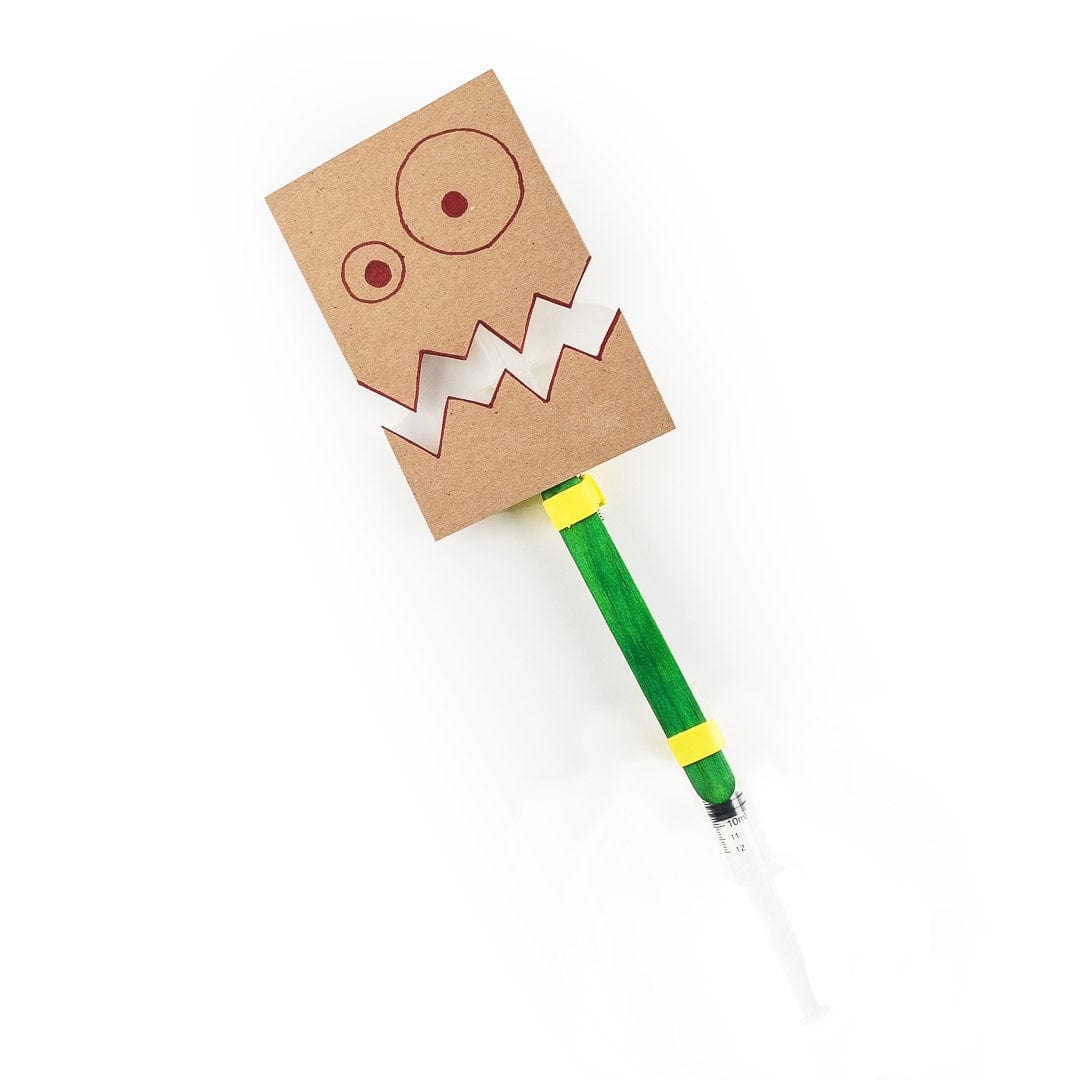
Monster Mouths: Answers for Educators and Program Leaders
Monster Mouths: Answers for Educators and Program Leaders
Monster Mouths is a FutureMakers Spark where learners build a pneumatic system, then design a cardboard monster face whose mouth opens and closes with air pressure. It is a 30 to 45 minute screen-free activity for kindergarten through 5th grade, and it is the entry-level match to FutureMakers' other pneumatic Spark, Monster Claws.
Last reviewed September 24, 2026
How to buy
Which Monster Mouths pack should I buy?
For one learner, the Single Learner Pack costs $8.95. For a class or program, the Small Group Pack of 10 costs $59.50, or $5.95 per learner, and the Class Pack of 25 costs $105.00, or $4.20 per learner. Small Group and Class Pack orders both qualify for purchase orders and tax-exempt purchasing; check "Our organization is tax-exempt" in the quote builder and enter your tax ID number, or submit your tax ID number and a tax-exempt certificate through a free store account if buying directly.
Can I order fewer than 10 Monster Mouths kits if my group is smaller?
Yes. Small Group Packs and Class Packs come in fixed sizes of 10 and 25, but the $8.95 Single Learner Pack lets a program order any exact quantity below 10. This is the option FutureMakers points buyers to when a real order does not divide evenly into a full 10-pack.
Can I use a purchase order or tax-exempt status to buy Monster Mouths?
Yes. Monster Mouths Small Group and Class Pack orders qualify for purchase orders on Net 30 terms and for tax-exempt purchasing, the same as every FutureMakers Spark. See the full how to buy FAQ for purchase order terms, vendor paperwork, and the tax-exempt steps.
Monster Mouths pack sizes and live prices
Pack
Units
Price
Per learner
Single Learner Pack
1
$8.95
$8.95
Small Group Pack
10
$59.50
$5.95
Class Pack
25
$105.00
$4.20
About the project
What do learners make with Monster Mouths, and what's the big idea?
Monster Mouths learners build a pneumatic system from two pistons and cylinders joined by a tube. They then design and attach a cardboard monster face, so pushing and pulling the free piston opens and closes the mouth. The big idea is pneumatics, moving things with air pressure, paired with a storytelling layer: FutureMakers' own worksheet has learners write a character backstory for the monster they build. See the full Monster Mouths guide for the complete build.
What is pneumatics, and how does Monster Mouths use it?
Pneumatics is the science of moving things with air pressure instead of a motor or a string. In Monster Mouths, two pistons connect through a flexible tube, and pushing one piston in moves the other piston out by transferring air through the tube. One piston has to start pushed in while the other starts pulled out, or both ends are closed and no air can flow between them. FutureMakers uses this same pneumatic system in Monster Claws, its more advanced pneumatic Spark, where the same push and pull opens and closes a claw instead of a mouth.
What extensions are there for early finishers or older learners?
Early finishers can add Creature Features like arms, teeth, hair, or hats from craft supplies, or try the Air Pressure Experiment, pushing both pistons in at once to feel compressed air resist. The Story Time extension gives every learner a printable backstory worksheet, then pairs them up for a puppet show with a neighbor. Older or more advanced learners can move into the Hydraulics Challenge, filling one cylinder with colored water instead of air to compare the two systems.
Using it in a session
How long does a Monster Mouths session take?
A Monster Mouths session is a 30 to 45 minute activity for kindergarten through 5th grade. Many builds land around 40 minutes inside that window. That time covers the pneumatic build plus designing the monster's face; the Story Time puppet show and Hydraulics Challenge extensions run as separate follow-on activities.
How many learners does one pack serve, and how should I group them?
Monster Mouths is a 1:1 build, so a Small Group Pack of 10 serves 10 learners and a Class Pack of 25 serves 25, each finishing their own creature. The only grouped activity is the Story Time extension's puppet show, where learners introduce their finished Monster Mouth to a neighbor and act out a short scene together.
What does an educator need to prepare and supply for Monster Mouths?
The educator needs to supply scissors for cutting the cardboard mouth and any extra creature features, plus markers or other drawing tools for designing the monster's face. Optional extras include additional cardboard or construction paper, tape, and colored water for the Hydraulics Challenge extension. Prep takes about 5 to 10 minutes, per the product listing.
What does a first successful Monster Mouths build look like?
A first success is pushing and pulling the free piston and watching the monster's cardboard mouth open and close reliably in response. Once that basic motion works, learners move on to decorating the face and, if the group is doing the extension, writing a short backstory for their creature.
What are the most common problems and fixes?
Three issues cover most Monster Mouths troubleshooting. A stuck system: make sure one piston is pushed in and the other pulled out before connecting the tube, since both closed or both open means no air can flow. A mouth that will not open or close enough: adjust the top piece of the face on the piston and add more adhesive. A floppy face: press the sticky strips down firmly on both the cylinder and the cardboard, and add standard tape if needed. Full troubleshooting is on the Monster Mouths guide's troubleshooting section.
Standards and skills
What academic standards does Monster Mouths align to?
Monster Mouths carries specific NGSS, Common Core ELA, and Common Core Math codes on its guide, from kindergarten through grade 8. The ELA codes include a narrative-writing standard, W.3-5.3, which matches the guide's own story-planning worksheet. The guide does not carry National Core Arts Standards or CASEL social-emotional competency codes, even though the puppet-show extension is a genuine creative-writing and social tie-in. The full table of codes is below.
Where can I find the full Monster Mouths guide and video?
Every code below appears on kidsmakethingsbetter.com/inst/monster-mouths. No CASEL or arts-standards codes appear on the guide.
Standard family
Code
What it covers
NGSS
K-PS2-1
Motion and Stability: Forces and Interactions
NGSS
K-2-ETS1-2
Develop a simple sketch, drawing, or physical model
NGSS
3-PS2-1
Forces and Interactions: Cause and Effect
NGSS
3-5-ETS1-3
Plan and carry out fair tests to identify failure points
NGSS
MS-PS3-5
Construct an explanation of energy transfer
NGSS
MS-ETS1-2
Evaluate competing design solutions
Common Core ELA
RI.K-2.7
Use illustrations and words to describe key ideas
Common Core ELA
SL.K-2.1
Participate in collaborative conversations
Common Core ELA
RI.3-5.3
Explain relationships between concepts in a text
Common Core ELA
W.3-5.3
Write narratives to develop real or imagined experiences
Common Core ELA
RST.6-8.3
Follow a multistep procedure carrying out experiments
Common Core ELA
SL.6-8.1
Engage in collaborative discussions with diverse partners
Common Core Math
K.MD.A.1
Describe measurable attributes of objects
Common Core Math
K.G.A.1
Describe objects using shapes and relative positions
Common Core Math
3.MD.B.4
Generate measurement data by measuring lengths
Common Core Math
4.OA.C.5
Generate and analyze patterns
Common Core Math
6.SP.B.5
Summarize numerical data sets in context
Common Core Math
6.EE.A.2
Write, read, and evaluate expressions
Who uses it and how
Do camps and after-school programs actually buy Monster Mouths?
Yes. County recreation and parks departments have included Monster Mouths in countywide orders that span many Sparks. See our after-school and summer programs answers page for how camps and rec departments buy across a full Spark catalogue.
Why would an art or STEM teacher use Monster Mouths?
Monster Mouths pairs an engineering build with a real writing task. The guide's own story-planning worksheet has learners write a character backstory before the puppet show extension, which lines up with the narrative-writing standard W.3-5.3 on the guide. That combination of building, drawing, and narrative writing is a natural fit for an art room or an integrated STEM and ELA classroom. See our classroom art and STEM answers page for more Sparks that combine building with storytelling or design.
<script type="application/ld+json">{"@context": "https://schema.org", "@type": "FAQPage", "mainEntity": [{"@type": "Question", "name": "Which Monster Mouths pack should I buy?", "acceptedAnswer": {"@type": "Answer", "text": "For one learner, the Single Learner Pack costs $8.95. For a class or program, the Small Group Pack of 10 costs $59.50, or $5.95 per learner, and the Class Pack of 25 costs $105.00, or $4.20 per learner. Small Group and Class Pack orders both qualify for purchase orders and tax-exempt purchasing; check \"Our organization is tax-exempt\" in the quote builder and enter your tax ID number, or submit your tax ID number and a tax-exempt certificate through a free store account if buying directly."}}, {"@type": "Question", "name": "Can I order fewer than 10 Monster Mouths kits if my group is smaller?", "acceptedAnswer": {"@type": "Answer", "text": "Yes. Small Group Packs and Class Packs come in fixed sizes of 10 and 25, but the $8.95 Single Learner Pack lets a program order any exact quantity below 10. This is the option FutureMakers points buyers to when a real order does not divide evenly into a full 10-pack."}}, {"@type": "Question", "name": "Can I use a purchase order or tax-exempt status to buy Monster Mouths?", "acceptedAnswer": {"@type": "Answer", "text": "Yes. Monster Mouths Small Group and Class Pack orders qualify for purchase orders on Net 30 terms and for tax-exempt purchasing, the same as every FutureMakers Spark. See the full how to buy FAQ for purchase order terms, vendor paperwork, and the tax-exempt steps."}}, {"@type": "Question", "name": "What do learners make with Monster Mouths, and what's the big idea?", "acceptedAnswer": {"@type": "Answer", "text": "Monster Mouths learners build a pneumatic system from two pistons and cylinders joined by a tube. They then design and attach a cardboard monster face, so pushing and pulling the free piston opens and closes the mouth. The big idea is pneumatics, moving things with air pressure, paired with a storytelling layer: FutureMakers' own worksheet has learners write a character backstory for the monster they build. See the full Monster Mouths guide for the complete build."}}, {"@type": "Question", "name": "What is pneumatics, and how does Monster Mouths use it?", "acceptedAnswer": {"@type": "Answer", "text": "Pneumatics is the science of moving things with air pressure instead of a motor or a string. In Monster Mouths, two pistons connect through a flexible tube, and pushing one piston in moves the other piston out by transferring air through the tube. One piston has to start pushed in while the other starts pulled out, or both ends are closed and no air can flow between them. FutureMakers uses this same pneumatic system in Monster Claws , its more advanced pneumatic Spark, where the same push and pull opens and closes a claw instead of a mouth."}}, {"@type": "Question", "name": "What extensions are there for early finishers or older learners?", "acceptedAnswer": {"@type": "Answer", "text": "Early finishers can add Creature Features like arms, teeth, hair, or hats from craft supplies, or try the Air Pressure Experiment, pushing both pistons in at once to feel compressed air resist. The Story Time extension gives every learner a printable backstory worksheet, then pairs them up for a puppet show with a neighbor. Older or more advanced learners can move into the Hydraulics Challenge, filling one cylinder with colored water instead of air to compare the two systems."}}, {"@type": "Question", "name": "How long does a Monster Mouths session take?", "acceptedAnswer": {"@type": "Answer", "text": "A Monster Mouths session is a 30 to 45 minute activity for kindergarten through 5th grade. Many builds land around 40 minutes inside that window. That time covers the pneumatic build plus designing the monster's face; the Story Time puppet show and Hydraulics Challenge extensions run as separate follow-on activities."}}, {"@type": "Question", "name": "How many learners does one pack serve, and how should I group them?", "acceptedAnswer": {"@type": "Answer", "text": "Monster Mouths is a 1:1 build, so a Small Group Pack of 10 serves 10 learners and a Class Pack of 25 serves 25, each finishing their own creature. The only grouped activity is the Story Time extension's puppet show, where learners introduce their finished Monster Mouth to a neighbor and act out a short scene together."}}, {"@type": "Question", "name": "What does an educator need to prepare and supply for Monster Mouths?", "acceptedAnswer": {"@type": "Answer", "text": "The educator needs to supply scissors for cutting the cardboard mouth and any extra creature features, plus markers or other drawing tools for designing the monster's face. Optional extras include additional cardboard or construction paper, tape, and colored water for the Hydraulics Challenge extension. Prep takes about 5 to 10 minutes, per the product listing."}}, {"@type": "Question", "name": "What does a first successful Monster Mouths build look like?", "acceptedAnswer": {"@type": "Answer", "text": "A first success is pushing and pulling the free piston and watching the monster's cardboard mouth open and close reliably in response. Once that basic motion works, learners move on to decorating the face and, if the group is doing the extension, writing a short backstory for their creature."}}, {"@type": "Question", "name": "What are the most common problems and fixes?", "acceptedAnswer": {"@type": "Answer", "text": "Three issues cover most Monster Mouths troubleshooting. A stuck system: make sure one piston is pushed in and the other pulled out before connecting the tube, since both closed or both open means no air can flow. A mouth that will not open or close enough: adjust the top piece of the face on the piston and add more adhesive. A floppy face: press the sticky strips down firmly on both the cylinder and the cardboard, and add standard tape if needed. Full troubleshooting is on the Monster Mouths guide's troubleshooting section ."}}, {"@type": "Question", "name": "What academic standards does Monster Mouths align to?", "acceptedAnswer": {"@type": "Answer", "text": "Monster Mouths carries specific NGSS, Common Core ELA, and Common Core Math codes on its guide, from kindergarten through grade 8. The ELA codes include a narrative-writing standard, W.3-5.3, which matches the guide's own story-planning worksheet. The guide does not carry National Core Arts Standards or CASEL social-emotional competency codes, even though the puppet-show extension is a genuine creative-writing and social tie-in. The full table of codes is below."}}, {"@type": "Question", "name": "Where can I find the full Monster Mouths guide and video?", "acceptedAnswer": {"@type": "Answer", "text": "The full illustrated Monster Mouths guide, with the pneumatic build steps, standards table, and troubleshooting, is at kidsmakethingsbetter.com/inst/monster-mouths . The companion video is on YouTube at Monster Mouths: Build Air-Powered Creatures . Both are free to view, and a free educator account opens the slide decks too, at Coach with Sparks ."}}, {"@type": "Question", "name": "Do camps and after-school programs actually buy Monster Mouths?", "acceptedAnswer": {"@type": "Answer", "text": "Yes. County recreation and parks departments have included Monster Mouths in countywide orders that span many Sparks. See our after-school and summer programs answers page for how camps and rec departments buy across a full Spark catalogue."}}, {"@type": "Question", "name": "Why would an art or STEM teacher use Monster Mouths?", "acceptedAnswer": {"@type": "Answer", "text": "Monster Mouths pairs an engineering build with a real writing task. The guide's own story-planning worksheet has learners write a character backstory before the puppet show extension, which lines up with the narrative-writing standard W.3-5.3 on the guide. That combination of building, drawing, and narrative writing is a natural fit for an art room or an integrated STEM and ELA classroom. See our classroom art and STEM answers page for more Sparks that combine building with storytelling or design."}}]}</script>