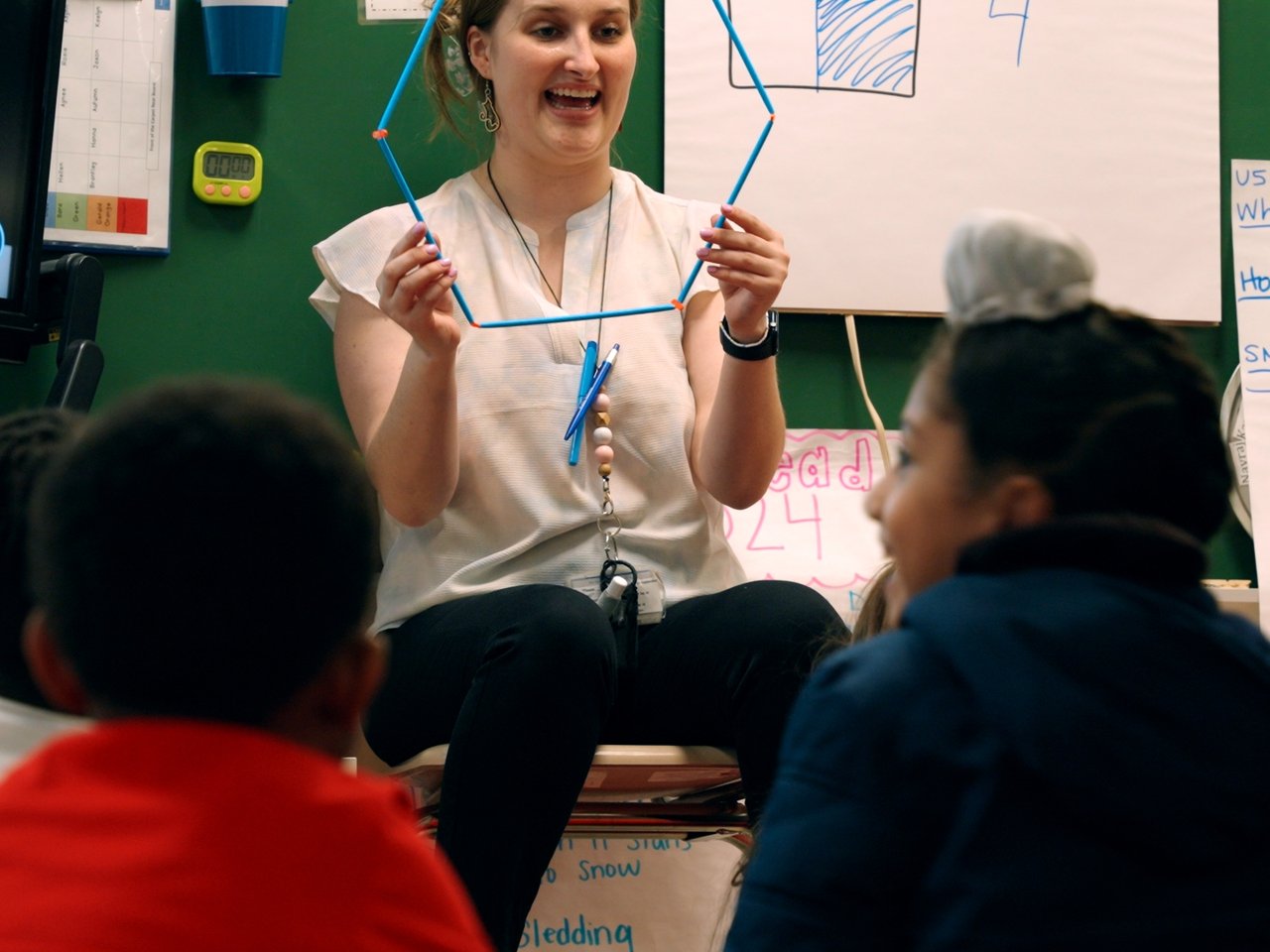
FutureMakers Sparks are hands-on art builds, kinetic sculptures, drawing machines, and automata, that also carry real engineering standards. Arts for Learning Maryland has booked four of them as visual art programming, not science programming, since 2013. Activity Time is not 30 to 45 minutes for every Spark. Blendies lists 30-45 minutes, Drawbots lists 45-60 minutes, and Straw Structures lists 30-60 minutes. No science background or classroom aide is required, and each of the 17 Sparks carries its own NGSS and Common Core codes. They are used in classrooms and school districts, from a single class to district-wide programs.
Last reviewed October 15, 2026
Getting a quote at kidsmakethingsbetter.com/quote: in the Purchasing Information section, check "Our organization is tax-exempt" and enter your tax ID number. Buying directly in the store: create a free account and submit your tax ID number with a tax-exempt certificate for review.
The order form is FutureMakers' quote builder at kidsmakethingsbetter.com/quote. Tell it about your program, adjust quantities in a line-item editor, and get a PDF quote to forward to purchasing. See the full how to buy FAQ for the complete step-by-step and every payment option.
For a single 45-minute period, start with a Spark whose Shopify Activity Time is 30 to 45 minutes. Blendies, Eyelusions, and Strawbots all list 30 to 45 minutes. Drawbots lists 45 to 60 minutes, so it fills a full period; a Class Pack covers 25 learners at $122.00, or $4.88 per learner, and each learner builds and keeps their own three-legged vibrating drawing robot in one sitting. Straw Structures lists 30 to 60 minutes, so treat it as an option that may run longer than one period. Full Drawbots steps are on the Drawbots guide.
Yes. Every kit ships with its own visual, numbered guide, so a substitute, teaching fellow, or aide can lead a build directly from the printed steps with very little prep.
Straw Structures ships with its own reusable, reclosable bag built for exactly this reset. At the end of a period, learners fit their straws and connectors back into that bag instead of a shared bin, and the same bag comes right back out for the next class. The connectors are molded from durable plastic, and even a bent or smushed straw isn't waste. The guide's own fix is to trim it and reuse the shorter piece as a cross-brace, so the kit restocks itself as it wears. FutureMakers hasn't published an exact reset time for six periods in a row, so build a few minutes into the end of each period for packing up, the same window the run of show below sets aside.
Most Sparks finish in a single sitting, which fits a once-a-week special-area schedule. Blendies lists an Activity Time of 30-45 minutes and Drawbots lists 45-60 minutes. Straw Structures lists 30-60 minutes. If you want a project that carries across visits instead, some Sparks include a documented multi-week extension, such as Linkages' "multi-session design project" or Straw Structures' "Mega Structure" challenge, which combines several learners' finished builds into one larger piece.
Prep time for most Sparks runs a few minutes, not hours. Straw Structures needs only scissors on hand for trimming bent straws and a ruler for reference, and nothing else. Drawbots needs a little more. Pre-stretch the included rubber band before class and have a projector ready for the guide's presentation slides. Every Spark's exact prep list is on its own /inst guide, under the materials the guide asks you to supply.
Grounded in Straw Structures. Its Activity Time is 30-60 minutes, so this outline is the guide's single-session structure, not a 30-45 minute claim. A Small Group Pack is 10 and a Class Pack is 25.
Straw Structures needs only scissors on hand for trimming bent or smushed straws and a ruler for reference; no other prep is required.
Every learner gets one kit and works from the printed visual guide, building a freestanding three-dimensional structure from a two-dimensional base shape.
The kit is designed to be built, tested, taken apart, and rebuilt in the same session, so a design that falls over is a retry, not a stopping point.
Learners who finish early can pair up for the "reach the ceiling" or "fit people inside" challenges, or combine several finished structures into one Mega Structure.
Fit the straws and connectors back into the kit's own reusable, reclosable bag so it's ready for the next class. No FutureMakers source states an exact end-of-class routine, so build a few minutes into the end of the period for this step.
Every Spark starts from the same base build, but the guides push learners to make it their own once that base works. Art Machines' own guide tells the facilitator to "let creativity lead" and to "encourage learners to add extra elements like arms, tails, or any feature they imagine, the more personal, the better," so two finished creatures rarely look alike. Blendies gives older learners a printed Advanced Pattern Choice Board so they pick their own symmetry pattern instead of one prescribed design. A Spark is more structured than an open studio project, since every learner follows the same steps to get a working mechanism, but from there, the finished piece is each learner's own.
Crankie Contraptions is FutureMakers' clearest art-engineering crossover for middle school. Learners build a hand-cranked scrolling story box, then illustrate and write the scroll themselves, so one 45 to 60 minute project covers a mechanical crank-and-scroll mechanism and visual storytelling together. It carries NGSS engineering-design codes through grade 8, including MS-ETS1-2 and MS-ETS1-4, alongside Common Core narrative-writing codes for the 6th to 8th grade band. See the Crankie Contraptions guide for the full standards list.
You don't need a science background to bring engineering into an art room. FutureMakers' stated mission is helping educators "confidently integrating engineering, tinkering, making and play" into what they already teach, and every /inst guide carries the engineering vocabulary built in, like Art Machines' lever-and-fulcrum framing for a kinetic sculpture. The visual guide walks each build step by step, so you teach from the same script a science teacher would use.
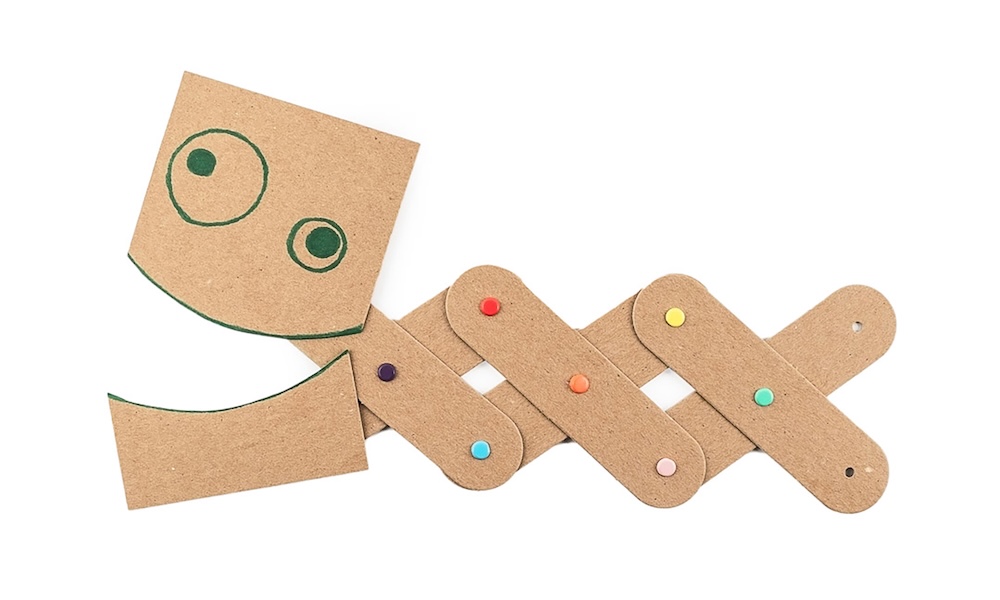
Art Machines is FutureMakers' kinetic-sculpture Spark for a classroom. Learners build a system of six connected cardboard levers and fulcra that extends and retracts as one compound machine, then redesign it into their own creature or invention using the guide's Arts Integration extension. It is a 1:1 build, so every learner builds and keeps their own machine, and the Storytelling extension has them give their creature a name, voice, and a three-event story. See the Art Machines guide for the full build.
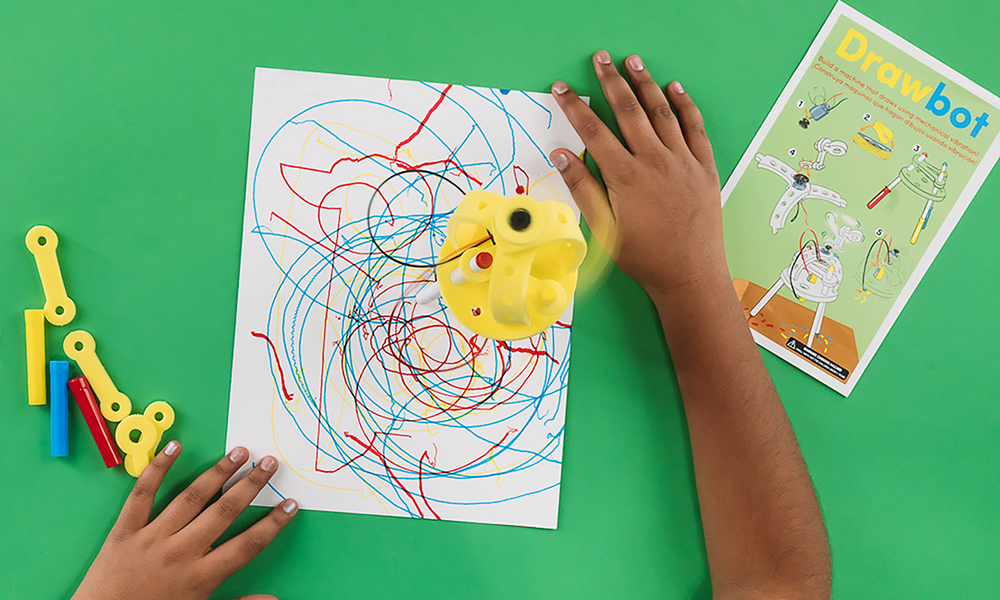
Drawbots is FutureMakers' drawing-machine Spark for grades 2 through 8. Learners build a three-legged foam structure powered by a small motor and an off-center weight, so once the circuit closes, the whole machine vibrates and draws on paper on its own. It runs 45 to 60 minutes, and the Pattern Challenge extension has learners aim for lines, circles, or random marks by changing where the weight sits. FutureMakers' blog post "Building Confidence: Drawing Machines" walks through a real design-challenge lesson.
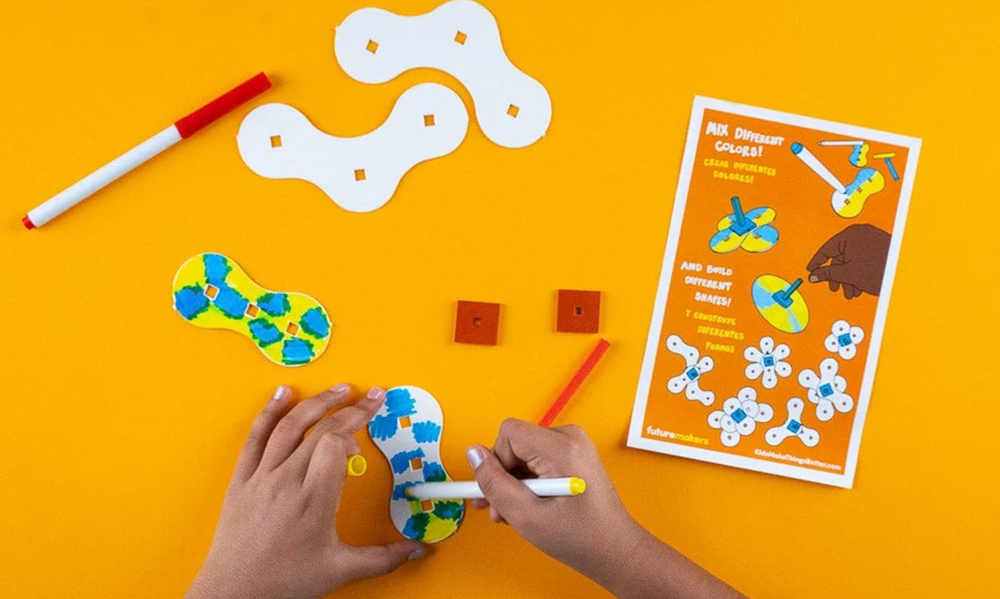
Blendies teaches optical color mixing through a spinning top. Learners build a reconfigurable cardboard spinning top from a square plastic spinning dowel, two cardboard "peanuts," and two flexible stoppers, color the pieces with primary-colored markers, then spin it fast enough that the eye blends the colors into secondary colors before it can separate them. It runs 30 to 45 minutes and suits learners from PK through middle school, built 1:1, with every learner getting their own set of primary-colored markers. See the Blendies guide for the full color-mixing sequence.
Several Sparks carry K-2 and 3-5 NGSS engineering-design codes directly. Straw Structures and Art Machines both list K-2-ETS1-2 (develop a simple sketch, drawing, or physical model) and 3-5-ETS1-3 (plan and carry out fair tests), and Crankie Contraptions adds 3-5-ETS1-2 (generate and compare multiple solutions). Screen Machines is the only Spark that also carries K-2-ETS1-1, the standard for asking questions and gathering information before designing. The full code list for every Spark is in the standards table below.
Every FutureMakers Spark carries at least one NGSS code in the grades 3-5 band. Most often that is 3-5-ETS1-3 (plan and carry out fair tests) or 3-PS2-1 (forces and interactions), paired with a matching Common Core code. Hypnotizers, for example, pairs Common Core 4.G.A.3 (recognize a line of symmetry) with NGSS 3-5-ETS1-3, and Eyelusions pairs Common Core 7.G.A.1 (scale drawings) with NGSS 3-PS2-1. See the full table below for every Spark's exact codes.
Match the grade band first, then check the exact code. The standards table below lists every FutureMakers Spark's grade range alongside its NGSS and Common Core codes, sourced from each /inst guide. K-2-ETS1-2 (develop a simple sketch, drawing, or physical model) appears on 14 of the 17 Sparks, so that code alone will not narrow your choice much; MS-PS3-5 (construct an explanation of energy transfer) appears on only 10, a better filter for a middle-school energy unit. No Spark guide lists a formal visual-arts standards code, so pair these NGSS and Common Core codes with your own arts curriculum rather than expecting a matching arts-standards code.
Social-emotional growth in a Spark session looks like a hard moment turning into a small win, not a worksheet score. In a Straw Structures session, partner challenges like "reach the ceiling" and "fit people inside" can pair learners who rarely work together, and staff can build on those moments afterward in their own conversations with learners. FutureMakers doesn't currently show CASEL competency codes on its /inst guides.
A collaborative build changes the room from quiet and individual to louder and negotiated. Straw Structures moves from a 1:1 individual build to partnered and team challenges like "reach the ceiling" and "fit people inside," which forces a negotiation over whose design idea wins.
A Class Pack of 25 matches a full classroom one to one, priced to come out of a classroom's own supply budget rather than a district grant or enrichment line. Every FutureMakers Spark sells in a 25-unit Class Pack priced $105 to $122 depending on the Spark, or $4.20 to $4.88 per learner, alongside a 10-unit Small Group Pack at $59.50 to $69.50. For an art classroom specifically, the Art Club bundle packages three Sparks, Crankie Contraptions, Drawbots, and Linkages, as a 25-of-each Bulk Bundle for $366, or a 10-of-each Small Group Bundle for $208.50.
District STEM coordinators pick classroom maker kits at scale by committing to one recurring purchase that covers every school, instead of leaving each classroom to buy on its own. Districts have bought this way for several years, as one district-level order each time rather than school by school. FutureMakers' quote form is built for that pattern, with a 100-to-300-learner tier and a 300-plus multi-site tier a coordinator can select directly. A single classroom teacher without district backing should look at the samples program or the grant wizard instead.
Yes, arts-integration grants have funded real FutureMakers purchases at Baltimore-area schools, and this is a different pot of money than a district's out-of-school-time budget or a classroom's own supply line. State arts council grants have funded Art Machines kits for elementary schools. FutureMakers also helps write arts-integration grant proposals for Baltimore City schools, designed so a school's own share stays small once grant funding covers the rest. Baltimore City schools can check eligibility through FutureMakers' grant wizard.
Codes as printed on each Spark's guide. No FutureMakers guide currently shows a CASEL social-emotional-learning code or a separate visual-arts standards code; pair these NGSS and Common Core codes with your own arts curriculum.
| Spark | Grades | NGSS codes | Common Core ELA | Common Core Math | Arts standards |
|---|---|---|---|---|---|
| Art Machines | K-5 | K-PS2-1, K-2-ETS1-2, 3-5-ETS1-1, 3-5-ETS1-3 | RI.K-2.7, SL.K-2.1, RI.3-5.7, W.3-5.2 | K.MD.A.1, K.G.A.1, 3.MD.B.4, 4.MD.A.2 | Not on guide |
| Blendies | PK - middle school | K-PS2-1, K-2-ETS1-2, 3-PS2-1, 4-PS3-1, MS-PS2-2, MS-LS1-8 | RI.K-2.7, SL.K-2.1, RI.3-5.3, SL.3-5.4, RST.6-8.3, SL.6-8.1 | K.G.B.4, 1.G.A.3, 4.G.A.3, 3.MD.B.3, 8.G.A.1, 6.SP.B.5 | Not on guide |
| Crankie Contraptions | 1-8, easily differentiated | K-2-ETS1-2, K-PS2-1, 3-5-ETS1-2, 3-5-ETS1-3, MS-ETS1-2, MS-ETS1-4 | RL.K-2.2, W.K-2.3, RL.3-5.5, SL.3-5.5, RL.6-8.5, W.6-8.3 | K.MD.A.1, 1.OA.A.1, 3.MD.B.4, 4.OA.C.5, 6.RP.A.1, 7.G.A.1 | Not on guide |
| Drawbots | 2-8 | K-PS2-1, K-2-ETS1-2, 3-5-ETS1-1, 3-5-ETS1-3, MS-PS3-5, MS-ETS1-2 | RI.K-2.7, SL.K-2.1, RI.3-5.7, W.3-5.2, RST.6-8.7, W.6-8.1 | K.MD.A.1, 1.G.A.2, 3.MD.B.4, 4.MD.A.3, 6.RP.A.3, 7.G.A.2 | Not on guide |
| Electric Vehicles | 3-8 | 4-PS3-2, 3-5-ETS1-3, MS-PS3-5, MS-ETS1-3 | RI.3-5.7, SL.3-5.1, RST.6-8.3, SL.6-8.1 | 4.G.A.2, 4.G.A.1, 6.RP.A.1, 7.RP.A.2 | Not on guide |
| Eyelusions | 2-8 | K-PS2-1, K-2-ETS1-2, 3-PS2-1, 3-5-ETS1-3, MS-LS1-8, MS-ETS1-2 | RI.K-2.7, SL.K-2.1, RI.3-5.3, W.3-5.2, RST.6-8.3, SL.6-8.1 | K.G.A.1, K.MD.A.1, 3.G.A.1, 4.G.A.3, 7.G.A.1, 7.G.B.4 | Not on guide |
| Flying Machines | 1-8 | K-PS3-1, K-2-ETS1-2, 3-PS2-1, 3-5-ETS1-3, MS-PS3-5, MS-ETS1-2 | RI.K-2.7, SL.K-2.1, RI.3-5.7, W.3-5.2, RST.6-8.7, W.6-8.1 | 2.MD.A.1, 2.G.A.1, 4.MD.A.2, 4.G.A.3, 7.RP.A.2, 6.G.A.1 | Not on guide |
| Hypnotizers | K-5 | K-PS2-1, K-2-ETS1-3, 4-PS3-1, 3-5-ETS1-3, MS-ETS1-4, MS-PS3-5 | RI.K-2.7, SL.K-2.1, RI.3-5.7, SL.3-5.1, RST.6-8.3, SL.6-8.1 | K.G.A.2, 1.G.A.2, 3.G.A.2, 4.G.A.3, 6.RP.A.1, 7.G.B.4 | Not on guide |
| Linkages | K-8 | K-PS2-1, K-2-ETS1-2, 3-PS2-1, 3-5-ETS1-3, MS-PS3-5, MS-ETS1-2 | RI.K-2.7, SL.K-2.1, RI.3-5.3, W.3-5.3, RST.6-8.3, SL.6-8.1 | K.MD.A.1, K.G.A.1, 3.MD.B.4, 4.OA.C.5, 6.RP.A.1, 7.G.A.2 | Not on guide |
| Mazes | K-8; guide differentiates K-2, 3-5, 6-8 | K-PS2-1, K-2-ETS1-2, 3-PS2-1, 3-5-ETS1-3, MS-ETS1-4, MS-ETS1-3 | RI.K-2.7, SL.K-2.1, RI.3-5.3, SL.3-5.1, RST.6-8.3, SL.6-8.1 | K.MD.A.1, K.G.A.1, 4.MD.C.5, 4.OA.C.5, 6.RP.A.3, 6.EE.C.9 | Not on guide |
| Monster Claws | 3-8 | 3-PS2-1, 3-5-ETS1-3, MS-PS3-5, MS-ETS1-2 | RI.3-5.3, W.3-5.2, RST.6-8.3, SL.6-8.1 | 3.MD.B.4, 4.OA.C.5, 6.RP.A.1, 8.G.C.9 | Not on guide |
| Monster Mouths | K-5 | K-PS2-1, K-2-ETS1-2, 3-PS2-1, 3-5-ETS1-3, MS-PS3-5, MS-ETS1-2 | RI.K-2.7, SL.K-2.1, RI.3-5.3, W.3-5.3, RST.6-8.3, SL.6-8.1 | K.MD.A.1, K.G.A.1, 3.MD.B.4, 4.OA.C.5, 6.SP.B.5, 6.EE.A.2 | Not on guide |
| Scene Machines | 2-8 | K-PS2-1, K-2-ETS1-2, 3-PS2-1, 3-5-ETS1-3, MS-PS3-5, MS-ETS1-3 | RI.K-2.7, SL.K-2.1, RI.3-5.3, W.3-5.3, RST.6-8.3, SL.6-8.1 | 2.MD.A.1, K.G.A.1, 4.MD.C.5, 4.OA.C.5, 7.G.B.4, 7.RP.A.2 | Not on guide |
| Screen Machines | 1-8; guide differentiates K-2, 3-5, 6-8 | K-2-ETS1-1, K-2-ETS1-2, 3-5-ETS1-2, 3-5-ETS1-3, MS-ETS1-3, MS-ETS1-4 | RL.K-2.2, SL.K-2.5, W.3-5.3, SL.3-5.4, W.6-8.3, SL.6-8.5 | K.G.A.1, 1.MD.A.1, 3.MD.B.4, 4.MD.A.3, 6.G.A.1, 7.G.B.6 | Not on guide |
| Straw Structures | PK-8; guide differentiates PK-K, 1-3, 4-8 | K-2-ETS1-3, K-2-ETS1-2, 3-5-ETS1-1, 3-5-ETS1-3, MS-ETS1-1, MS-ETS1-2 | RI.K-2.7, SL.K-2.1, RI.3-5.3, SL.3-5.4, RST.6-8.3, SL.6-8.1 | K.G.A.1, K.CC.B.5, 3.MD.B.4, 3.G.A.1, 6.G.A.1, 6.RP.A.1 | Not on guide |
| Strawbots | Grade 2 - middle school | K-PS2-1, K-2-ETS1-2, 3-PS2-1, 3-5-ETS1-3, MS-PS3-5, MS-ETS1-2 | SL.K-2.1, RI.K-2.7, RI.3-5.3, W.3-5.2, RST.6-8.3, SL.6-8.1 | K.G.A.1, K.MD.A.1, 3.MD.B.4, 4.G.A.1, 6.RP.A.1, 6.EE.C.9 | Not on guide |
| Wind-Up Vehicles | 2-8 | K-PS2-1, K-2-ETS1-2, 3-PS2-1, 3-5-ETS1-3, MS-PS3-5, MS-ETS1-3 | RI.K-2.7, SL.K-2.1, RI.3-5.3, W.3-5.2, RST.6-8.3, SL.6-8.1 | 2.MD.A.1, K.G.A.1, 3.MD.B.4, 4.MD.A.2, 6.RP.A.3, 7.SP.B.4 | Not on guide |


