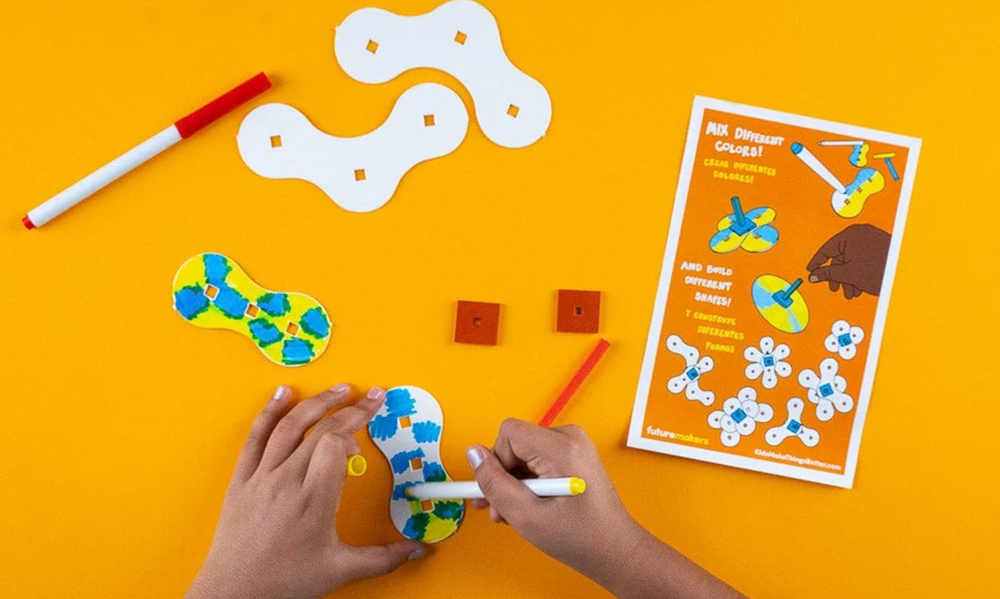
FutureMakers Blendies is a reconfigurable cardboard spinning top that learners build, test for symmetry and balance, then color to watch primary colors optically blend as it spins.
Last reviewed September 24, 2026
How to buy
Which Blendies pack should I buy?
For one learner, the Single Learner Pack costs $8.95. For a class or program, the Small Group Pack of 10 costs $69.50, or $6.95 per learner, and the Class Pack of 25 costs $122.00, or $4.88 per learner. Small Group and Class Pack orders both qualify for purchase orders and tax-exempt purchasing; check "Our organization is tax-exempt" in the quote builder and enter your tax ID number, or submit your tax ID number and a tax-exempt certificate through a free store account if buying directly.
Can I try Blendies before I buy a class set?
Yes. FutureMakers offers a free sample program at kidsmakethingsbetter.com/samples, and you can ask for Blendies by name when you request yours. A paid Single Learner Pack ($8.95) also lets you test the build yourself before ordering a class set.
Can I use a purchase order or tax-exempt status to buy Blendies?
Yes. Blendies Small Group and Class Pack orders qualify for purchase orders on Net 30 terms and for tax-exempt purchasing, the same as every FutureMakers Spark. See the full how to buy FAQ for purchase order terms, vendor paperwork, and the tax-exempt steps.
About the project
What do learners make with Blendies, and what's the big idea?
FutureMakers Blendies is a reconfigurable cardboard spinning top that learners build and test in symmetrical and asymmetrical versions. They then color it with primary markers to watch their brain optically blend the colors into secondary colors as it spins. The build explores symmetry and balance alongside optical color mixing and gives learners two different spinning techniques to practice fine motor control. Read the full Blendies guide for the complete build sequence.
Where can I find the full Blendies guide and video?
The full Blendies educator guide, including build photos, standards codes, and troubleshooting, is free and public at the Blendies guide page, no login required. A video walkthrough of the same build is on YouTube: Blendies: Explore Spinning Color and Symmetry. A separate coaching video and slide deck are available with a free educator account at coach-with-sparks.
Using it in a session
How long does a Blendies session take?
A Blendies session takes 30 to 45 minutes, sized for learners from pre-K through middle school. That window covers building a basic Blendie, testing both spinning techniques, and moving into the color-blending phase with markers once the base build works. A program with only a short drop-in slot can stop after the build-and-spin phase and treat color-blending as an optional extension.
How many learners does a Blendies pack serve, and do they build alone or share materials?
Blendies comes in a Single Learner Pack, a Small Group Pack of 10, and a Class Pack of 25. Each learner builds and keeps their own cardboard spinning top on a square plastic spinning dowel with flexible stoppers, and each learner's kit includes their own set of primary-colored markers (red, yellow, blue) for the color-blending phase. See the build steps for how the base and coloring phases are separated.
What does an educator need to prepare and supply for Blendies?
An educator should pull the primary-colored markers out of each kit and set them aside until the color-blending phase, so younger learners are not tempted to use them too early. Kits should be labeled in individual bags ahead of time, and learners need to move to the floor or a large clear surface for spinning; the only outside supply needed is that smooth spinning surface. Prep takes about 5 to 10 minutes, per the product listing. Full prep notes are in the guide.
What does a first successful Blendies build look like?
A first successful Blendie is a basic build: one stopper, two peanut-shaped pieces crossed in an X, and a second stopper pressed tight. It spins cleanly on a flat surface using either the one-hand flick or the two-hand wrap-and-push technique. Getting a symmetrical version spinning first gives a learner something to compare once they try asymmetrical builds, and a steady, long spin signals the base build is solid before moving on to coloring.
What are the most common Blendies problems and fixes?
The three most common Blendies problems are pieces coming loose mid-spin, trouble removing pieces from the board, and colors that look muddy instead of blending. Press the top stopper down harder to re-sandwich a loose stack; twist a stuck piece a quarter turn before pulling it off the board; and for muddy colors, check that colors are on the fronts only, the spin is fast enough, and two different primary colors were used. See the full troubleshooting guide for every fix.
How can I extend Blendies for early finishers or older learners?
Early finishers can try Symmetry Challenges, building the biggest or smallest symmetrical Blendie they can, or Pattern Blending, adding a two-color pattern to the back side. Older learners, grade 3 and up, get an Advanced Pattern Choice Board, and a Radial vs Bilateral Symmetry Hunt asks them to find examples of both symmetry types around the room. The guide lists all five extensions.
Standards and skills
What academic standards does Blendies meet?
Blendies carries NGSS codes spanning forces, energy, and motion from kindergarten through middle school, plus Common Core reading, writing, speaking, and math codes on symmetry and data, all printed on the Blendies standards page. The table below lists every code. The guide does not carry CASEL or any state-specific social-emotional-learning codes for this Spark; only NGSS and Common Core alignments are documented.
What vocabulary and skills does Blendies build?
Blendies introduces symmetry vocabulary, peanut and wing for the two board pieces, plus bilateral symmetry, radial symmetry, and primary and secondary color, used correctly as learners build, test, and describe their own spinning top. Fine motor skill development is named explicitly as a goal alongside the engineering and art content, since both spinning techniques require controlled hand movement. Every Spark is individually packed so each learner keeps what they build.
Blendies standards codes
Codes as printed on the Blendies guide. No CASEL or state-specific codes are documented for this Spark.
Framework
Code
What it covers
NGSS
K-PS2-1
Motion and Stability: Forces and Interactions
NGSS
K-2-ETS1-2
Engineering Design: simple sketch, drawing, or model
NGSS
3-PS2-1
Forces and Interactions: balanced and unbalanced forces
NGSS
4-PS3-1
Energy: speed and kinetic energy
NGSS
MS-PS2-2
Motion and Stability: effect of forces on motion
NGSS
MS-LS1-8
Sensory receptors sending messages to the brain
Common Core ELA
RI.K-2.7
Use illustrations and words to describe key ideas
Common Core ELA
SL.K-2.1
Participate in collaborative conversations
Common Core ELA
RI.3-5.3
Explain relationships between ideas in a text
Common Core ELA
SL.3-5.4
Report on a topic with descriptive details
Common Core ELA
RST.6-8.3
Follow a multistep procedure in experiments
Common Core ELA
SL.6-8.1
Engage in collaborative discussions to analyze ideas
Common Core Math
K.G.B.4
Analyze and compare two- and three-dimensional shapes
Common Core Math
1.G.A.3
Partition shapes into equal shares
Common Core Math
4.G.A.3
Recognize a line of symmetry
Common Core Math
3.MD.B.3
Draw a scaled bar graph to represent a data set
Common Core Math
8.G.A.1
Verify properties of rotations, reflections, and translations
Common Core Math
6.SP.B.5
Summarize numerical data sets in relation to their context
Who uses it and how
Do clinicians use Blendies for ABA or other sessions?
Blendies is one of two Sparks in FutureMakers' clinician pilot. A BCBA-led practice helped write the Playbook that maps the build to goals like requesting, labeling, and motor imitation. The activity takes 5 to 10 minutes to prep, is piloted with clients ages 5 to 12, and works in 1:1 sessions, small groups, or natural environment teaching. The Playbook frames Blendies as one activity toward a client's own goals, not a curriculum, and both pilot Sparks contain small parts that need a pica or mouthing check first. See how clinicians use Sparks for more.
How do art and STEM teachers use Blendies?
Art and STEM teachers book Blendies as a Visual Art project through Arts for Learning Maryland, one of the three Sparks FutureMakers has run there since 2013 alongside Art Machines and Crankie Contraptions. In the classroom, Blendies pairs a hands-on build with a science idea, optical color mixing, so a single session covers symmetry, balance, and how the eye blends fast-spinning colors. See how art and STEM classrooms use Sparks for more.
Do after-school and parks and recreation programs use Blendies?
Yes. County recreation and parks departments have included Blendies in countywide orders for their after-school sites, ordering individually packaged 10-packs. Blendies fits a short-session slot well since the build takes 30 to 45 minutes and only needs a smooth tabletop or floor to spin on, no electricity or extra equipment. See how after-school and camp programs use Sparks.
<script type="application/ld+json">{"@context": "https://schema.org", "@type": "FAQPage", "mainEntity": [{"@type": "Question", "name": "Which Blendies pack should I buy?", "acceptedAnswer": {"@type": "Answer", "text": "For one learner, the Single Learner Pack costs $8.95. For a class or program, the Small Group Pack of 10 costs $69.50, or $6.95 per learner, and the Class Pack of 25 costs $122.00, or $4.88 per learner. Small Group and Class Pack orders both qualify for purchase orders and tax-exempt purchasing; check \"Our organization is tax-exempt\" in the quote builder and enter your tax ID number, or submit your tax ID number and a tax-exempt certificate through a free store account if buying directly."}}, {"@type": "Question", "name": "Can I try Blendies before I buy a class set?", "acceptedAnswer": {"@type": "Answer", "text": "Yes. FutureMakers offers a free sample program at kidsmakethingsbetter.com/samples , and you can ask for Blendies by name when you request yours. A paid Single Learner Pack ($8.95) also lets you test the build yourself before ordering a class set."}}, {"@type": "Question", "name": "Can I use a purchase order or tax-exempt status to buy Blendies?", "acceptedAnswer": {"@type": "Answer", "text": "Yes. Blendies Small Group and Class Pack orders qualify for purchase orders on Net 30 terms and for tax-exempt purchasing, the same as every FutureMakers Spark. See the full how to buy FAQ for purchase order terms, vendor paperwork, and the tax-exempt steps."}}, {"@type": "Question", "name": "What do learners make with Blendies, and what's the big idea?", "acceptedAnswer": {"@type": "Answer", "text": "FutureMakers Blendies is a reconfigurable cardboard spinning top that learners build and test in symmetrical and asymmetrical versions. They then color it with primary markers to watch their brain optically blend the colors into secondary colors as it spins. The build explores symmetry and balance alongside optical color mixing and gives learners two different spinning techniques to practice fine motor control. Read the full Blendies guide for the complete build sequence."}}, {"@type": "Question", "name": "Where can I find the full Blendies guide and video?", "acceptedAnswer": {"@type": "Answer", "text": "The full Blendies educator guide, including build photos, standards codes, and troubleshooting, is free and public at the Blendies guide page , no login required. A video walkthrough of the same build is on YouTube: Blendies: Explore Spinning Color and Symmetry . A separate coaching video and slide deck are available with a free educator account at coach-with-sparks ."}}, {"@type": "Question", "name": "How long does a Blendies session take?", "acceptedAnswer": {"@type": "Answer", "text": "A Blendies session takes 30 to 45 minutes, sized for learners from pre-K through middle school. That window covers building a basic Blendie, testing both spinning techniques, and moving into the color-blending phase with markers once the base build works. A program with only a short drop-in slot can stop after the build-and-spin phase and treat color-blending as an optional extension."}}, {"@type": "Question", "name": "How many learners does a Blendies pack serve, and do they build alone or share materials?", "acceptedAnswer": {"@type": "Answer", "text": "Blendies comes in a Single Learner Pack, a Small Group Pack of 10, and a Class Pack of 25. Each learner builds and keeps their own cardboard spinning top on a square plastic spinning dowel with flexible stoppers, and each learner's kit includes their own set of primary-colored markers (red, yellow, blue) for the color-blending phase. See the build steps for how the base and coloring phases are separated."}}, {"@type": "Question", "name": "What does an educator need to prepare and supply for Blendies?", "acceptedAnswer": {"@type": "Answer", "text": "An educator should pull the primary-colored markers out of each kit and set them aside until the color-blending phase, so younger learners are not tempted to use them too early. Kits should be labeled in individual bags ahead of time, and learners need to move to the floor or a large clear surface for spinning; the only outside supply needed is that smooth spinning surface. Prep takes about 5 to 10 minutes, per the product listing. Full prep notes are in the guide ."}}, {"@type": "Question", "name": "What does a first successful Blendies build look like?", "acceptedAnswer": {"@type": "Answer", "text": "A first successful Blendie is a basic build: one stopper, two peanut-shaped pieces crossed in an X, and a second stopper pressed tight. It spins cleanly on a flat surface using either the one-hand flick or the two-hand wrap-and-push technique. Getting a symmetrical version spinning first gives a learner something to compare once they try asymmetrical builds, and a steady, long spin signals the base build is solid before moving on to coloring."}}, {"@type": "Question", "name": "What are the most common Blendies problems and fixes?", "acceptedAnswer": {"@type": "Answer", "text": "The three most common Blendies problems are pieces coming loose mid-spin, trouble removing pieces from the board, and colors that look muddy instead of blending. Press the top stopper down harder to re-sandwich a loose stack; twist a stuck piece a quarter turn before pulling it off the board; and for muddy colors, check that colors are on the fronts only, the spin is fast enough, and two different primary colors were used. See the full troubleshooting guide for every fix."}}, {"@type": "Question", "name": "How can I extend Blendies for early finishers or older learners?", "acceptedAnswer": {"@type": "Answer", "text": "Early finishers can try Symmetry Challenges, building the biggest or smallest symmetrical Blendie they can, or Pattern Blending, adding a two-color pattern to the back side. Older learners, grade 3 and up, get an Advanced Pattern Choice Board, and a Radial vs Bilateral Symmetry Hunt asks them to find examples of both symmetry types around the room. The guide lists all five extensions ."}}, {"@type": "Question", "name": "What academic standards does Blendies meet?", "acceptedAnswer": {"@type": "Answer", "text": "Blendies carries NGSS codes spanning forces, energy, and motion from kindergarten through middle school, plus Common Core reading, writing, speaking, and math codes on symmetry and data, all printed on the Blendies standards page . The table below lists every code. The guide does not carry CASEL or any state-specific social-emotional-learning codes for this Spark; only NGSS and Common Core alignments are documented."}}, {"@type": "Question", "name": "What vocabulary and skills does Blendies build?", "acceptedAnswer": {"@type": "Answer", "text": "Blendies introduces symmetry vocabulary, peanut and wing for the two board pieces, plus bilateral symmetry, radial symmetry, and primary and secondary color, used correctly as learners build, test, and describe their own spinning top. Fine motor skill development is named explicitly as a goal alongside the engineering and art content, since both spinning techniques require controlled hand movement. Every Spark is individually packed so each learner keeps what they build."}}, {"@type": "Question", "name": "Do clinicians use Blendies for ABA or other sessions?", "acceptedAnswer": {"@type": "Answer", "text": "Blendies is one of two Sparks in FutureMakers' clinician pilot. A BCBA-led practice helped write the Playbook that maps the build to goals like requesting, labeling, and motor imitation. The activity takes 5 to 10 minutes to prep, is piloted with clients ages 5 to 12, and works in 1:1 sessions, small groups, or natural environment teaching. The Playbook frames Blendies as one activity toward a client's own goals, not a curriculum, and both pilot Sparks contain small parts that need a pica or mouthing check first. See how clinicians use Sparks for more."}}, {"@type": "Question", "name": "How do art and STEM teachers use Blendies?", "acceptedAnswer": {"@type": "Answer", "text": "Art and STEM teachers book Blendies as a Visual Art project through Arts for Learning Maryland, one of the three Sparks FutureMakers has run there since 2013 alongside Art Machines and Crankie Contraptions. In the classroom, Blendies pairs a hands-on build with a science idea, optical color mixing, so a single session covers symmetry, balance, and how the eye blends fast-spinning colors. See how art and STEM classrooms use Sparks for more."}}, {"@type": "Question", "name": "Do after-school and parks and recreation programs use Blendies?", "acceptedAnswer": {"@type": "Answer", "text": "Yes. County recreation and parks departments have included Blendies in countywide orders for their after-school sites, ordering individually packaged 10-packs. Blendies fits a short-session slot well since the build takes 30 to 45 minutes and only needs a smooth tabletop or floor to spin on, no electricity or extra equipment. See how after-school and camp programs use Sparks ."}}]}</script>