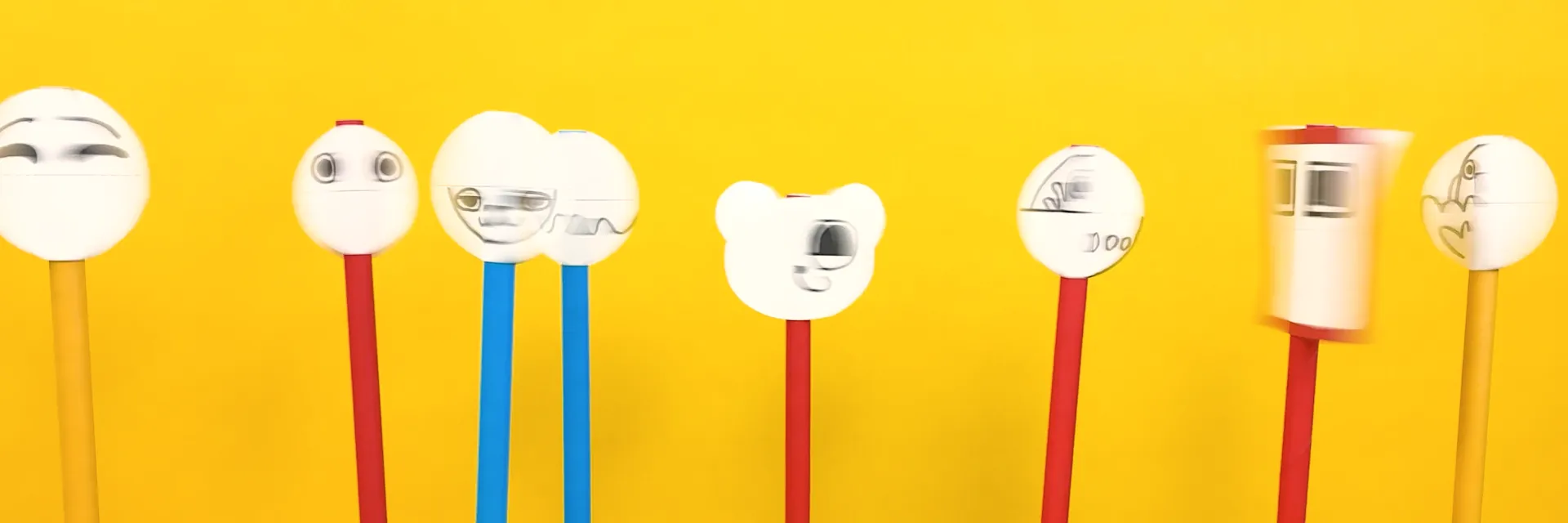
FutureMakers Eyelusions has learners build a motorized thaumatrope, a battery-and-motor spinner that merges two hand-drawn images into one optical illusion.
Last reviewed September 24, 2026
How to buy
Which Eyelusions pack should I buy?
For one learner, the Single Learner Pack costs $8.95. For a class or program, the Small Group Pack of 10 costs $69.50, or $6.95 per learner, and the Class Pack of 25 costs $122.00, or $4.88 per learner. Small Group and Class Pack orders both qualify for purchase orders and tax-exempt purchasing; check "Our organization is tax-exempt" in the quote builder and enter your tax ID number, or submit your tax ID number and a tax-exempt certificate through a free store account if buying directly.
Can I try Eyelusions before I buy a class set?
Yes. FutureMakers offers a free sample program at kidsmakethingsbetter.com/samples, and you can ask for Eyelusions by name when you request yours. A paid Single Learner Pack ($8.95) also lets you test the build yourself before ordering a class set.
Can I use a purchase order or tax-exempt status to buy Eyelusions?
Yes. Eyelusions Small Group and Class Pack orders qualify for purchase orders on Net 30 terms and for tax-exempt purchasing, the same as every FutureMakers Spark. See the full how to buy FAQ for purchase order terms, vendor paperwork, and the tax-exempt steps.
About the project
What do learners make with Eyelusions, and what's the big idea?
FutureMakers Eyelusions has learners build a motorized thaumatrope, a battery-and-motor spinner that merges two hand-drawn images on opposite ends of a paper tube into one optical illusion once it spins fast enough. The build explores persistence of vision, the way a brain fills the gap between two fast-moving images, alongside completing an electrical circuit and designing a symmetrical, split image across three levels of difficulty. Read the full Eyelusions guide for the complete build sequence.
Where can I find the full Eyelusions guide and video?
The full Eyelusions educator guide, including build photos, standards codes, and troubleshooting, is free and public at the Eyelusions guide page, no login required. A video walkthrough of the same build is on YouTube: Eyelusions: Create Moving Optical Illusions. A separate coaching video and slide deck are available with a free educator account at coach-with-sparks.
Using it in a session
How long does an Eyelusions session take?
An Eyelusions session is a 30 to 45 minute activity, the Shopify Activity Time on all three listings. See the full guide for the build sequence.
How many learners does an Eyelusions pack serve, and do they build alone or together?
Eyelusions comes in a Single Learner Pack, a Small Group Pack of 10, and a Class Pack of 25, suited to grades 2 through 8. Each learner builds their own spinner individually, and the Collaborative Half-Image Challenge extension pairs two learners who each design one half of an image without seeing the other's work until it spins. See the build steps for the individual build before pairing up.
What does an educator need to prepare and supply for Eyelusions?
An educator should print the practice and design sheet for each learner ahead of time and keep sticky notes and tape on hand for when the kit's circle stickers run out. Kits ship with foam components, a battery, a motor, a paper tube, and sticker sets, but the educator needs to supply pencils, water-based markers or crayons, and scissors. Prep takes about 5 to 10 minutes, per the product listing. Full prep notes are in the guide.
What does a first successful Eyelusions build look like?
A first successful Eyelusions build has two aligned stickers, with the top staying at the top on both sides, attached to the tube and seated on the motor connector. Touching both wires to the battery spins the tube fast enough that the two drawings blend into a single image. Getting that alignment right the first time is what separates a clean illusion from a blurry, mismatched spin.
What are the most common Eyelusions problems and fixes?
The three most common Eyelusions problems are bent wire ends, a motor that will not spin despite correct wiring, and a mushed or bent tube end. Lift the battery slightly, hold the wire against the terminal, then press both down into the foam together to fix bent wires; check whether the motor has shifted out of its foam holder and reseat it snugly if it will not spin; and trim a damaged tube end straight with scissors for a clean edge. See the full troubleshooting guide for every fix.
How can I extend Eyelusions for early finishers or older learners?
Early finishers can try Sticky Note Supersized Illusions, building a bigger image once the circle stickers run out, or the Spice Scale Showdown, moving up to a medium or spiciest difficulty level. Older learners can take on the Collaborative Half-Image Challenge, designing one half of an image without seeing their partner's half, or try New Sticker Design prompts like a bird and nest or a cat and hat. The guide lists all four extensions.
Standards and skills
What academic standards does Eyelusions meet?
Eyelusions carries NGSS codes on forces, engineering design, and how sensory receptors send messages to the brain, plus Common Core reading, writing, and geometry codes, all printed on the Eyelusions standards page. The table below lists every code. The guide does not carry CASEL or any state-specific social-emotional-learning codes for this Spark; only NGSS and Common Core alignments are documented.
What vocabulary and skills does Eyelusions build?
Eyelusions introduces the vocabulary of thaumatrope, optical illusion, persistence of vision, the phi phenomenon, and circuit, used correctly as learners design, wire, and test their own spinner. The guide favors peer help before adult help by design, since letting a learner ask a neighbor first builds collaborative problem-solving and lets them own their own breakthroughs. Every Spark is individually packed so each learner keeps what they build.
Eyelusions standards codes
Codes as printed on the Eyelusions guide. No CASEL or state-specific codes are documented for this Spark.
Framework
Code
What it covers
NGSS
K-PS2-1
Plan and conduct an investigation to compare forces
NGSS
K-2-ETS1-2
Develop a simple sketch or model of a solution
NGSS
3-PS2-1
Effects of balanced and unbalanced forces on motion
NGSS
3-5-ETS1-3
Plan and carry out fair tests to identify failure points
NGSS
MS-LS1-8
Sensory receptors sending messages to the brain
NGSS
MS-ETS1-2
Evaluate competing design solutions
Common Core ELA
RI.K-2.7
Use illustrations and details to describe key ideas
Common Core ELA
SL.K-2.1
Participate in collaborative conversations
Common Core ELA
RI.3-5.3
Explain relationships between events or concepts
Common Core ELA
W.3-5.2
Write informative and explanatory texts
Common Core ELA
RST.6-8.3
Follow a multistep procedure precisely
Common Core ELA
SL.6-8.1
Engage in collaborative discussion
Common Core Math
K.G.A.1
Describe positions and shapes in the environment
Common Core Math
K.MD.A.1
Describe measurable attributes of objects
Common Core Math
3.G.A.1
Understand shared attributes across shape categories
Common Core Math
4.G.A.3
Recognize a line of symmetry
Common Core Math
7.G.A.1
Solve problems involving scale drawings of geometric figures
Common Core Math
7.G.B.4
Formulas for the area and circumference of a circle
<script type="application/ld+json">{"@context": "https://schema.org", "@type": "FAQPage", "mainEntity": [{"@type": "Question", "name": "Which Eyelusions pack should I buy?", "acceptedAnswer": {"@type": "Answer", "text": "For one learner, the Single Learner Pack costs $8.95. For a class or program, the Small Group Pack of 10 costs $69.50, or $6.95 per learner, and the Class Pack of 25 costs $122.00, or $4.88 per learner. Small Group and Class Pack orders both qualify for purchase orders and tax-exempt purchasing; check \"Our organization is tax-exempt\" in the quote builder and enter your tax ID number, or submit your tax ID number and a tax-exempt certificate through a free store account if buying directly."}}, {"@type": "Question", "name": "Can I try Eyelusions before I buy a class set?", "acceptedAnswer": {"@type": "Answer", "text": "Yes. FutureMakers offers a free sample program at kidsmakethingsbetter.com/samples , and you can ask for Eyelusions by name when you request yours. A paid Single Learner Pack ($8.95) also lets you test the build yourself before ordering a class set."}}, {"@type": "Question", "name": "Can I use a purchase order or tax-exempt status to buy Eyelusions?", "acceptedAnswer": {"@type": "Answer", "text": "Yes. Eyelusions Small Group and Class Pack orders qualify for purchase orders on Net 30 terms and for tax-exempt purchasing, the same as every FutureMakers Spark. See the full how to buy FAQ for purchase order terms, vendor paperwork, and the tax-exempt steps."}}, {"@type": "Question", "name": "What do learners make with Eyelusions, and what's the big idea?", "acceptedAnswer": {"@type": "Answer", "text": "FutureMakers Eyelusions has learners build a motorized thaumatrope, a battery-and-motor spinner that merges two hand-drawn images on opposite ends of a paper tube into one optical illusion once it spins fast enough. The build explores persistence of vision, the way a brain fills the gap between two fast-moving images, alongside completing an electrical circuit and designing a symmetrical, split image across three levels of difficulty. Read the full Eyelusions guide for the complete build sequence."}}, {"@type": "Question", "name": "Where can I find the full Eyelusions guide and video?", "acceptedAnswer": {"@type": "Answer", "text": "The full Eyelusions educator guide, including build photos, standards codes, and troubleshooting, is free and public at the Eyelusions guide page , no login required. A video walkthrough of the same build is on YouTube: Eyelusions: Create Moving Optical Illusions . A separate coaching video and slide deck are available with a free educator account at coach-with-sparks ."}}, {"@type": "Question", "name": "How long does an Eyelusions session take?", "acceptedAnswer": {"@type": "Answer", "text": "An Eyelusions session is a 30 to 45 minute activity, the Shopify Activity Time on all three listings. See the full guide for the build sequence."}}, {"@type": "Question", "name": "How many learners does an Eyelusions pack serve, and do they build alone or together?", "acceptedAnswer": {"@type": "Answer", "text": "Eyelusions comes in a Single Learner Pack, a Small Group Pack of 10, and a Class Pack of 25, suited to grades 2 through 8. Each learner builds their own spinner individually, and the Collaborative Half-Image Challenge extension pairs two learners who each design one half of an image without seeing the other's work until it spins. See the build steps for the individual build before pairing up."}}, {"@type": "Question", "name": "What does an educator need to prepare and supply for Eyelusions?", "acceptedAnswer": {"@type": "Answer", "text": "An educator should print the practice and design sheet for each learner ahead of time and keep sticky notes and tape on hand for when the kit's circle stickers run out. Kits ship with foam components, a battery, a motor, a paper tube, and sticker sets, but the educator needs to supply pencils, water-based markers or crayons, and scissors. Prep takes about 5 to 10 minutes, per the product listing. Full prep notes are in the guide ."}}, {"@type": "Question", "name": "What does a first successful Eyelusions build look like?", "acceptedAnswer": {"@type": "Answer", "text": "A first successful Eyelusions build has two aligned stickers, with the top staying at the top on both sides, attached to the tube and seated on the motor connector. Touching both wires to the battery spins the tube fast enough that the two drawings blend into a single image. Getting that alignment right the first time is what separates a clean illusion from a blurry, mismatched spin."}}, {"@type": "Question", "name": "What are the most common Eyelusions problems and fixes?", "acceptedAnswer": {"@type": "Answer", "text": "The three most common Eyelusions problems are bent wire ends, a motor that will not spin despite correct wiring, and a mushed or bent tube end. Lift the battery slightly, hold the wire against the terminal, then press both down into the foam together to fix bent wires; check whether the motor has shifted out of its foam holder and reseat it snugly if it will not spin; and trim a damaged tube end straight with scissors for a clean edge. See the full troubleshooting guide for every fix."}}, {"@type": "Question", "name": "How can I extend Eyelusions for early finishers or older learners?", "acceptedAnswer": {"@type": "Answer", "text": "Early finishers can try Sticky Note Supersized Illusions, building a bigger image once the circle stickers run out, or the Spice Scale Showdown, moving up to a medium or spiciest difficulty level. Older learners can take on the Collaborative Half-Image Challenge, designing one half of an image without seeing their partner's half, or try New Sticker Design prompts like a bird and nest or a cat and hat. The guide lists all four extensions ."}}, {"@type": "Question", "name": "What academic standards does Eyelusions meet?", "acceptedAnswer": {"@type": "Answer", "text": "Eyelusions carries NGSS codes on forces, engineering design, and how sensory receptors send messages to the brain, plus Common Core reading, writing, and geometry codes, all printed on the Eyelusions standards page . The table below lists every code. The guide does not carry CASEL or any state-specific social-emotional-learning codes for this Spark; only NGSS and Common Core alignments are documented."}}, {"@type": "Question", "name": "What vocabulary and skills does Eyelusions build?", "acceptedAnswer": {"@type": "Answer", "text": "Eyelusions introduces the vocabulary of thaumatrope, optical illusion, persistence of vision, the phi phenomenon, and circuit, used correctly as learners design, wire, and test their own spinner. The guide favors peer help before adult help by design, since letting a learner ask a neighbor first builds collaborative problem-solving and lets them own their own breakthroughs. Every Spark is individually packed so each learner keeps what they build."}}]}</script>