FutureMakers Sparks are screen-free building kits that youth services librarians, family engagement coordinators, and PTA STEM night organizers use to host family nights, summer reading events, and drop-in makerspace hours, or hand out as take-home kits, without a science background on staff. Packs run $4.20 to $6.95 per learner, kids can lead their own stations, and libraries buy them repeatedly for exactly this reason.
Last reviewed September 25, 2026
How to buy
Can a library or PTA use a purchase order or tax-exempt status to buy Sparks?
Yes to both. A purchasing quote at /quote generates a PDF in about two minutes on Net 30 terms so your business office can cut a PO against it, and tax exemption just needs your tax ID number: check "Our organization is tax-exempt" in the Purchasing Information section and enter it there, or if you're buying directly in the store, create a free account and submit it with a tax-exempt certificate for review. On a quote, a 5% discount also applies automatically to card purchases, no cap, stacking with any other discount. Shop checkout does not apply it. See the full how to buy FAQ for purchase order terms, vendor paperwork, and every payment option.
How do I use the order form on the website?
The order form is FutureMakers' quote builder at kidsmakethingsbetter.com/quote. Tell it about your program, adjust quantities in a line-item editor, and get a PDF quote to forward to purchasing. See the full how to buy FAQ for the complete step-by-step and every payment option.
Can a library system place one order across multiple branches?
Yes. A multi-branch library system can place a single system-wide order, including in large quantities. A quote built at /quote scales up to the site's own "300+ (multi-site)" learner-count tier for exactly this kind of order.
What it looks like
What does a Sparks family night actually look like, minute by minute?
A Sparks family night runs as one build session where each family or table group works from its own kit, then shows what they made in a short share-out at the end. A small group of learners builds a Spark ahead of time, makes a coaching guide, and leads a step of the process at the event, with teacher involvement minimal. See the run of show below for a 45 to 60 minute version, and browse the Flying Machines guide for a Spark built for exactly this format.
Can kids lead the station themselves at a family night, or does staff have to be the one showing them?
Kids can lead a Sparks station themselves once a small group has built the project ahead of time and walked through FutureMakers' learner-led coaching guide, which is documented on the company's own family-night FAQ. Staff or a parent volunteer stays nearby for setup and troubleshooting, but isn't the one demonstrating the build. This is also how the community schools page describes the same format for coordinators running multi-station events.
What does a parent and child actually do together during a Spark build?
A parent and child typically build side by side from one kit, negotiating who does which step. The Mazes guide describes partners "negotiating where to connect their board with a partner's," and the Straw Structures guide names teamwork directly as families work toward a structure "as tall as you." A quieter moment shows up in Monster Mouths, where the guide has each builder introduce their finished puppet to a neighbor before anyone leaves the table.
What's a screen-free engineering activity for a library summer reading program?
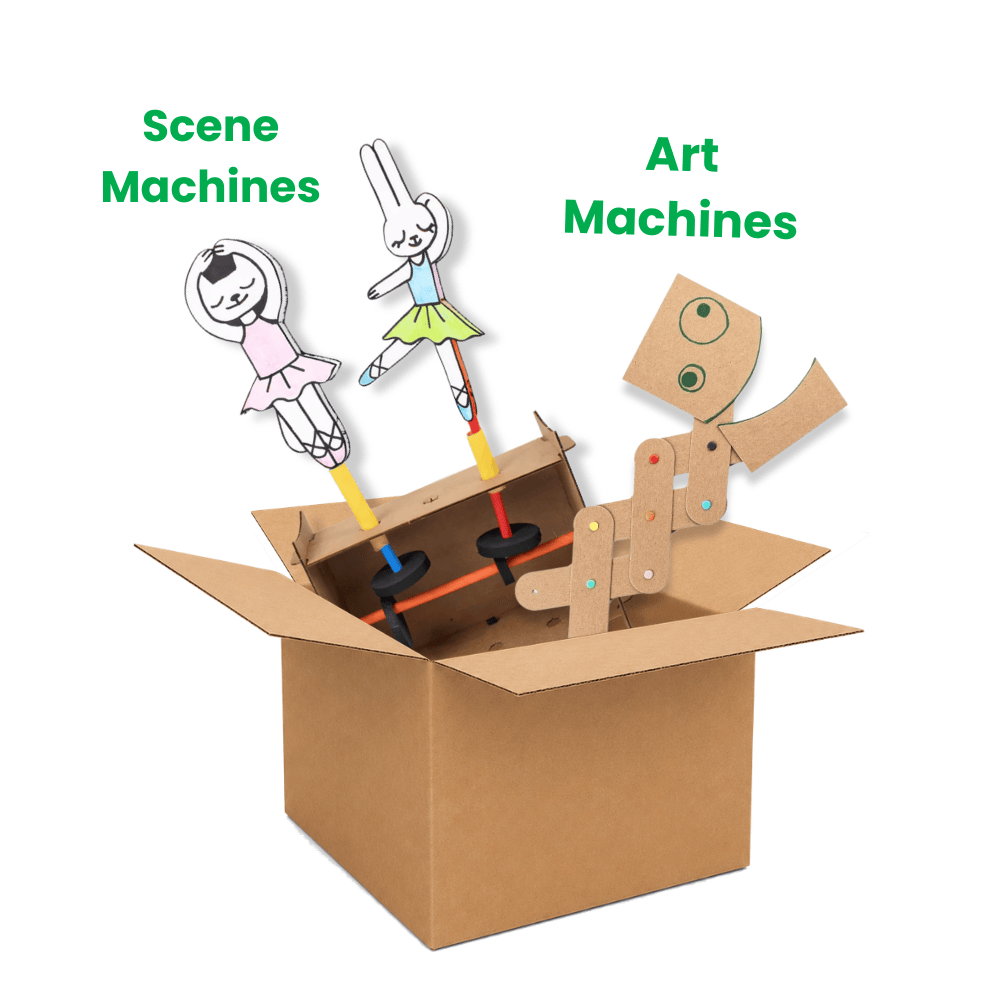
FutureMakers Sparks are a screen-free option libraries have used for summer programming for several years running. Some library systems have bought for a summer season and then returned for a system-wide order ahead of fall programs. Art Machines is a kinetic-sculpture build where each learner keeps their own moving cardboard creature. See the Art Machines guide for the full build.
Do Sparks come with any Spanish-language materials for a family night?
Yes. Every Spark's written elements print in English and Spanish, which covers instruction sheets and similar printed pieces. That matters for a library serving multilingual families or running family-engagement programming for a Title I-adjacent branch. Check the printed sheet in your specific Spark's kit to confirm which written pieces are included.
Are there any small parts or safety concerns for the toddlers and younger siblings who show up at a family night?
Every Spark includes small parts, connectors, brads, dowels, and similar pieces, so a toddler or preschooler who isn't the one building should stay within arm's reach. The clearest safety language we have comes from our clinician program materials, which say plainly that two Sparks "contain small parts" and call for a fit check with anyone prone to putting objects in their mouth. We don't have a library-specific version of that warning, but the same kind of pieces ship in every Spark sold to libraries. FutureMakers hasn't published an age threshold like "not for children under 3" on any listing, so treat every Spark as a small-parts item and supervise young siblings the way you would any building toy.
A 45 to 60 minute Sparks family night, run of show
Based on FutureMakers' family-night format (learner-led stations, minimal teacher involvement, growing family attendance) and the standard 1:1 build format most Sparks guides use.
0:00Welcome and check-in
Families arrive, sign in, and are pointed to their station. A small team of learners who already built the Spark ahead of time staffs each table.
0:05Quick demo from a learner leader
One of the pre-trained learners shows the one technique everyone needs, using the coaching guide FutureMakers built for exactly this moment.
0:10Families build together
Each family builds from its own kit at its own pace. Staff and learner leaders circulate rather than take over.
0:35Troubleshoot and iterate
Guides for Sparks like Wind-Up Vehicles and Straw Structures build in a 'try again' step; nobody's build has to work on the first attempt.
0:50Share out
Families show their build to a neighboring table or the whole room, the moment FutureMakers ties to rising family attendance.
0:55Pack up and take home
Each family keeps its build; individually packed kits mean nothing has to be reassembled or collected.
Coaching your staff and volunteers
Can library staff lead a Sparks program with no science background?
Yes. Every Spark ships with a printed instruction sheet, and a free FutureMakers educator account adds a coaching video, slide decks, and a "playbook maker" tool for the person leading the room, none of which require a science degree to use. FutureMakers built this format with librarians and youth developers in mind, the exact people who ask early questions about who will manage the kits and how to train staff. Sign up for the free account at coach-with-sparks.
How much prep time does a librarian need before hosting a Spark station?
Guides consistently ask a facilitator to do one thing ahead of time: build a sample so the room has something to look at. The Art Machines guide's only prep instruction is to "make an example ahead of time, keep it simple so learners can be more creative." Beyond that one sample build, most Sparks need no rehearsal, since the free coaching video and slide decks cover the rest.
Does a parent or teen volunteer need training before leading a table, or can they just read the instructions?
A volunteer can lead a table from the printed instruction sheet included in every kit. Several guides build coaching language directly into that sheet, like Drawbots' note that "peer helpers are powerful" and its advice to let nearby builders lend a hand rather than waiting for one adult. For a volunteer who wants more before the event, the free coach-with-sparks account adds a short video and slide deck per Spark.
Where Sparks fit your programs
What Spark fits a library drop-in program with no fixed schedule?
Several Sparks list a single 30 to 45 minute build window on their own guides, which fits most drop-in slots. Blendies, Eyelusions, Strawbots, and Wind-Up Vehicles all state "30 to 45 minutes." Each is a 1:1 build, so a family or single visitor can start and finish in one sitting without waiting on a group start time. See the Blendies guide for one example.
Can Sparks work as a take-home kit families build at home?
Yes. Every Spark ships individually packed and belongs to the builder once it's finished, which is how several guides frame the moment on purpose: the Screen Machines guide tells facilitators to "tell learners upfront that this project will belong to them when they're done. Ownership boosts engagement." That makes a Single Learner Pack, at $8.95, a natural take-home option for a program that hands out one kit per family instead of hosting a group build on site.
What Spark works well for a teen volunteer program at the library?
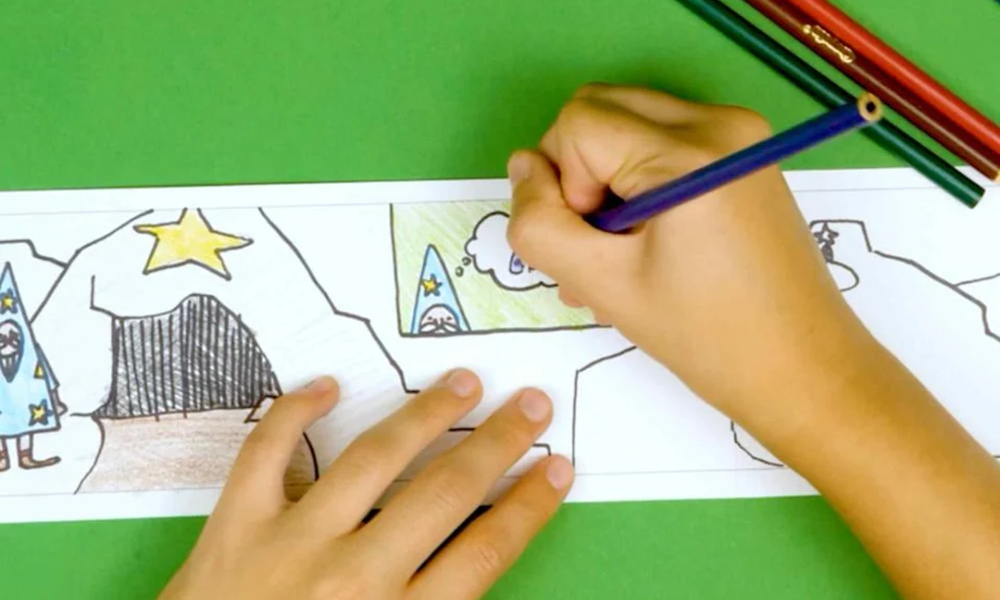
Crankie Contraptions is built around a storytelling performance a teen can rehearse and then lead, since its guide has builders "share with a neighbor, small group, or the whole class" once the hand-cranked scroll works. Drawbots is a second option. Its Small Group Pack listing names it as fitting "after-school clubs, Scouting programs, gifted and talented classes" and similar peer-led settings. Both run as a single build a teen volunteer can practice once, then repeat at each table.
A Crankie Contraptions scroll in progress, ready for the storytelling performance a teen volunteer can lead.
What Spark works for a storytime-adjacent program with very young kids?
Blendies and Straw Structures are both designed for Pre-K through 8th grade, and Straw Structures' own guide writes separate discussion questions for a Pre-K to Kindergarten band specifically. Mazes is a third option built to scale down. Its guide differentiates activities for K-2 as well as older bands, and a caregiver can build alongside a Pre-K child rather than the child working alone.
Is there a Spark bundle built specifically for libraries?
Yes. The Library Makerspace bundle pairs Scene Machines and Art Machines in two sizes: a Small Group version (10 of each, $119) and a Bulk version (25 of each, $210), sold directly on the FutureMakers store. It's the one product on the site actually named for this audience. See it at the Small Group bundle or the Bulk bundle.
Do Sparks work for a family night with a wide mix of ages at one table?
Blendies is built for exactly this spread. It is designed for Pre-K through 8th grade, with a shared set of markers and a build every age group can finish. Mazes scales the same way in the other direction, moving from a single-board build for one child up to a four- or six-board cooperative build a family or mixed-age group finishes together.
Social and emotional growth you'd see in the room
What social and emotional behaviors would I actually see during a family Spark build?
Watch for two named moments. The Mazes guide describes a parent and child negotiating "where to connect their board to a partner's," and Wind-Up Vehicles tells builders up front that "it's totally okay to try something that doesn't work." These are behaviors the guides describe as design goals, not outcomes FutureMakers has measured with data, so treat them as a preview of what to watch for rather than a guarantee.
What's a good conversation starter for a family that's quiet or unsure how to start?
Several guides script this moment for the adult leading the table rather than leaving it to chance. Hypnotizers' guide advises the facilitator to "name the vocabulary out loud" as a builder works, on the reasoning that "vocabulary sticks when it's named at the moment it's felt," which doubles as an easy opener between a parent and child who aren't sure what to say to each other over a kit.
Does a shy kid need a partner, or can they build alone at a family event?
Almost every Spark is a 1:1 build by default, so a child who wants to work alone can, then choose whether to show anyone the result. Art Machines' guide frames peer help as optional and additive rather than required, noting that inviting another learner to help "builds confidence and creativity" when a builder wants it, not as a rule that everyone must partner up.
Standards and skills
Which Spark should I pick for a specific age group or standards goal?
The right Spark for a family-engagement setting depends on the age band and standard you need, from Pre-K engineering design to middle-school story retelling. Art Machines fits kindergarten through 5th grade on NGSS K-2-ETS1-2, Straw Structures fits Pre-K through 8th grade on NGSS K-2-ETS1-3, and Crankie Contraptions fits lower elementary through middle school on CCSS.RL.K-2.2 for retelling a story. The table below adds three more Sparks with their ages, what families build, and a standard code each, pulled straight from each Spark's own /inst guide page, visible with no login required. A free coach-with-sparks account adds a slide deck if your library needs to cite alignment in a grant report.
Cost and funding
How much does a Sparks family night cost per learner?
Cost per learner runs $4.20 to $4.88 in a 25-unit Class Pack and $5.95 to $6.95 in a 10-unit Small Group Pack, depending on the Spark, based on live FutureMakers pricing. That's a per-learner number, not a flat per-family price: a family bringing three kids needs three kits, so multiply by however many builders show up per family. Company-wide, FutureMakers gives the same range as "$4 and $7 per learner, depending on the format purchased," which matches this pack-by-pack math. A 45-learner night using Class Packs runs in the low hundreds of dollars in kit cost alone.
Can our Friends of the Library group or PTA pay for Sparks?
Yes. PTA funding and a library's year-end budget are both workable ways to pay for Sparks. A Friends of the Library group or PTA can use the same instant PDF quote at /quote that a library purchasing department would use.
What do I write in my library's IMLS or LSTA grant report about a Sparks program?
Describe what actually happened: the number of kits distributed, the specific Spark used, and what each participant built and kept. For example: "Our library ran a family Sparks night using [Spark name], distributing [N] individually packed kits; each family built and kept a hands-on engineering project, with no facilitator training required beyond the kit's own printed guide." Stick to attendance counts and what was built rather than a skills or engagement claim, since that requires its own measurement tool, like PLA's Project Outcome, that a single family night doesn't provide on its own.
Which Spark for which family-engagement setting
Ages and standards codes below come directly from each Spark's /inst guide page or Shopify listing.
Spark
Ages
What families make
Example standard
Art Machines
Ages 5 to 10 (K-5)
A hand-cranked cardboard creature with moving levers and fulcra
NGSS K-2-ETS1-2 (engineering design)
Straw Structures
Ages 4 and up (Pre-K to middle school bands)
A free-standing straw-and-connector structure as tall as the builder
NGSS K-2-ETS1-3 (engineering design)
Blendies
Pre-K through middle school
A hand-spun, hand-colored spinning top that blends colors in motion
NGSS K-PS2-1 (motion and stability)
Flying Machines
Grades 1-8
A wind-up, motorized flying model families iterate for distance or style
NGSS K-PS3-1 (energy)
Crankie Contraptions
Lower elementary through middle school
A hand-cranked scrolling story box with an original illustrated tale
CCSS.RL.K-2.2 (retell a story)
Scene Machines
Grades 2-8
A moving automata scene with characters and mechanisms of the builder's design
<script type="application/ld+json">{"@context": "https://schema.org", "@type": "FAQPage", "mainEntity": [{"@type": "Question", "name": "Can a library or PTA use a purchase order or tax-exempt status to buy Sparks?", "acceptedAnswer": {"@type": "Answer", "text": "Yes to both. A purchasing quote at /quote generates a PDF in about two minutes on Net 30 terms so your business office can cut a PO against it, and tax exemption just needs your tax ID number: check \"Our organization is tax-exempt\" in the Purchasing Information section and enter it there, or if you're buying directly in the store, create a free account and submit it with a tax-exempt certificate for review. On a quote, a 5% discount also applies automatically to card purchases, no cap, stacking with any other discount. Shop checkout does not apply it. See the full how to buy FAQ for purchase order terms, vendor paperwork, and every payment option."}}, {"@type": "Question", "name": "How do I use the order form on the website?", "acceptedAnswer": {"@type": "Answer", "text": "The order form is FutureMakers' quote builder at kidsmakethingsbetter.com/quote . Tell it about your program, adjust quantities in a line-item editor, and get a PDF quote to forward to purchasing. See the full how to buy FAQ for the complete step-by-step and every payment option."}}, {"@type": "Question", "name": "Can a library system place one order across multiple branches?", "acceptedAnswer": {"@type": "Answer", "text": "Yes. A multi-branch library system can place a single system-wide order, including in large quantities. A quote built at /quote scales up to the site's own \"300+ (multi-site)\" learner-count tier for exactly this kind of order."}}, {"@type": "Question", "name": "What does a Sparks family night actually look like, minute by minute?", "acceptedAnswer": {"@type": "Answer", "text": "A Sparks family night runs as one build session where each family or table group works from its own kit, then shows what they made in a short share-out at the end. A small group of learners builds a Spark ahead of time, makes a coaching guide, and leads a step of the process at the event, with teacher involvement minimal. See the run of show below for a 45 to 60 minute version, and browse the Flying Machines guide for a Spark built for exactly this format."}}, {"@type": "Question", "name": "Can kids lead the station themselves at a family night, or does staff have to be the one showing them?", "acceptedAnswer": {"@type": "Answer", "text": "Kids can lead a Sparks station themselves once a small group has built the project ahead of time and walked through FutureMakers' learner-led coaching guide, which is documented on the company's own family-night FAQ. Staff or a parent volunteer stays nearby for setup and troubleshooting, but isn't the one demonstrating the build. This is also how the community schools page describes the same format for coordinators running multi-station events."}}, {"@type": "Question", "name": "What does a parent and child actually do together during a Spark build?", "acceptedAnswer": {"@type": "Answer", "text": "A parent and child typically build side by side from one kit, negotiating who does which step. The Mazes guide describes partners \"negotiating where to connect their board with a partner's,\" and the Straw Structures guide names teamwork directly as families work toward a structure \"as tall as you.\" A quieter moment shows up in Monster Mouths, where the guide has each builder introduce their finished puppet to a neighbor before anyone leaves the table."}}, {"@type": "Question", "name": "What's a screen-free engineering activity for a library summer reading program?", "acceptedAnswer": {"@type": "Answer", "text": "FutureMakers Sparks are a screen-free option libraries have used for summer programming for several years running. Some library systems have bought for a summer season and then returned for a system-wide order ahead of fall programs. Art Machines is a kinetic-sculpture build where each learner keeps their own moving cardboard creature. See the Art Machines guide for the full build."}}, {"@type": "Question", "name": "Do Sparks come with any Spanish-language materials for a family night?", "acceptedAnswer": {"@type": "Answer", "text": "Yes. Every Spark's written elements print in English and Spanish, which covers instruction sheets and similar printed pieces. That matters for a library serving multilingual families or running family-engagement programming for a Title I-adjacent branch. Check the printed sheet in your specific Spark's kit to confirm which written pieces are included."}}, {"@type": "Question", "name": "Are there any small parts or safety concerns for the toddlers and younger siblings who show up at a family night?", "acceptedAnswer": {"@type": "Answer", "text": "Every Spark includes small parts, connectors, brads, dowels, and similar pieces, so a toddler or preschooler who isn't the one building should stay within arm's reach. The clearest safety language we have comes from our clinician program materials, which say plainly that two Sparks \"contain small parts\" and call for a fit check with anyone prone to putting objects in their mouth. We don't have a library-specific version of that warning, but the same kind of pieces ship in every Spark sold to libraries. FutureMakers hasn't published an age threshold like \"not for children under 3\" on any listing, so treat every Spark as a small-parts item and supervise young siblings the way you would any building toy."}}, {"@type": "Question", "name": "Can library staff lead a Sparks program with no science background?", "acceptedAnswer": {"@type": "Answer", "text": "Yes. Every Spark ships with a printed instruction sheet, and a free FutureMakers educator account adds a coaching video, slide decks, and a \"playbook maker\" tool for the person leading the room, none of which require a science degree to use. FutureMakers built this format with librarians and youth developers in mind, the exact people who ask early questions about who will manage the kits and how to train staff. Sign up for the free account at coach-with-sparks ."}}, {"@type": "Question", "name": "How much prep time does a librarian need before hosting a Spark station?", "acceptedAnswer": {"@type": "Answer", "text": "Guides consistently ask a facilitator to do one thing ahead of time: build a sample so the room has something to look at. The Art Machines guide's only prep instruction is to \"make an example ahead of time, keep it simple so learners can be more creative.\" Beyond that one sample build, most Sparks need no rehearsal, since the free coaching video and slide decks cover the rest."}}, {"@type": "Question", "name": "Does a parent or teen volunteer need training before leading a table, or can they just read the instructions?", "acceptedAnswer": {"@type": "Answer", "text": "A volunteer can lead a table from the printed instruction sheet included in every kit. Several guides build coaching language directly into that sheet, like Drawbots' note that \"peer helpers are powerful\" and its advice to let nearby builders lend a hand rather than waiting for one adult. For a volunteer who wants more before the event, the free coach-with-sparks account adds a short video and slide deck per Spark."}}, {"@type": "Question", "name": "What Spark fits a library drop-in program with no fixed schedule?", "acceptedAnswer": {"@type": "Answer", "text": "Several Sparks list a single 30 to 45 minute build window on their own guides, which fits most drop-in slots. Blendies, Eyelusions, Strawbots, and Wind-Up Vehicles all state \"30 to 45 minutes.\" Each is a 1:1 build, so a family or single visitor can start and finish in one sitting without waiting on a group start time. See the Blendies guide for one example."}}, {"@type": "Question", "name": "Can Sparks work as a take-home kit families build at home?", "acceptedAnswer": {"@type": "Answer", "text": "Yes. Every Spark ships individually packed and belongs to the builder once it's finished, which is how several guides frame the moment on purpose: the Screen Machines guide tells facilitators to \"tell learners upfront that this project will belong to them when they're done. Ownership boosts engagement.\" That makes a Single Learner Pack, at $8.95, a natural take-home option for a program that hands out one kit per family instead of hosting a group build on site."}}, {"@type": "Question", "name": "What Spark works well for a teen volunteer program at the library?", "acceptedAnswer": {"@type": "Answer", "text": "Crankie Contraptions is built around a storytelling performance a teen can rehearse and then lead, since its guide has builders \"share with a neighbor, small group, or the whole class\" once the hand-cranked scroll works. Drawbots is a second option. Its Small Group Pack listing names it as fitting \"after-school clubs, Scouting programs, gifted and talented classes\" and similar peer-led settings. Both run as a single build a teen volunteer can practice once, then repeat at each table."}}, {"@type": "Question", "name": "What Spark works for a storytime-adjacent program with very young kids?", "acceptedAnswer": {"@type": "Answer", "text": "Blendies and Straw Structures are both designed for Pre-K through 8th grade, and Straw Structures' own guide writes separate discussion questions for a Pre-K to Kindergarten band specifically. Mazes is a third option built to scale down. Its guide differentiates activities for K-2 as well as older bands, and a caregiver can build alongside a Pre-K child rather than the child working alone."}}, {"@type": "Question", "name": "Is there a Spark bundle built specifically for libraries?", "acceptedAnswer": {"@type": "Answer", "text": "Yes. The Library Makerspace bundle pairs Scene Machines and Art Machines in two sizes: a Small Group version (10 of each, $119) and a Bulk version (25 of each, $210), sold directly on the FutureMakers store. It's the one product on the site actually named for this audience. See it at the Small Group bundle or the Bulk bundle ."}}, {"@type": "Question", "name": "Do Sparks work for a family night with a wide mix of ages at one table?", "acceptedAnswer": {"@type": "Answer", "text": "Blendies is built for exactly this spread. It is designed for Pre-K through 8th grade, with a shared set of markers and a build every age group can finish. Mazes scales the same way in the other direction, moving from a single-board build for one child up to a four- or six-board cooperative build a family or mixed-age group finishes together."}}, {"@type": "Question", "name": "What social and emotional behaviors would I actually see during a family Spark build?", "acceptedAnswer": {"@type": "Answer", "text": "Watch for two named moments. The Mazes guide describes a parent and child negotiating \"where to connect their board to a partner's,\" and Wind-Up Vehicles tells builders up front that \"it's totally okay to try something that doesn't work.\" These are behaviors the guides describe as design goals, not outcomes FutureMakers has measured with data, so treat them as a preview of what to watch for rather than a guarantee."}}, {"@type": "Question", "name": "What's a good conversation starter for a family that's quiet or unsure how to start?", "acceptedAnswer": {"@type": "Answer", "text": "Several guides script this moment for the adult leading the table rather than leaving it to chance. Hypnotizers' guide advises the facilitator to \"name the vocabulary out loud\" as a builder works, on the reasoning that \"vocabulary sticks when it's named at the moment it's felt,\" which doubles as an easy opener between a parent and child who aren't sure what to say to each other over a kit."}}, {"@type": "Question", "name": "Does a shy kid need a partner, or can they build alone at a family event?", "acceptedAnswer": {"@type": "Answer", "text": "Almost every Spark is a 1:1 build by default, so a child who wants to work alone can, then choose whether to show anyone the result. Art Machines' guide frames peer help as optional and additive rather than required, noting that inviting another learner to help \"builds confidence and creativity\" when a builder wants it, not as a rule that everyone must partner up."}}, {"@type": "Question", "name": "Which Spark should I pick for a specific age group or standards goal?", "acceptedAnswer": {"@type": "Answer", "text": "The right Spark for a family-engagement setting depends on the age band and standard you need, from Pre-K engineering design to middle-school story retelling. Art Machines fits kindergarten through 5th grade on NGSS K-2-ETS1-2, Straw Structures fits Pre-K through 8th grade on NGSS K-2-ETS1-3, and Crankie Contraptions fits lower elementary through middle school on CCSS.RL.K-2.2 for retelling a story. The table below adds three more Sparks with their ages, what families build, and a standard code each, pulled straight from each Spark's own /inst guide page , visible with no login required. A free coach-with-sparks account adds a slide deck if your library needs to cite alignment in a grant report."}}, {"@type": "Question", "name": "How much does a Sparks family night cost per learner?", "acceptedAnswer": {"@type": "Answer", "text": "Cost per learner runs $4.20 to $4.88 in a 25-unit Class Pack and $5.95 to $6.95 in a 10-unit Small Group Pack, depending on the Spark, based on live FutureMakers pricing. That's a per-learner number, not a flat per-family price: a family bringing three kids needs three kits, so multiply by however many builders show up per family. Company-wide, FutureMakers gives the same range as \"$4 and $7 per learner, depending on the format purchased,\" which matches this pack-by-pack math. A 45-learner night using Class Packs runs in the low hundreds of dollars in kit cost alone."}}, {"@type": "Question", "name": "Can our Friends of the Library group or PTA pay for Sparks?", "acceptedAnswer": {"@type": "Answer", "text": "Yes. PTA funding and a library's year-end budget are both workable ways to pay for Sparks. A Friends of the Library group or PTA can use the same instant PDF quote at /quote that a library purchasing department would use."}}, {"@type": "Question", "name": "What do I write in my library's IMLS or LSTA grant report about a Sparks program?", "acceptedAnswer": {"@type": "Answer", "text": "Describe what actually happened: the number of kits distributed, the specific Spark used, and what each participant built and kept. For example: \"Our library ran a family Sparks night using [Spark name], distributing [N] individually packed kits; each family built and kept a hands-on engineering project, with no facilitator training required beyond the kit's own printed guide.\" Stick to attendance counts and what was built rather than a skills or engagement claim, since that requires its own measurement tool, like PLA's Project Outcome, that a single family night doesn't provide on its own."}}]}</script>