Straw Structures: Answers for Educators and Program Leaders
Straw Structures: Answers for Educators and Program Leaders
Straw Structures has learners connect paper straws and connectors into standing three-dimensional towers, in a 30 to 60 minute session sized for a Small Group Pack of 10 or a Class Pack of 25.
Last reviewed October 1, 2026
How to buy
Which Straw Structures pack should I buy?
For one learner, the Single Learner Pack costs $8.95. For a class or program, the Small Group Pack of 10 costs $69.50, or $6.95 per learner, and the Class Pack of 25 costs $122.00, or $4.88 per learner. Small Group and Class Pack orders both qualify for purchase orders and tax-exempt purchasing; check "Our organization is tax-exempt" in the quote builder and enter your tax ID number, or submit your tax ID number and a tax-exempt certificate through a free store account if buying directly.
Can I try Straw Structures before I buy a class set?
Yes. FutureMakers offers a free sample program at kidsmakethingsbetter.com/samples, and you can ask for Straw Structures by name when you request yours. A paid Single Learner Pack ($8.95) also lets you test the build yourself before ordering a class set.
Can I use a purchase order or tax-exempt status to buy Straw Structures?
Yes. Straw Structures Small Group and Class Pack orders qualify for purchase orders on Net 30 terms and for tax-exempt purchasing, the same as every FutureMakers Spark. See the full how to buy FAQ for purchase order terms, vendor paperwork, and the tax-exempt steps.
About the project
What do learners make with Straw Structures and what's the big idea?
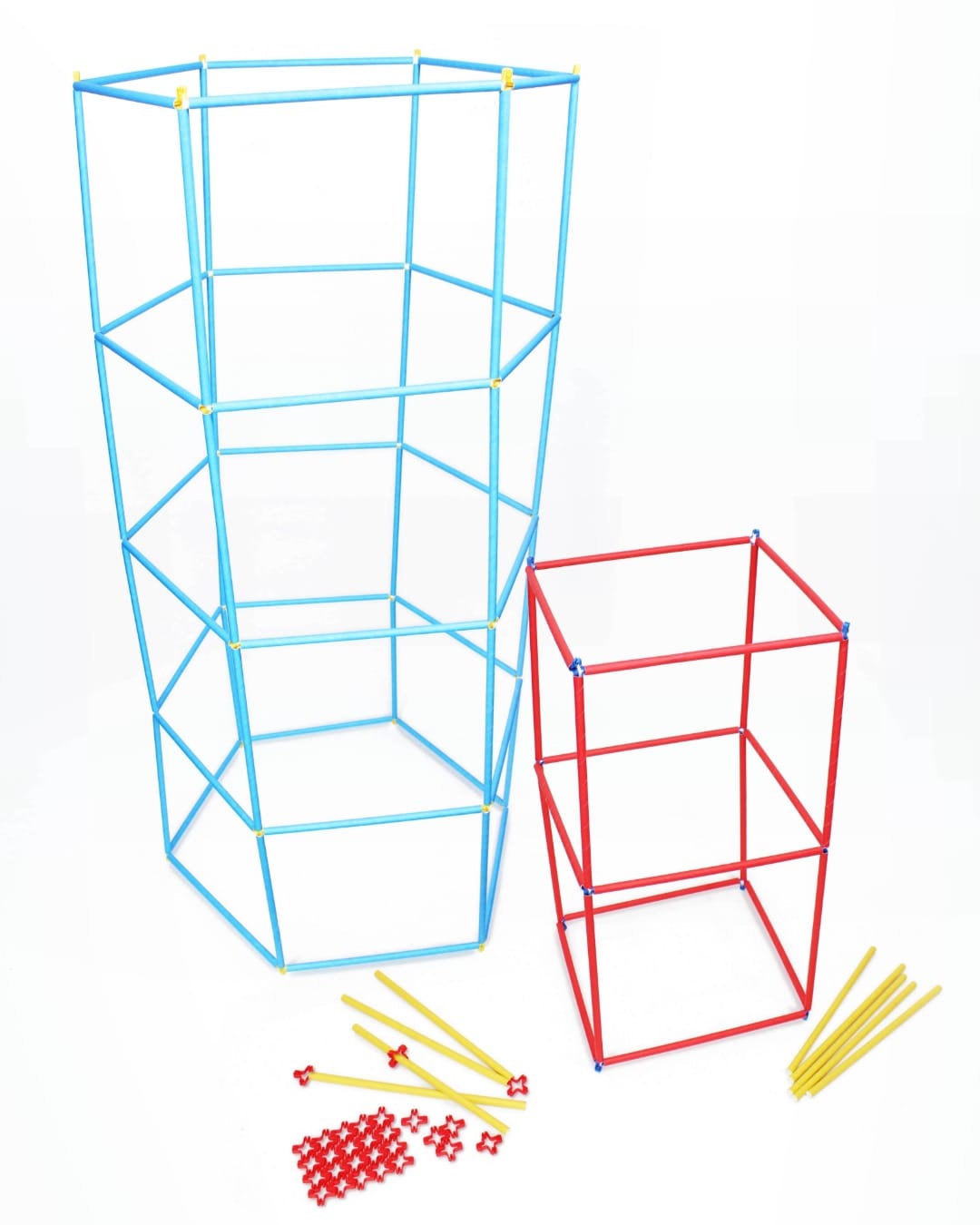
Straw Structures has learners connect sturdy paper straws with flexible plastic connectors to turn simple line segments into two-dimensional shapes, then build those shapes upward into three-dimensional forms called prisms. The big idea is a real engineering trade-off: a wider base is more stable, while a narrower base reaches higher but topples more easily, and cross pieces reinforce a structure once it stands. It is a screen-free, 30 to 60 minute build that can be taken apart and rebuilt, not a one-time model. See the Straw Structures guide for the full build.
What's included in the Straw Structures kit?
Each Straw Structures kit includes 60 sturdy jumbo paper straws (12 inches long, in three colors) and a set of flexible plastic connectors made from durable, earth-friendly materials. It also includes a visual guide and a reusable reclosable bag. Nothing motorized or electronic is involved. The only tools an educator needs to add are scissors, for trimming a bent or smushed straw, and a ruler or measuring tape for comparing structure heights, both covered in the next answer. See the full parts list.
Using it in a session
How long does a Straw Structures session take?
A Straw Structures session takes 30 to 60 minutes, and the build is designed to be taken apart and rebuilt rather than finished once and set aside. The shorter end of that window covers a first freestanding structure; the collaborative "reach the ceiling" and "fit people inside" challenges, or the whole-class Mega Structure extension, use the longer end since they combine multiple learners' kits. Many classroom first builds land around an hour, the top of that window; collaborative extensions and Mega Structure can run as a second session. Full build steps.
How many learners does one Straw Structures pack serve, and how should I group them?
A Straw Structures Small Group Pack serves 10 learners and a Class Pack serves 25. Each learner starts with an individual build, a structure as tall as they can make it, then FutureMakers' guide scales up: teams combine or redesign their structures to build taller together, and a whole-class Mega Structure extension combines every learner's kit into one. Plan one kit per learner for the core build, and regroup into pairs or teams only for the collaborative extensions. Build steps.
What does an educator need to prepare and supply for Straw Structures?
The educator needs very little beyond the kit itself: scissors, so learners can trim a bent or shortened straw, and a ruler or measuring tape for estimating and comparing structure heights. Everything else, straws, connectors, and the visual guide, is in the kit. FutureMakers' guide also flags one safety note for the tallest builds: lay a too-tall structure on its side to add pieces, then stand it back up as a team, and never let anyone climb on furniture to reach it. Prep takes about 5 to 10 minutes, per the product listing. Full prep list.
What does a first successful Straw Structures build look like?
A first successful Straw Structures build is any freestanding three-dimensional structure, built from any base shape, that stands on its own without being held up. FutureMakers' guide names this exact milestone before learners move to reinforcement, wider bases, or a team challenge. The base shape doesn't matter, a triangle, square, or hexagon base all count, as long as the connected straws hold their own shape upright. See the guide's stand-alone goals.
What are the most common problems and fixes with Straw Structures?
Five problems show up most often in the Straw Structures guide. Loose connections: press each connector in completely and squeeze the straw end slightly before inserting, checking connections again as the structure grows. A structure that keeps tipping over: widen the base with more segments, since a six-segment hexagon is more stable than a four-segment square. Can't seat the first verticals at corners: start with multi-segment lines so open connector points are ready before building upward. Bent or smushed straws: trim the damaged end with scissors so it fits a connector again, or repurpose the shortened straw as a cross piece. Structure too tall to reach: lay it on its side, add layers horizontally, then stand it back up as a team—never climb on furniture. Full troubleshooting is in the Straw Structures guide's troubleshooting section.
What extensions can I offer early finishers or older learners with Straw Structures?
Early finishers can try Wearables, building geometric masks, hats, or outfits from straws and connectors, or take on the Weird Shape Challenge, an open design prompt with no set base shape. Older or more ambitious learners can research and recreate a real building for the Dream Buildings extension, engineer a load-bearing Straw Basket, or run a Bridge Challenge that spans a gap and tests weight capacity. A whole class can close with a Mega Structure, combining every learner's kit into one shared build. FutureMakers' guide says this isn't a race. Extension instructions.
Who uses it and how
Can a substitute or aide lead a Straw Structures build?
Yes. Every kit ships with its own visual, numbered guide, so a substitute, teaching fellow, or aide can lead a build directly from the printed steps with very little prep. See the classroom art and STEM answers page for more.
Do community schools use Straw Structures at family nights?
Yes. Community schools use Straw Structures at family engagement nights, including learner-led (cascade) stations where students who already built the project help lead caregivers. Facilitators report that caregivers often come to watch their own child present. See the community schools answers page for the family-night model.
Do Scout troops use Straw Structures?
Yes. Cub Scout dens use Straw Structures for Scouting America's Build It Up, Knock It Down adventure; FutureMakers publishes a free Cub Scout leader guide. Scouts typically build on the floor with adult supervision. See the Cub Scouts landing page and the Cub Scout Straw Structures guide PDF.
{"@context":"https://schema.org","@type":"FAQPage","mainEntity":[{"@type":"Question","name":"Which Straw Structures pack should I buy?","acceptedAnswer":{"@type":"Answer","text":"For one learner, the Single Learner Pack costs $8.95. For a class or program, the Small Group Pack of 10 costs $69.50, or $6.95 per learner, and the Class Pack of 25 costs $122.00, or $4.88 per learner. Small Group and Class Pack orders both qualify for purchase orders and tax-exempt purchasing; check \"Our organization is tax-exempt\" in the quote builder and enter your tax ID number, or submit your tax ID number and a tax-exempt certificate through a free store account if buying directly."}},{"@type":"Question","name":"Can I try Straw Structures before I buy a class set?","acceptedAnswer":{"@type":"Answer","text":"Yes. FutureMakers offers a free sample program at kidsmakethingsbetter.com/samples, and you can ask for Straw Structures by name when you request yours. A paid Single Learner Pack ($8.95) also lets you test the build yourself before ordering a class set."}},{"@type":"Question","name":"Can I use a purchase order or tax-exempt status to buy Straw Structures?","acceptedAnswer":{"@type":"Answer","text":"Yes. Straw Structures Small Group and Class Pack orders qualify for purchase orders on Net 30 terms and for tax-exempt purchasing, the same as every FutureMakers Spark. See the full how to buy FAQ for purchase order terms, vendor paperwork, and the tax-exempt steps."}},{"@type":"Question","name":"What do learners make with Straw Structures and what's the big idea?","acceptedAnswer":{"@type":"Answer","text":"Straw Structures has learners connect sturdy paper straws with flexible plastic connectors to turn simple line segments into two-dimensional shapes, then build those shapes upward into three-dimensional forms called prisms. The big idea is a real engineering trade-off: a wider base is more stable, while a narrower base reaches higher but topples more easily, and cross pieces reinforce a structure once it stands. It is a screen-free, 30 to 60 minute build that can be taken apart and rebuilt, not a one-time model. See the Straw Structures guide for the full build."}},{"@type":"Question","name":"What's included in the Straw Structures kit?","acceptedAnswer":{"@type":"Answer","text":"Each Straw Structures kit includes 60 sturdy jumbo paper straws (12 inches long, in three colors) and a set of flexible plastic connectors made from durable, earth-friendly materials. It also includes a visual guide and a reusable reclosable bag. Nothing motorized or electronic is involved. The only tools an educator needs to add are scissors, for trimming a bent or smushed straw, and a ruler or measuring tape for comparing structure heights, both covered in the next answer. See the full parts list."}},{"@type":"Question","name":"How long does a Straw Structures session take?","acceptedAnswer":{"@type":"Answer","text":"A Straw Structures session takes 30 to 60 minutes, and the build is designed to be taken apart and rebuilt rather than finished once and set aside. The shorter end of that window covers a first freestanding structure; the collaborative \"reach the ceiling\" and \"fit people inside\" challenges, or the whole-class Mega Structure extension, use the longer end since they combine multiple learners' kits. Many classroom first builds land around an hour, the top of that window; collaborative extensions and Mega Structure can run as a second session. Full build steps."}},{"@type":"Question","name":"How many learners does one Straw Structures pack serve, and how should I group them?","acceptedAnswer":{"@type":"Answer","text":"A Straw Structures Small Group Pack serves 10 learners and a Class Pack serves 25. Each learner starts with an individual build, a structure as tall as they can make it, then FutureMakers' guide scales up: teams combine or redesign their structures to build taller together, and a whole-class Mega Structure extension combines every learner's kit into one. Plan one kit per learner for the core build, and regroup into pairs or teams only for the collaborative extensions. Build steps."}},{"@type":"Question","name":"What does an educator need to prepare and supply for Straw Structures?","acceptedAnswer":{"@type":"Answer","text":"The educator needs very little beyond the kit itself: scissors, so learners can trim a bent or shortened straw, and a ruler or measuring tape for estimating and comparing structure heights. Everything else, straws, connectors, and the visual guide, is in the kit. FutureMakers' guide also flags one safety note for the tallest builds: lay a too-tall structure on its side to add pieces, then stand it back up as a team, and never let anyone climb on furniture to reach it. Prep takes about 5 to 10 minutes, per the product listing. Full prep list."}},{"@type":"Question","name":"What does a first successful Straw Structures build look like?","acceptedAnswer":{"@type":"Answer","text":"A first successful Straw Structures build is any freestanding three-dimensional structure, built from any base shape, that stands on its own without being held up. FutureMakers' guide names this exact milestone before learners move to reinforcement, wider bases, or a team challenge. The base shape doesn't matter, a triangle, square, or hexagon base all count, as long as the connected straws hold their own shape upright. See the guide's stand-alone goals."}},{"@type":"Question","name":"What are the most common problems and fixes with Straw Structures?","acceptedAnswer":{"@type":"Answer","text":"Five problems show up most often in the Straw Structures guide. Loose connections: press each connector in completely and squeeze the straw end slightly before inserting, checking connections again as the structure grows. A structure that keeps tipping over: widen the base with more segments, since a six-segment hexagon is more stable than a four-segment square. Can't seat the first verticals at corners: start with multi-segment lines so open connector points are ready before building upward. Bent or smushed straws: trim the damaged end with scissors so it fits a connector again, or repurpose the shortened straw as a cross piece. Structure too tall to reach: lay it on its side, add layers horizontally, then stand it back up as a team-never climb on furniture. Full troubleshooting is in the Straw Structures guide's troubleshooting section."}},{"@type":"Question","name":"What extensions can I offer early finishers or older learners with Straw Structures?","acceptedAnswer":{"@type":"Answer","text":"Early finishers can try Wearables, building geometric masks, hats, or outfits from straws and connectors, or take on the Weird Shape Challenge, an open design prompt with no set base shape. Older or more ambitious learners can research and recreate a real building for the Dream Buildings extension, engineer a load-bearing Straw Basket, or run a Bridge Challenge that spans a gap and tests weight capacity. A whole class can close with a Mega Structure, combining every learner's kit into one shared build. FutureMakers' guide says this isn't a race. Extension instructions."}},{"@type":"Question","name":"What academic standards does Straw Structures align to?","acceptedAnswer":{"@type":"Answer","text":"Straw Structures' guide documents Next Generation Science Standards (NGSS) codes from kindergarten through middle school, including K-2-ETS1-3, K-2-ETS1-2, 3-5-ETS1-1, 3-5-ETS1-3, MS-ETS1-1, and MS-ETS1-2. It also documents Common Core codes in both ELA and Math across the same grade bands, with a strong geometry thread given the shape-to-form design of the build; see the table below for the full list. The guide lists NGSS and Common Core codes. It doesn't list CASEL codes, though it does name perseverance and teamwork as build outcomes in its own descriptive text."}},{"@type":"Question","name":"Where can I find the full Straw Structures guide and video?","acceptedAnswer":{"@type":"Answer","text":"The complete Straw Structures build guide, with every step photographed and troubleshooting for 5 common problems, is free at kidsmakethingsbetter.com/inst/straw-structures. A companion coaching video walks through the same build; watch it on YouTube at Straw Structures: Build Towers and Structures | Hands-On STEM Activity. Both are free to view without an account; a free FutureMakers educator account also opens a slide deck and coaching tutorial through Coach with Sparks."}},{"@type":"Question","name":"Can a substitute or aide lead a Straw Structures build?","acceptedAnswer":{"@type":"Answer","text":"Yes. Every kit ships with its own visual, numbered guide, so a substitute, teaching fellow, or aide can lead a build directly from the printed steps with very little prep. See the classroom art and STEM answers page for more."}},{"@type":"Question","name":"Do community schools use Straw Structures at family nights?","acceptedAnswer":{"@type":"Answer","text":"Yes. Community schools use Straw Structures at family engagement nights, including learner-led (cascade) stations where students who already built the project help lead caregivers. Facilitators report that caregivers often come to watch their own child present. See the community schools answers page for the family-night model."}},{"@type":"Question","name":"Do Scout troops use Straw Structures?","acceptedAnswer":{"@type":"Answer","text":"Yes. Cub Scout dens use Straw Structures for Scouting America's Build It Up, Knock It Down adventure; FutureMakers publishes a free Cub Scout leader guide. Scouts typically build on the floor with adult supervision. See the Cub Scouts landing page and the Cub Scout Straw Structures guide PDF."}}]}