Wind-Up Vehicles: Answers for Educators and Program Leaders
Wind-Up Vehicles: Answers for Educators and Program Leaders
Wind-Up Vehicles has learners build a spring-powered rolling vehicle, then take it apart and reinvent an original one, in a 30 to 45 minute build sized for a Small Group Pack of 10 or a Class Pack of 25.
Last reviewed September 24, 2026
How to buy
Which Wind-Up Vehicles pack should I buy?
For one learner, the Single Learner Pack costs $8.95. For a class or program, the Small Group Pack of 10 costs $59.50, or $5.95 per learner, and the Class Pack of 25 costs $105.00, or $4.20 per learner. Small Group and Class Pack orders both qualify for purchase orders and tax-exempt purchasing; check "Our organization is tax-exempt" in the quote builder and enter your tax ID number, or submit your tax ID number and a tax-exempt certificate through a free store account if buying directly.
Are there bundle options for Wind-Up Vehicles?
Yes. FutureMakers sells three Wind-Up bundles, each pairing Wind-Up Vehicles with Hypnotizers and Flying Machines. The Wind-Up Family Bundle ($26.85) gives one of each Spark, the Wind-Up Small Group Bundle ($188.50) gives 10 of each, and the Wind-Up Bulk Bundle ($332.00) gives 25 of each. Family Bundle, Small Group Bundle, and Bulk Bundle are all live.
Can I try Wind-Up Vehicles before I buy a class set?
Yes. FutureMakers offers a free sample program at kidsmakethingsbetter.com/samples, and you can ask for Wind-Up Vehicles by name when you request yours. A paid Single Learner Pack ($8.95) also lets you test the build yourself before ordering a class set.
Can I use a purchase order or tax-exempt status to buy Wind-Up Vehicles?
Yes. Wind-Up Vehicles Small Group and Class Pack orders qualify for purchase orders on Net 30 terms and for tax-exempt purchasing, the same as every FutureMakers Spark. See the full how to buy FAQ for purchase order terms, vendor paperwork, and the tax-exempt steps.
About the project
What do learners make with Wind-Up Vehicles and what's the big idea?
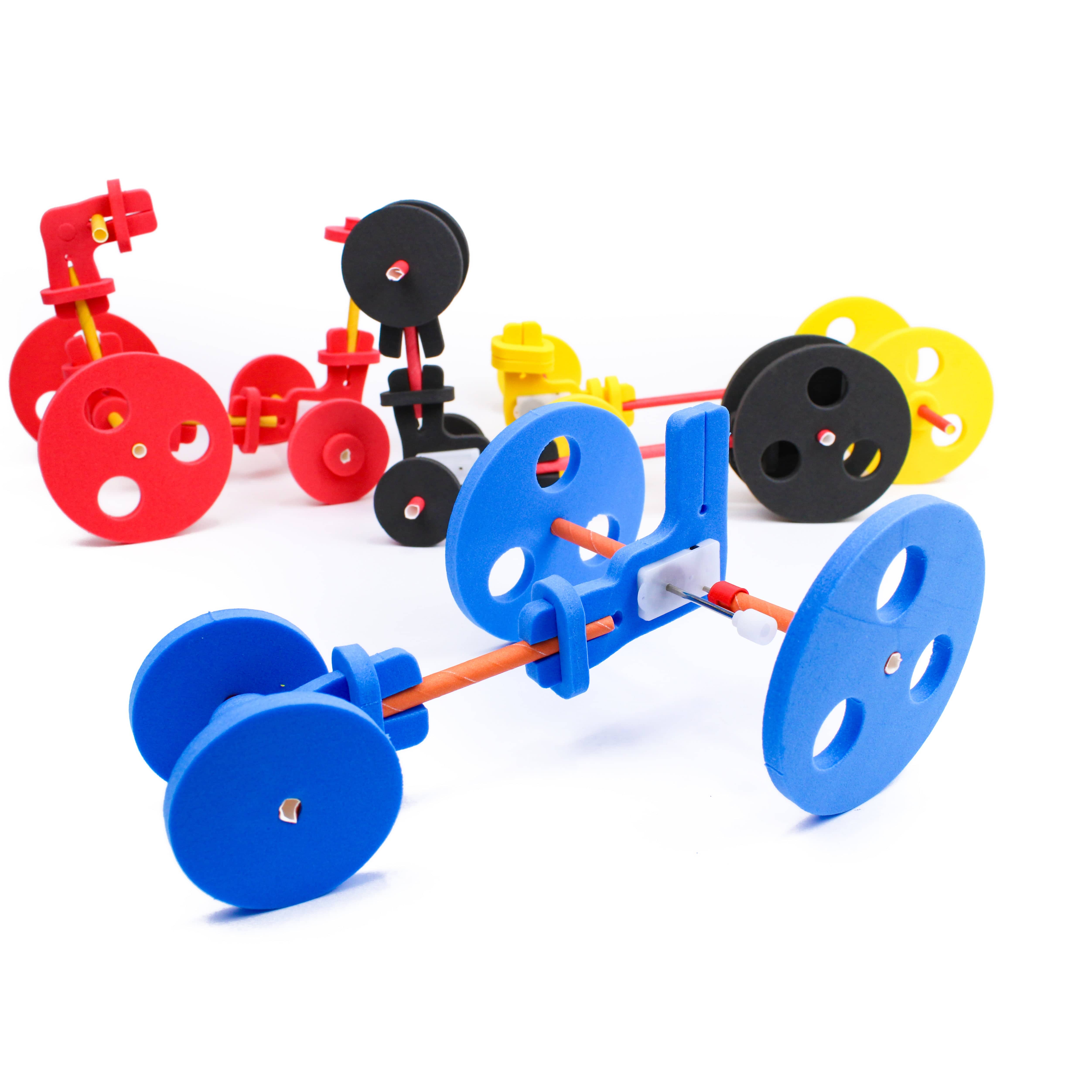
Wind-Up Vehicles has learners follow a shared basic build to attach a spring-powered wind-up mechanism, straw axles, and foam wheels into a rolling vehicle. They then take it apart and reinvent a completely original vehicle from the same reusable parts. The big idea is stored energy: FutureMakers' guide has learners explain how the wind-up mechanism stores potential energy when tightened and releases it as kinetic energy when let go, using a wedge-and-collar joint as the core mechanical skill. FutureMakers calls it the most open-ended build in the Sparks catalog. See the Wind-Up Vehicles guide for the full build.
What's included in the Wind-Up Vehicles kit?
Each Wind-Up Vehicles kit includes two foam sheets (motor holder, wheels, wedges, collars, and stoppers), a set of six paper straws for axles, one spring-powered wind-up mechanism, a printed instruction sheet, and a reclosable bag. Everything needed for the basic build and for reinventing it afterward is included; the only tool an educator needs to add is scissors, for trimming straw axles, covered in the next answer. See the full parts list.
Using it in a session
How long does a Wind-Up Vehicles session take?
A Wind-Up Vehicles session takes 30 to 45 minutes, for grades 2 through 8. That window covers building the shared basic vehicle, testing it, and starting the open-ended reinvention step. The signature Cross-Kit Combination Challenge locks two or more finished vehicles into one giant rolling machine and adds time on top of the base build. Full build steps.
How many learners does one Wind-Up Vehicles pack serve, and how should I group them?
A Wind-Up Vehicles Small Group Pack serves 10 learners and a Class Pack serves 25, with each learner building their own basic vehicle first. FutureMakers' guide then scales up with the Cross-Kit Combination Challenge, its signature extension, where learners combine their finished vehicle with two, three, or every classmate's vehicle to form one giant rolling machine. Plan one kit per learner for the base build, and regroup only for that combination challenge once every vehicle rolls. Build steps.
What does an educator need to prepare and supply for Wind-Up Vehicles?
The educator needs to supply scissors, for trimming straw axles to length or cutting off a bent or mushy end. A flat runway or ramp, masking tape or chalk for race lanes, and a timer are optional extras for racing or a wheel-diameter experiment, not required for the core build. Everything else, the foam parts, straws, and wind-up mechanism, comes in the kit. Prep takes about 5 to 10 minutes, per the product listing. Full prep list.
What does a first successful Wind-Up Vehicles build look like?
A first successful Wind-Up Vehicles build is a four-wheeled basic vehicle that rolls forward, or even backward, across the floor on a single wind of the spring motor. FutureMakers' guide names winding the motor, releasing it, and watching the vehicle roll as the target before learners move to reinvention or a design challenge. A vehicle that rolls backward isn't a mistake; the guide treats it as a quick fix, not a failure. See the guide's stand-alone goals.
What are the most common problems and fixes with Wind-Up Vehicles?
Three problems come up most with Wind-Up Vehicles. The vehicle won't roll at all: check whether a collar is dragging on the ground, whether the straw is seated in its wedge, and whether the motor was wound far enough to hear clicks. The vehicle rolls backward: that isn't a failure, so lift the wind-up mechanism out and re-seat it facing the other way. The axle wobbles or the vehicle leans: slide the wheels inward toward the motor for stability and trim excess straw length. Full troubleshooting is in the Wind-Up Vehicles guide's troubleshooting section.
What extensions can I offer early finishers or older learners with Wind-Up Vehicles?
Early finishers can take on a Design Challenge built around a single constraint: two wheels only, the smallest possible vehicle, or the most parts used. A Convertible Racer challenges learners to build a vehicle with two distinct modes that both roll forward. Older or more ambitious learners can run the signature Cross-Kit Combination Challenge, locking several finished vehicles into one giant rolling machine, or set up a wheel-diameter experiment with a ramp and timed trials. FutureMakers' guide says trying something that fails is how you learn. Extension instructions.
Standards and skills
What academic standards does Wind-Up Vehicles align to?
Wind-Up Vehicles' guide documents Next Generation Science Standards (NGSS) codes from kindergarten through middle school, including K-PS2-1, K-2-ETS1-2, 3-PS2-1, 3-5-ETS1-3, MS-PS3-5, and MS-ETS1-3. It also documents Common Core codes in both ELA and Math across the same grade bands, with a distance-and-rate thread given the racing and combination challenges; see the table below for the full list. The guide lists NGSS and Common Core codes. It doesn't list CASEL codes.
Where can I find the full Wind-Up Vehicles guide and video?
Every code below appears on the Wind-Up Vehicles guide.
Standard
Code
What it covers
NGSS
K-PS2-1
Motion and Stability: Forces and Interactions
NGSS
K-2-ETS1-2
Develop a simple sketch, drawing, or physical model
NGSS
3-PS2-1
Forces and Interactions
NGSS
3-5-ETS1-3
Plan and carry out fair tests to identify failure points
NGSS
MS-PS3-5
Energy Transfer: Construct an explanation of energy transfer
NGSS
MS-ETS1-3
Analyze data from tests to determine similarities and differences among competing solutions
Common Core ELA
RI.K-2.7
Use illustrations and words in a text to describe key ideas
Common Core ELA
SL.K-2.1
Participate in collaborative conversations
Common Core ELA
RI.3-5.3
Explain relationships between concepts in a text
Common Core ELA
W.3-5.2
Write informative/explanatory texts to examine a topic
Common Core ELA
RST.6-8.3
Follow a multistep procedure when carrying out experiments
Common Core ELA
SL.6-8.1
Engage in collaborative discussions with diverse partners
Common Core Math
2.MD.A.1
Measure the length of an object
Common Core Math
K.G.A.1
Describe objects using names of shapes and relative positions
Common Core Math
3.MD.B.4
Generate measurement data by measuring lengths
Common Core Math
4.MD.A.2
Use the four operations to solve word problems involving distances
Common Core Math
6.RP.A.3
Use ratio and rate reasoning to solve real-world problems
Common Core Math
7.SP.B.4
Use measures of center to draw informal comparative inferences about two populations
Who uses it and how
Do after-school and parks and recreation programs use Wind-Up Vehicles?
Yes. County recreation programs pair Wind-Up Vehicles with Electric Vehicles for a "things that move" theme, and some have expanded their orders to additional sites on their own initiative. The free coaching slides are built so non-specialist after-school staff can run the build without a science background. See the after-school and summer answers page for more on how this segment buys.
<script type="application/ld+json">{"@context": "https://schema.org", "@type": "FAQPage", "mainEntity": [{"@type": "Question", "name": "Which Wind-Up Vehicles pack should I buy?", "acceptedAnswer": {"@type": "Answer", "text": "For one learner, the Single Learner Pack costs $8.95. For a class or program, the Small Group Pack of 10 costs $59.50, or $5.95 per learner, and the Class Pack of 25 costs $105.00, or $4.20 per learner. Small Group and Class Pack orders both qualify for purchase orders and tax-exempt purchasing; check \"Our organization is tax-exempt\" in the quote builder and enter your tax ID number, or submit your tax ID number and a tax-exempt certificate through a free store account if buying directly."}}, {"@type": "Question", "name": "Are there bundle options for Wind-Up Vehicles?", "acceptedAnswer": {"@type": "Answer", "text": "Yes. FutureMakers sells three Wind-Up bundles, each pairing Wind-Up Vehicles with Hypnotizers and Flying Machines. The Wind-Up Family Bundle ($26.85) gives one of each Spark, the Wind-Up Small Group Bundle ($188.50) gives 10 of each, and the Wind-Up Bulk Bundle ($332.00) gives 25 of each. Family Bundle , Small Group Bundle , and Bulk Bundle are all live."}}, {"@type": "Question", "name": "Can I try Wind-Up Vehicles before I buy a class set?", "acceptedAnswer": {"@type": "Answer", "text": "Yes. FutureMakers offers a free sample program at kidsmakethingsbetter.com/samples , and you can ask for Wind-Up Vehicles by name when you request yours. A paid Single Learner Pack ($8.95) also lets you test the build yourself before ordering a class set."}}, {"@type": "Question", "name": "Can I use a purchase order or tax-exempt status to buy Wind-Up Vehicles?", "acceptedAnswer": {"@type": "Answer", "text": "Yes. Wind-Up Vehicles Small Group and Class Pack orders qualify for purchase orders on Net 30 terms and for tax-exempt purchasing, the same as every FutureMakers Spark. See the full how to buy FAQ for purchase order terms, vendor paperwork, and the tax-exempt steps."}}, {"@type": "Question", "name": "What do learners make with Wind-Up Vehicles and what's the big idea?", "acceptedAnswer": {"@type": "Answer", "text": "Wind-Up Vehicles has learners follow a shared basic build to attach a spring-powered wind-up mechanism, straw axles, and foam wheels into a rolling vehicle. They then take it apart and reinvent a completely original vehicle from the same reusable parts. The big idea is stored energy: FutureMakers' guide has learners explain how the wind-up mechanism stores potential energy when tightened and releases it as kinetic energy when let go, using a wedge-and-collar joint as the core mechanical skill. FutureMakers calls it the most open-ended build in the Sparks catalog. See the Wind-Up Vehicles guide for the full build."}}, {"@type": "Question", "name": "What's included in the Wind-Up Vehicles kit?", "acceptedAnswer": {"@type": "Answer", "text": "Each Wind-Up Vehicles kit includes two foam sheets (motor holder, wheels, wedges, collars, and stoppers), a set of six paper straws for axles, one spring-powered wind-up mechanism, a printed instruction sheet, and a reclosable bag. Everything needed for the basic build and for reinventing it afterward is included; the only tool an educator needs to add is scissors, for trimming straw axles, covered in the next answer. See the full parts list ."}}, {"@type": "Question", "name": "How long does a Wind-Up Vehicles session take?", "acceptedAnswer": {"@type": "Answer", "text": "A Wind-Up Vehicles session takes 30 to 45 minutes, for grades 2 through 8. That window covers building the shared basic vehicle, testing it, and starting the open-ended reinvention step. The signature Cross-Kit Combination Challenge locks two or more finished vehicles into one giant rolling machine and adds time on top of the base build. Full build steps ."}}, {"@type": "Question", "name": "How many learners does one Wind-Up Vehicles pack serve, and how should I group them?", "acceptedAnswer": {"@type": "Answer", "text": "A Wind-Up Vehicles Small Group Pack serves 10 learners and a Class Pack serves 25, with each learner building their own basic vehicle first. FutureMakers' guide then scales up with the Cross-Kit Combination Challenge, its signature extension, where learners combine their finished vehicle with two, three, or every classmate's vehicle to form one giant rolling machine. Plan one kit per learner for the base build, and regroup only for that combination challenge once every vehicle rolls. Build steps ."}}, {"@type": "Question", "name": "What does an educator need to prepare and supply for Wind-Up Vehicles?", "acceptedAnswer": {"@type": "Answer", "text": "The educator needs to supply scissors, for trimming straw axles to length or cutting off a bent or mushy end. A flat runway or ramp, masking tape or chalk for race lanes, and a timer are optional extras for racing or a wheel-diameter experiment, not required for the core build. Everything else, the foam parts, straws, and wind-up mechanism, comes in the kit. Prep takes about 5 to 10 minutes, per the product listing. Full prep list ."}}, {"@type": "Question", "name": "What does a first successful Wind-Up Vehicles build look like?", "acceptedAnswer": {"@type": "Answer", "text": "A first successful Wind-Up Vehicles build is a four-wheeled basic vehicle that rolls forward, or even backward, across the floor on a single wind of the spring motor. FutureMakers' guide names winding the motor, releasing it, and watching the vehicle roll as the target before learners move to reinvention or a design challenge. A vehicle that rolls backward isn't a mistake; the guide treats it as a quick fix, not a failure. See the guide's stand-alone goals ."}}, {"@type": "Question", "name": "What are the most common problems and fixes with Wind-Up Vehicles?", "acceptedAnswer": {"@type": "Answer", "text": "Three problems come up most with Wind-Up Vehicles. The vehicle won't roll at all: check whether a collar is dragging on the ground, whether the straw is seated in its wedge, and whether the motor was wound far enough to hear clicks. The vehicle rolls backward: that isn't a failure, so lift the wind-up mechanism out and re-seat it facing the other way. The axle wobbles or the vehicle leans: slide the wheels inward toward the motor for stability and trim excess straw length. Full troubleshooting is in the Wind-Up Vehicles guide's troubleshooting section ."}}, {"@type": "Question", "name": "What extensions can I offer early finishers or older learners with Wind-Up Vehicles?", "acceptedAnswer": {"@type": "Answer", "text": "Early finishers can take on a Design Challenge built around a single constraint: two wheels only, the smallest possible vehicle, or the most parts used. A Convertible Racer challenges learners to build a vehicle with two distinct modes that both roll forward. Older or more ambitious learners can run the signature Cross-Kit Combination Challenge, locking several finished vehicles into one giant rolling machine, or set up a wheel-diameter experiment with a ramp and timed trials. FutureMakers' guide says trying something that fails is how you learn. Extension instructions ."}}, {"@type": "Question", "name": "What academic standards does Wind-Up Vehicles align to?", "acceptedAnswer": {"@type": "Answer", "text": "Wind-Up Vehicles' guide documents Next Generation Science Standards (NGSS) codes from kindergarten through middle school, including K-PS2-1, K-2-ETS1-2, 3-PS2-1, 3-5-ETS1-3, MS-PS3-5, and MS-ETS1-3. It also documents Common Core codes in both ELA and Math across the same grade bands, with a distance-and-rate thread given the racing and combination challenges; see the table below for the full list. The guide lists NGSS and Common Core codes. It doesn't list CASEL codes."}}, {"@type": "Question", "name": "Where can I find the full Wind-Up Vehicles guide and video?", "acceptedAnswer": {"@type": "Answer", "text": "The complete Wind-Up Vehicles build guide, with every step photographed and troubleshooting for 5 common problems, is free at kidsmakethingsbetter.com/inst/wind-up-vehicles . A companion coaching video walks through the same build; watch it on YouTube at Wind-Up Vehicles: Build Spring-Powered Vehicles | Hands-On STEM Activity . Both are free to view without an account; a free FutureMakers educator account also opens a slide deck and coaching tutorial through Coach with Sparks ."}}, {"@type": "Question", "name": "Do after-school and parks and recreation programs use Wind-Up Vehicles?", "acceptedAnswer": {"@type": "Answer", "text": "Yes. County recreation programs pair Wind-Up Vehicles with Electric Vehicles for a \"things that move\" theme, and some have expanded their orders to additional sites on their own initiative. The free coaching slides are built so non-specialist after-school staff can run the build without a science background. See the after-school and summer answers page for more on how this segment buys."}}]}</script>