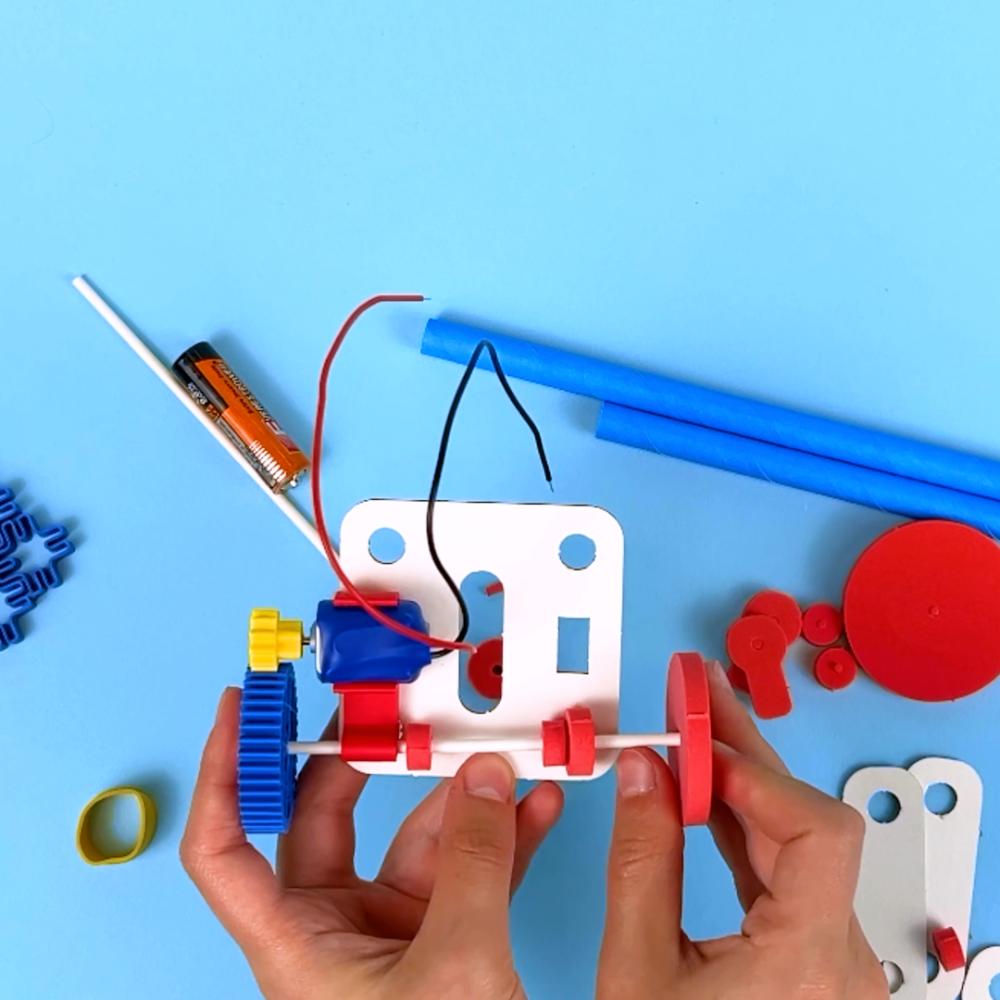
FutureMakers Electric Vehicles has learners assemble a working electric circuit, build a wheeled platform around it, then swap the battery wires to reverse direction and discover polarity.
Last reviewed September 24, 2026
How to buy
Which Electric Vehicles pack should I buy?
For one learner, the Single Learner Pack costs $8.95. For a class or program, the Small Group Pack of 10 costs $69.50, or $6.95 per learner, and the Class Pack of 25 costs $122.00, or $4.88 per learner. Small Group and Class Pack orders both qualify for purchase orders and tax-exempt purchasing; check "Our organization is tax-exempt" in the quote builder and enter your tax ID number, or submit your tax ID number and a tax-exempt certificate through a free store account if buying directly.
Can I try Electric Vehicles before I buy a class set?
Yes. FutureMakers offers a free sample program at kidsmakethingsbetter.com/samples, and you can ask for Electric Vehicles by name when you request yours. A paid Single Learner Pack ($8.95) also lets you test the build yourself before ordering a class set.
Can I use a purchase order or tax-exempt status to buy Electric Vehicles?
Yes. Electric Vehicles Small Group and Class Pack orders qualify for purchase orders on Net 30 terms and for tax-exempt purchasing, the same as every FutureMakers Spark. See the full how to buy FAQ for purchase order terms, vendor paperwork, and the tax-exempt steps.
About the project
What do learners make with Electric Vehicles, and what's the big idea?
FutureMakers Electric Vehicles has learners assemble a working electric circuit from a battery, motor, and gears, then build a wheeled cardboard platform around it. Swapping the battery wires reverses the vehicle's direction, the moment learners discover polarity for themselves. It's the only Spark where a learner closes a real circuit and feels a motor spin gears they just installed, covering circuits, gear trains, polarity, and the chain of energy from chemical to electrical to mechanical to kinetic. Read the full Electric Vehicles guide for the complete build sequence.
Where can I find the full Electric Vehicles guide and video?
The full Electric Vehicles educator guide, including build photos, standards codes, and troubleshooting, is free and public at the Electric Vehicles guide page, no login required. A video walkthrough of the same build is on YouTube: Electric Vehicles: Build Motorized Cars. A separate coaching video and slide deck are available with a free educator account at coach-with-sparks.
Using it in a session
How long does an Electric Vehicles session take?
Plan for 45 to 60 minutes, enough time for a learner to go from parts to a running car and test it. See the guide's prep notes before scheduling a session.
How many learners does an Electric Vehicles pack serve, and do they build alone or together?
Electric Vehicles comes in a Single Learner Pack, a Small Group Pack of 10, and a Class Pack of 25. Each learner builds and keeps their own vehicle individually, and the Vehicle Combination Challenge extension has one or two classmates combine multiple finished vehicles into a single larger vehicle. See the build steps for the individual build before combining.
What does an educator need to prepare and supply for Electric Vehicles?
An educator should pre-teach the circuit concept, which wire is positive and which battery end is positive, before building, since that single explanation makes the Connect the Battery step several times faster. Building one vehicle ahead of time using the slide deck also helps, and detaching a wire before storing a partly built project keeps the battery from draining overnight. The only added supply is scissors, which the guide calls highly recommended. Prep takes about 5 to 10 minutes, per the product listing. Full prep notes are in the guide.
What does a first successful Electric Vehicles build look like?
A first successful Electric Vehicles build has the first axle's gear wheel meshing with the motor gear and the battery connected under the rubber band. Once both connections are made, the motor spins the wheels and the vehicle rolls across a flat surface on its own. A vehicle that rolls backward instead of forward is not a failure, it is a live polarity lesson, fixed by swapping the two wires under the battery band.
What are the most common Electric Vehicles problems and fixes?
The three most common Electric Vehicles problems are a motor that will not spin at all, a motor that spins but the wheels do not turn, and a battery band that keeps slipping off. Check both wire ends are pressed firmly against the battery terminals and confirm battery orientation for a still motor; push the foam bearing up or down until the gear teeth catch if the wheels do not turn; and stretch the battery band wider before seating it and tucking the wires underneath, which may take two or three tries. See the full troubleshooting guide for every fix.
How can I extend Electric Vehicles for early finishers or older learners?
Early finishers can try the Smallest Vehicle Challenge or the Three-Wheel Challenge, both of which push learners to rebuild with fewer parts while keeping the vehicle running. Older learners can take on the Circle-Driving Challenge, adjusting wheel size or motor placement to make the vehicle drive in a controlled circle, or the Vehicle Combination Challenge, joining two or three vehicles into one. The guide lists all six extensions.
Standards and skills
What academic standards does Electric Vehicles meet?
Electric Vehicles carries NGSS energy-transfer and engineering-design codes for grades 3 through 8, plus Common Core reading, speaking, and math codes on angles and ratios, all printed on the Electric Vehicles standards page. Unlike most other Sparks, Electric Vehicles has no kindergarten-through-grade-2 standards band; its codes start at grade 3. The guide does not carry CASEL or any state-specific social-emotional-learning codes for this Spark; only NGSS and Common Core alignments are documented.
What vocabulary and skills does Electric Vehicles build?
Electric Vehicles introduces circuit vocabulary, open and closed circuit, polarity, gear mesh, axle, bearing, and bushing, used correctly as learners wire, test, and troubleshoot their own vehicle. The guide explicitly frames failure as part of the process, reminding educators to tell learners it is okay to fail and try again since that is the whole point of iteration. Every Spark is individually packed so each learner keeps what they build.
Electric Vehicles standards codes
Codes as printed on the Electric Vehicles guide. This Spark has no K-2 standards band. No CASEL or state-specific codes are documented.
Framework
Code
What it covers
NGSS
4-PS3-2
Energy Transfer: make observations about energy transfer
NGSS
3-5-ETS1-3
Plan and carry out fair tests to identify failure points
NGSS
MS-PS3-5
Construct an explanation of energy transfer
NGSS
MS-ETS1-3
Analyze data to compare design solutions
Common Core ELA
RI.3-5.7
Interpret information presented visually
Common Core ELA
SL.3-5.1
Engage effectively in collaborative discussions
Common Core ELA
RST.6-8.3
Follow a multistep procedure when carrying out experiments
Common Core ELA
SL.6-8.1
Engage in discussions with diverse partners
Common Core Math
4.G.A.2
Classify two-dimensional figures by lines and angles
Common Core Math
4.G.A.1
Draw and identify lines and angles, and classify shapes
Common Core Math
6.RP.A.1
Understand ratio concepts and reasoning
Common Core Math
7.RP.A.2
Recognize and represent proportional relationships
Who uses it and how
Do after-school and parks and recreation programs use Electric Vehicles?
Yes. County recreation programs pair Electric Vehicles with Wind-Up Vehicles for a "things that move" theme, and some have expanded their orders to additional sites on their own initiative. The free coaching slides are built so non-specialist staff can lead the build. See how after-school and camp programs use Sparks for more.
<script type="application/ld+json">{"@context": "https://schema.org", "@type": "FAQPage", "mainEntity": [{"@type": "Question", "name": "Which Electric Vehicles pack should I buy?", "acceptedAnswer": {"@type": "Answer", "text": "For one learner, the Single Learner Pack costs $8.95. For a class or program, the Small Group Pack of 10 costs $69.50, or $6.95 per learner, and the Class Pack of 25 costs $122.00, or $4.88 per learner. Small Group and Class Pack orders both qualify for purchase orders and tax-exempt purchasing; check \"Our organization is tax-exempt\" in the quote builder and enter your tax ID number, or submit your tax ID number and a tax-exempt certificate through a free store account if buying directly."}}, {"@type": "Question", "name": "Can I try Electric Vehicles before I buy a class set?", "acceptedAnswer": {"@type": "Answer", "text": "Yes. FutureMakers offers a free sample program at kidsmakethingsbetter.com/samples , and you can ask for Electric Vehicles by name when you request yours. A paid Single Learner Pack ($8.95) also lets you test the build yourself before ordering a class set."}}, {"@type": "Question", "name": "Can I use a purchase order or tax-exempt status to buy Electric Vehicles?", "acceptedAnswer": {"@type": "Answer", "text": "Yes. Electric Vehicles Small Group and Class Pack orders qualify for purchase orders on Net 30 terms and for tax-exempt purchasing, the same as every FutureMakers Spark. See the full how to buy FAQ for purchase order terms, vendor paperwork, and the tax-exempt steps."}}, {"@type": "Question", "name": "What do learners make with Electric Vehicles, and what's the big idea?", "acceptedAnswer": {"@type": "Answer", "text": "FutureMakers Electric Vehicles has learners assemble a working electric circuit from a battery, motor, and gears, then build a wheeled cardboard platform around it. Swapping the battery wires reverses the vehicle's direction, the moment learners discover polarity for themselves. It's the only Spark where a learner closes a real circuit and feels a motor spin gears they just installed, covering circuits, gear trains, polarity, and the chain of energy from chemical to electrical to mechanical to kinetic. Read the full Electric Vehicles guide for the complete build sequence."}}, {"@type": "Question", "name": "Where can I find the full Electric Vehicles guide and video?", "acceptedAnswer": {"@type": "Answer", "text": "The full Electric Vehicles educator guide, including build photos, standards codes, and troubleshooting, is free and public at the Electric Vehicles guide page , no login required. A video walkthrough of the same build is on YouTube: Electric Vehicles: Build Motorized Cars . A separate coaching video and slide deck are available with a free educator account at coach-with-sparks ."}}, {"@type": "Question", "name": "How long does an Electric Vehicles session take?", "acceptedAnswer": {"@type": "Answer", "text": "Plan for 45 to 60 minutes, enough time for a learner to go from parts to a running car and test it. See the guide's prep notes before scheduling a session."}}, {"@type": "Question", "name": "How many learners does an Electric Vehicles pack serve, and do they build alone or together?", "acceptedAnswer": {"@type": "Answer", "text": "Electric Vehicles comes in a Single Learner Pack, a Small Group Pack of 10, and a Class Pack of 25. Each learner builds and keeps their own vehicle individually, and the Vehicle Combination Challenge extension has one or two classmates combine multiple finished vehicles into a single larger vehicle. See the build steps for the individual build before combining."}}, {"@type": "Question", "name": "What does an educator need to prepare and supply for Electric Vehicles?", "acceptedAnswer": {"@type": "Answer", "text": "An educator should pre-teach the circuit concept, which wire is positive and which battery end is positive, before building, since that single explanation makes the Connect the Battery step several times faster. Building one vehicle ahead of time using the slide deck also helps, and detaching a wire before storing a partly built project keeps the battery from draining overnight. The only added supply is scissors, which the guide calls highly recommended. Prep takes about 5 to 10 minutes, per the product listing. Full prep notes are in the guide ."}}, {"@type": "Question", "name": "What does a first successful Electric Vehicles build look like?", "acceptedAnswer": {"@type": "Answer", "text": "A first successful Electric Vehicles build has the first axle's gear wheel meshing with the motor gear and the battery connected under the rubber band. Once both connections are made, the motor spins the wheels and the vehicle rolls across a flat surface on its own. A vehicle that rolls backward instead of forward is not a failure, it is a live polarity lesson, fixed by swapping the two wires under the battery band."}}, {"@type": "Question", "name": "What are the most common Electric Vehicles problems and fixes?", "acceptedAnswer": {"@type": "Answer", "text": "The three most common Electric Vehicles problems are a motor that will not spin at all, a motor that spins but the wheels do not turn, and a battery band that keeps slipping off. Check both wire ends are pressed firmly against the battery terminals and confirm battery orientation for a still motor; push the foam bearing up or down until the gear teeth catch if the wheels do not turn; and stretch the battery band wider before seating it and tucking the wires underneath, which may take two or three tries. See the full troubleshooting guide for every fix."}}, {"@type": "Question", "name": "How can I extend Electric Vehicles for early finishers or older learners?", "acceptedAnswer": {"@type": "Answer", "text": "Early finishers can try the Smallest Vehicle Challenge or the Three-Wheel Challenge, both of which push learners to rebuild with fewer parts while keeping the vehicle running. Older learners can take on the Circle-Driving Challenge, adjusting wheel size or motor placement to make the vehicle drive in a controlled circle, or the Vehicle Combination Challenge, joining two or three vehicles into one. The guide lists all six extensions ."}}, {"@type": "Question", "name": "What academic standards does Electric Vehicles meet?", "acceptedAnswer": {"@type": "Answer", "text": "Electric Vehicles carries NGSS energy-transfer and engineering-design codes for grades 3 through 8, plus Common Core reading, speaking, and math codes on angles and ratios, all printed on the Electric Vehicles standards page . Unlike most other Sparks, Electric Vehicles has no kindergarten-through-grade-2 standards band; its codes start at grade 3. The guide does not carry CASEL or any state-specific social-emotional-learning codes for this Spark; only NGSS and Common Core alignments are documented."}}, {"@type": "Question", "name": "What vocabulary and skills does Electric Vehicles build?", "acceptedAnswer": {"@type": "Answer", "text": "Electric Vehicles introduces circuit vocabulary, open and closed circuit, polarity, gear mesh, axle, bearing, and bushing, used correctly as learners wire, test, and troubleshoot their own vehicle. The guide explicitly frames failure as part of the process, reminding educators to tell learners it is okay to fail and try again since that is the whole point of iteration. Every Spark is individually packed so each learner keeps what they build."}}, {"@type": "Question", "name": "Do after-school and parks and recreation programs use Electric Vehicles?", "acceptedAnswer": {"@type": "Answer", "text": "Yes. County recreation programs pair Electric Vehicles with Wind-Up Vehicles for a \"things that move\" theme, and some have expanded their orders to additional sites on their own initiative. The free coaching slides are built so non-specialist staff can lead the build. See how after-school and camp programs use Sparks for more."}}]}</script>