FutureMakers Sparks for After-School, Camp, and Parks and Recreation Programs
FutureMakers Sparks for After-School, Camp, and Parks and Recreation Programs
FutureMakers Sparks are screen-free, individually packed STEM kits built for after-school staff, summer camp counselors, and parks and recreation programs to lead without a science background. A non-specialist staffer leads a 20 to 60 minute session with a free video and slide deck, and county recreation programs have reordered them across multiple seasons.
Last reviewed September 24, 2026
How to buy
Can I buy fewer than 10 of a Spark instead of a full Small Group Pack?
Yes. The answer is the $8.95 Single Learner Pack, sold one at a time in the Single Spark Packs collection, with no 10-unit minimum. For an in-between number like 12, buying one Small Group Pack of 10 plus two singles (for example, $69.50 + $8.95 + $8.95 = $87.40 for Straw Structures) is usually cheaper than 12 singles outright ($107.40). Run the math for your own count and Spark before ordering.
How do I use the order form on the website?
The order form is FutureMakers' quote builder at kidsmakethingsbetter.com/quote. Tell it about your program, adjust quantities in a line-item editor, and get a PDF quote to forward to purchasing. See the full how to buy FAQ for the complete step-by-step and every payment option.
Does FutureMakers accept purchase orders and tax-exempt purchases for a county recreation department?
Yes. The instant quote builder generates a PDF quote in about two minutes with Net 30 payment terms, a 5 percent discount for paying by card, purchasing card, or ACH, and a 90-day validity window, so a purchasing admin can cut a PO against it with no salesperson involved. Getting a quote: check "Our organization is tax-exempt" in the Purchasing Information section and enter your tax ID number. Buying directly in the store: create a free account and submit your tax ID number with a tax-exempt certificate for review. See the full how to buy FAQ for purchase order terms, vendor paperwork, and every payment option.
What a session looks like on your team
Can a part-time counselor or camp staffer lead a FutureMakers Spark without STEM training?
Yes. Every FutureMakers Spark comes with a tutorial video and an illustrated slide deck built for a non-specialist to lead cold, free at coach-with-sparks. County recreation programs have run Sparks this way across multiple sites using the free coaching slides. Training isn't a guarantee, though: even after an in-person session, some staff may not feel confident leading a program alone, so plan a dry run before your first live session.
What does a Spark session actually look like, minute by minute?
A typical FutureMakers Spark session runs 30 to 45 minutes: a short video or slide intro, then each kid builds their own kit at their own pace. Staff circulate instead of lecturing, since every Spark ships individually packed and the guide's own troubleshooting steps are written for a staffer to walk a stuck kid through a fix without stopping the room. See the run of show below, and the full Straw Structures guide for one real example.
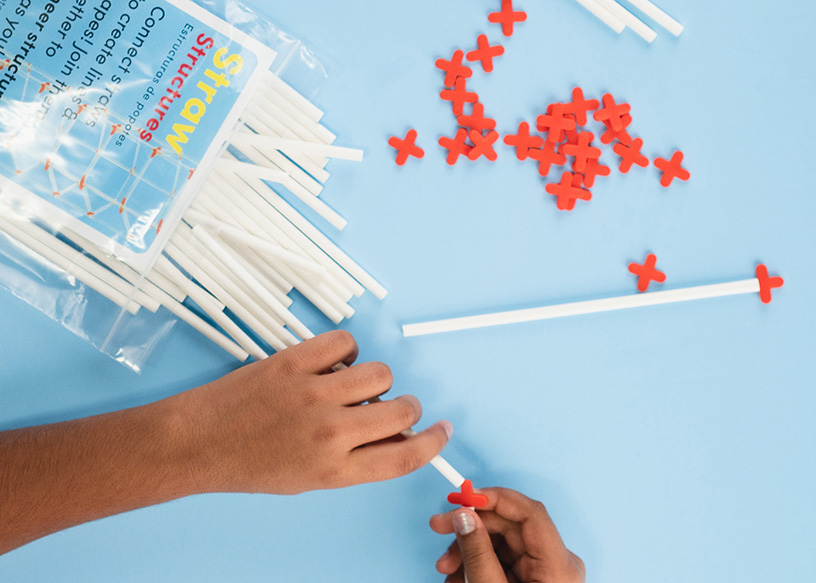
A Straw Structures build in progress: no group materials to divide, since each kit is individually packed.
How do I lead one activity for a room with both 6-year-olds and 12-year-olds?
Pick a Spark that FutureMakers already differentiates by grade band inside one guide, like Straw Structures or Mazes. Straw Structures covers Pre-K through Kindergarten, 1st through 3rd, and 4th through 8th bands, so younger kids finish the base build while older kids move into built-in extensions, like combining towers into a team "Mega Structure." That built-in range means one Spark purchase can cover a mixed-age room instead of buying a separate activity for every age group.
What if I only have one staff member for 20 or more kids?
Because every FutureMakers Spark is individually packed, each kid builds their own kit in parallel instead of waiting on shared materials or a rotation, which is what lets one staffer lead a large group. County recreation departments have bought many different Sparks in a single countywide order, and camp and after-school programs order across several Sparks at once. For an especially large room, pick a Spark with a short troubleshooting list, like Straw Structures or Wind-Up Vehicles, so a stuck kid needs less of your one staffer's time.
What staff-to-child ratio is a FutureMakers Spark session actually built for?
FutureMakers doesn't publish or test for a specific staff-to-child supervision ratio. What is real: every Spark is a 1:1 build, one individually packed kit per learner, so kids build in parallel instead of waiting on shared materials, which is how a single staffer can lead a group of 20 or more. That's a kit ratio, not a supervision ratio. Your program's own licensing, contract, or grant rules still set the actual staffing minimum for the room, and having a Spark on the schedule doesn't change what those rules require.
Planning a week or a summer of Sparks
How do I plan a week of camp themes using FutureMakers Sparks?
Group Sparks by the skill or theme you want that week, the way real buyers already do. Recreation programs have built a rollout around two vehicle Sparks, Electric Vehicles and Wind-Up Vehicles, a "things that move" week, and others have mixed several different Sparks into one order for variety across a season. Either approach works: go deep on one theme, or mix a few Sparks so each day feels different.
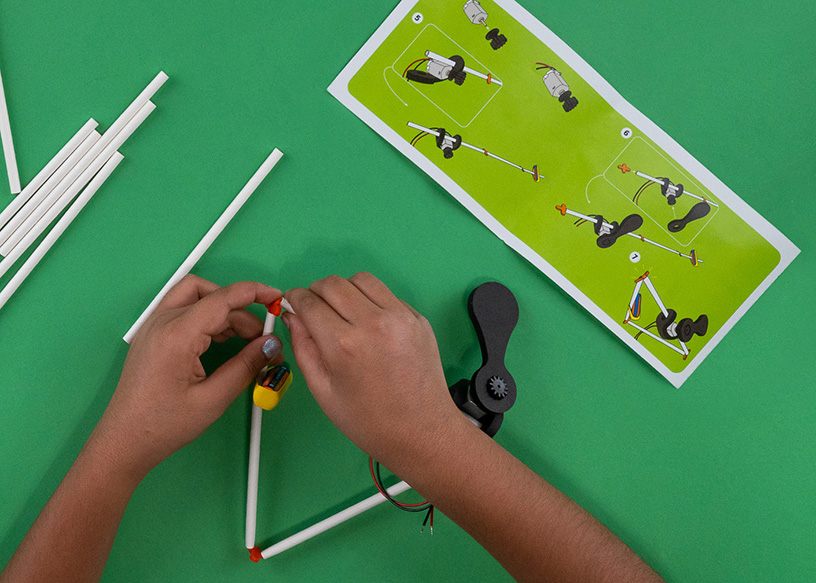
Electric Vehicles: one half of a two-Spark vehicle week.
Which Sparks work well for a full summer of camp programming?
FutureMakers keeps a running Summer Camp Favorites collection of Sparks picked for camp settings, alongside a dedicated After-School Programs collection for the school-year side of the same job. Both draw from the same 17-Spark catalogue, so a program that buys for camp in July can reorder the identical kits for its fall after-school cycle.
How do I know which Spark fits which age group and how long it takes?
FutureMakers publishes an age range and a session length on every product listing. They vary enough to matter for planning: Wind-Up Vehicles runs 30 to 45 minutes for grades 2 through 8, Straw Structures runs 30 to 60 minutes for Pre-K through 8th grade, and Crankie Contraptions runs 45 to 60 minutes for lower elementary through middle school. The table below covers all 17 Sparks.
How much prep time does a Spark take before I lead it?
Prep varies by Spark, but the low end is genuinely low: Straw Structures needs nothing beyond scissors and a ruler already in the room. The high end still fits inside a normal planning period: Electric Vehicles works best if a staffer pre-teaches the idea of a circuit and builds one first using the slide deck, since that step "makes the Connect the Battery step much faster" for the group. Either way, FutureMakers recommends every Spark leader build one Spark before the session using the free video or slide deck at coach-with-sparks.
Can I use the same kits for summer camp and then again for the fall after-school program?
Yes. Programs that run both camp and after-school have bought Sparks for summer campers and then reordered for the fall after-school cycle. A Spark kit doesn't expire or need a season-specific version, so unopened stock or extras from a summer order carry straight into an after-school cycle without a new purchase.
Attendance, engagement, and proof it works
Does hands-on making actually increase attendance at an after-school program or camp?
FutureMakers doesn't have a measured attendance study for camps, parks and recreation departments, or 21st CCLC sites. What does show up in the numbers: recreation programs have reordered Sparks across multiple seasons on their own initiative, a sign that families and staff keep choosing to bring the activity back.
What do kids actually take home from a Spark session?
Every FutureMakers Spark is individually packed, so each kid keeps the exact thing they built rather than a shared classroom project. FutureMakers frames this as a deliberate choice: giving kids ownership of what they make is meant to boost engagement, encourage bigger risks while building, and let the activity keep going after the session ends, at home with a parent or sibling. For a program answering to families about what their kid did that day, a real object to bring home is a concrete answer.
Each Spark ships individually packed, so what a kid builds is theirs to keep.
Is there real proof that camps and afterschool programs keep using Sparks season after season?
Yes. Recreation departments have reordered Sparks across multiple seasons on their own initiative: a program that requested samples, placed a first order, used the kits with its summer campers, and then asked to order more for its fall after-school program. This is repeat-purchase evidence from real programs, not a measured study.
Which camps, parks and recreation departments, and after-school programs actually use FutureMakers Sparks?
County parks and recreation departments, camp programs, and after-school programs buy and reorder FutureMakers Sparks, including repeat orders across seasons and multi-site expansions. These are purchasing and repeat-business relationships, not a formal case study with measured results.
What social and emotional growth looks like at the table
What social and emotional skills actually show up when a group builds Sparks together?
Social and emotional skills that show up when a group builds Sparks together include patience, persistence, and problem diagnosis, each tied to a specific moment in the build. A kid whose Straw Structures tower keeps tipping over widens the base and tries again, since the guide calls the activity "NOT a race" and says it "rewards patience and planning." A kid whose Monster Claws claw only opens partway slows down, disconnects the tube, and rebalances the two pistons before it works, real practice diagnosing a problem instead of walking away from it.
What happens when a kid's build doesn't work the first time?
When a kid's build doesn't work the first time, a FutureMakers Spark session points them to a troubleshooting step built into the guide, so the fix comes from them, not an adult. The Wind-Up Vehicles guide tells the builder up front that "it's totally okay to try something that doesn't work" and treats a vehicle rolling backward as a fix, not a failure: "lift the wind-up mechanism out and re-seat it facing the other way," which gets the vehicle rolling the right direction again. The kid ends the session with a working build, not a stuck one.
If every kid builds their own kit, where does teamwork come in?
Teamwork comes in right after each kid finishes their individual build, when several FutureMakers Sparks add a team challenge that combines everyone's separate kits into one shared object. Straw Structures lets teams combine towers to build one that reaches the ceiling, or fold every builder's kit into a single "Mega Structure." Wind-Up Vehicles has a matching "Cross-Kit Combination Challenge" where two, three, or every vehicle in the room locks together into one giant rolling machine. The negotiation over whose piece goes where happens naturally, without an adult assigning roles.
Funding and staff training
How much does a FutureMakers Spark cost per kid for a camp or after-school program?
A Class Pack of 25 runs $4.20 to $4.88 per kid, and a Small Group Pack of 10 runs $5.95 to $6.95 per kid, both live Shopify prices. Browse current prices across the full Spark catalogue.
Does a FutureMakers Spark session count as academic enrichment for a 21st CCLC Annual Performance Report?
A FutureMakers Spark is a hands-on engineering build with its own academic standards attached. Straw Structures, for example, carries NGSS code K-2-ETS1-3 (engineering design) and Common Core code K.G.A.1 (describing shapes), and every one of the 17 Sparks carries codes like these. FutureMakers hasn't mapped any Spark to a specific 21st CCLC Annual Performance Report category. Whether a session counts as academic enrichment for your program's APR is your program's own call to make with those standards codes in hand.
Can FutureMakers train our staff in person instead of just shipping a kit?
FutureMakers has delivered in-person staff training to parks and recreation departments before, including as part of a large catalogue order. This hasn't been a standing, book-anytime service, so ask about current availability through Labs and Workshops rather than assuming it ships with every order.
Are there discounts for multi-site programs or recreation departments buying at scale?
Paying by card or ACH through the quote builder gets an automatic 5 percent discount with no cap. You choose one payment method, so the two do not stack, but the discount does stack with a volume coupon before any negotiated discount. There's no separate discount rate just for buying across multiple sites. Some programs have expanded an order from one site to additional sites on their own initiative. That shows a purchase can scale across sites, not that there is an extra multi-site discount.
Is there a cheap way to test a Spark with one group before committing a chunk of my season's budget to it?
Yes. FutureMakers offers a free samples program at /samples, shipped via UPS at no cost, so a coordinator can try a Spark with one group before buying Class Packs for a full summer or season. Sample requests average about 1.3 items each, and you can name the Spark you want to test when you request one. If the sample works for your group, the same Spark scales up through the quote builder without starting over.
A 45-minute Spark session, run of show
Built from the structure every FutureMakers guide follows (a quick-start video or slide deck, guided build steps, troubleshooting, and a take-home close). Exact minutes shift with your group size and the Spark you pick; several Sparks run 45 to 60 minutes instead of 30 to 45.
0:00Set up and hand out kits
Each kid gets their own individually packed Spark kit; there are no group materials to divide.
0:05Quick-start video or slide deck
Staff play the short tutorial video or walk the slide deck instead of demonstrating the build themselves.
0:10Build time
Kids build at their own pace; staff circulate and use the guide's own troubleshooting steps for anyone stuck.
0:35Share and combine
Groups that finish early try an extension, like combining separate builds into one team challenge.
0:45Pack up to take home
Each kid packs up their own finished build to take home, since every Spark ships individually to keep.
All 17 Sparks by age range and session length
Pulled from each Spark's product listing and educator guide. Most Sparks state a time range right in the guide. For seven Sparks that range isn't written into the guide yet, so the number below comes from the product listing instead.
Spark
Best age range
Session length
Extra supplies beyond the kit
Straw Structures
Ages 4 and up (Pre-K through 8th grade, differentiated)
<script type="application/ld+json">{"@context": "https://schema.org", "@type": "FAQPage", "mainEntity": [{"@type": "Question", "name": "Can I buy fewer than 10 of a Spark instead of a full Small Group Pack?", "acceptedAnswer": {"@type": "Answer", "text": "Yes. The answer is the $8.95 Single Learner Pack, sold one at a time in the Single Spark Packs collection, with no 10-unit minimum. For an in-between number like 12, buying one Small Group Pack of 10 plus two singles (for example, $69.50 + $8.95 + $8.95 = $87.40 for Straw Structures) is usually cheaper than 12 singles outright ($107.40). Run the math for your own count and Spark before ordering."}}, {"@type": "Question", "name": "How do I use the order form on the website?", "acceptedAnswer": {"@type": "Answer", "text": "The order form is FutureMakers' quote builder at kidsmakethingsbetter.com/quote . Tell it about your program, adjust quantities in a line-item editor, and get a PDF quote to forward to purchasing. See the full how to buy FAQ for the complete step-by-step and every payment option."}}, {"@type": "Question", "name": "Does FutureMakers accept purchase orders and tax-exempt purchases for a county recreation department?", "acceptedAnswer": {"@type": "Answer", "text": "Yes. The instant quote builder generates a PDF quote in about two minutes with Net 30 payment terms, a 5 percent discount for paying by card, purchasing card, or ACH, and a 90-day validity window, so a purchasing admin can cut a PO against it with no salesperson involved. Getting a quote: check \"Our organization is tax-exempt\" in the Purchasing Information section and enter your tax ID number. Buying directly in the store: create a free account and submit your tax ID number with a tax-exempt certificate for review. See the full how to buy FAQ for purchase order terms, vendor paperwork, and every payment option."}}, {"@type": "Question", "name": "Can a part-time counselor or camp staffer lead a FutureMakers Spark without STEM training?", "acceptedAnswer": {"@type": "Answer", "text": "Yes. Every FutureMakers Spark comes with a tutorial video and an illustrated slide deck built for a non-specialist to lead cold, free at coach-with-sparks . County recreation programs have run Sparks this way across multiple sites using the free coaching slides. Training isn't a guarantee, though: even after an in-person session, some staff may not feel confident leading a program alone, so plan a dry run before your first live session."}}, {"@type": "Question", "name": "What does a Spark session actually look like, minute by minute?", "acceptedAnswer": {"@type": "Answer", "text": "A typical FutureMakers Spark session runs 30 to 45 minutes: a short video or slide intro, then each kid builds their own kit at their own pace. Staff circulate instead of lecturing, since every Spark ships individually packed and the guide's own troubleshooting steps are written for a staffer to walk a stuck kid through a fix without stopping the room. See the run of show below, and the full Straw Structures guide for one real example."}}, {"@type": "Question", "name": "How do I lead one activity for a room with both 6-year-olds and 12-year-olds?", "acceptedAnswer": {"@type": "Answer", "text": "Pick a Spark that FutureMakers already differentiates by grade band inside one guide, like Straw Structures or Mazes. Straw Structures covers Pre-K through Kindergarten, 1st through 3rd, and 4th through 8th bands, so younger kids finish the base build while older kids move into built-in extensions, like combining towers into a team \"Mega Structure.\" That built-in range means one Spark purchase can cover a mixed-age room instead of buying a separate activity for every age group."}}, {"@type": "Question", "name": "What if I only have one staff member for 20 or more kids?", "acceptedAnswer": {"@type": "Answer", "text": "Because every FutureMakers Spark is individually packed, each kid builds their own kit in parallel instead of waiting on shared materials or a rotation, which is what lets one staffer lead a large group. County recreation departments have bought many different Sparks in a single countywide order, and camp and after-school programs order across several Sparks at once. For an especially large room, pick a Spark with a short troubleshooting list, like Straw Structures or Wind-Up Vehicles, so a stuck kid needs less of your one staffer's time."}}, {"@type": "Question", "name": "What staff-to-child ratio is a FutureMakers Spark session actually built for?", "acceptedAnswer": {"@type": "Answer", "text": "FutureMakers doesn't publish or test for a specific staff-to-child supervision ratio. What is real: every Spark is a 1:1 build, one individually packed kit per learner, so kids build in parallel instead of waiting on shared materials, which is how a single staffer can lead a group of 20 or more. That's a kit ratio, not a supervision ratio. Your program's own licensing, contract, or grant rules still set the actual staffing minimum for the room, and having a Spark on the schedule doesn't change what those rules require."}}, {"@type": "Question", "name": "How do I plan a week of camp themes using FutureMakers Sparks?", "acceptedAnswer": {"@type": "Answer", "text": "Group Sparks by the skill or theme you want that week, the way real buyers already do. Recreation programs have built a rollout around two vehicle Sparks, Electric Vehicles and Wind-Up Vehicles, a \"things that move\" week, and others have mixed several different Sparks into one order for variety across a season. Either approach works: go deep on one theme, or mix a few Sparks so each day feels different."}}, {"@type": "Question", "name": "Which Sparks work well for a full summer of camp programming?", "acceptedAnswer": {"@type": "Answer", "text": "FutureMakers keeps a running Summer Camp Favorites collection of Sparks picked for camp settings, alongside a dedicated After-School Programs collection for the school-year side of the same job. Both draw from the same 17-Spark catalogue, so a program that buys for camp in July can reorder the identical kits for its fall after-school cycle."}}, {"@type": "Question", "name": "How do I know which Spark fits which age group and how long it takes?", "acceptedAnswer": {"@type": "Answer", "text": "FutureMakers publishes an age range and a session length on every product listing. They vary enough to matter for planning: Wind-Up Vehicles runs 30 to 45 minutes for grades 2 through 8, Straw Structures runs 30 to 60 minutes for Pre-K through 8th grade, and Crankie Contraptions runs 45 to 60 minutes for lower elementary through middle school. The table below covers all 17 Sparks."}}, {"@type": "Question", "name": "How much prep time does a Spark take before I lead it?", "acceptedAnswer": {"@type": "Answer", "text": "Prep varies by Spark, but the low end is genuinely low: Straw Structures needs nothing beyond scissors and a ruler already in the room. The high end still fits inside a normal planning period: Electric Vehicles works best if a staffer pre-teaches the idea of a circuit and builds one first using the slide deck, since that step \"makes the Connect the Battery step much faster\" for the group. Either way, FutureMakers recommends every Spark leader build one Spark before the session using the free video or slide deck at coach-with-sparks ."}}, {"@type": "Question", "name": "Can I use the same kits for summer camp and then again for the fall after-school program?", "acceptedAnswer": {"@type": "Answer", "text": "Yes. Programs that run both camp and after-school have bought Sparks for summer campers and then reordered for the fall after-school cycle. A Spark kit doesn't expire or need a season-specific version, so unopened stock or extras from a summer order carry straight into an after-school cycle without a new purchase."}}, {"@type": "Question", "name": "Does hands-on making actually increase attendance at an after-school program or camp?", "acceptedAnswer": {"@type": "Answer", "text": "FutureMakers doesn't have a measured attendance study for camps, parks and recreation departments, or 21st CCLC sites. What does show up in the numbers: recreation programs have reordered Sparks across multiple seasons on their own initiative, a sign that families and staff keep choosing to bring the activity back."}}, {"@type": "Question", "name": "What do kids actually take home from a Spark session?", "acceptedAnswer": {"@type": "Answer", "text": "Every FutureMakers Spark is individually packed, so each kid keeps the exact thing they built rather than a shared classroom project. FutureMakers frames this as a deliberate choice: giving kids ownership of what they make is meant to boost engagement, encourage bigger risks while building, and let the activity keep going after the session ends, at home with a parent or sibling. For a program answering to families about what their kid did that day, a real object to bring home is a concrete answer."}}, {"@type": "Question", "name": "Is there real proof that camps and afterschool programs keep using Sparks season after season?", "acceptedAnswer": {"@type": "Answer", "text": "Yes. Recreation departments have reordered Sparks across multiple seasons on their own initiative: a program that requested samples, placed a first order, used the kits with its summer campers, and then asked to order more for its fall after-school program. This is repeat-purchase evidence from real programs, not a measured study."}}, {"@type": "Question", "name": "Which camps, parks and recreation departments, and after-school programs actually use FutureMakers Sparks?", "acceptedAnswer": {"@type": "Answer", "text": "County parks and recreation departments, camp programs, and after-school programs buy and reorder FutureMakers Sparks, including repeat orders across seasons and multi-site expansions. These are purchasing and repeat-business relationships, not a formal case study with measured results."}}, {"@type": "Question", "name": "What social and emotional skills actually show up when a group builds Sparks together?", "acceptedAnswer": {"@type": "Answer", "text": "Social and emotional skills that show up when a group builds Sparks together include patience, persistence, and problem diagnosis, each tied to a specific moment in the build. A kid whose Straw Structures tower keeps tipping over widens the base and tries again, since the guide calls the activity \"NOT a race\" and says it \"rewards patience and planning.\" A kid whose Monster Claws claw only opens partway slows down, disconnects the tube, and rebalances the two pistons before it works, real practice diagnosing a problem instead of walking away from it."}}, {"@type": "Question", "name": "What happens when a kid's build doesn't work the first time?", "acceptedAnswer": {"@type": "Answer", "text": "When a kid's build doesn't work the first time, a FutureMakers Spark session points them to a troubleshooting step built into the guide, so the fix comes from them, not an adult. The Wind-Up Vehicles guide tells the builder up front that \"it's totally okay to try something that doesn't work\" and treats a vehicle rolling backward as a fix, not a failure: \"lift the wind-up mechanism out and re-seat it facing the other way,\" which gets the vehicle rolling the right direction again. The kid ends the session with a working build, not a stuck one."}}, {"@type": "Question", "name": "If every kid builds their own kit, where does teamwork come in?", "acceptedAnswer": {"@type": "Answer", "text": "Teamwork comes in right after each kid finishes their individual build, when several FutureMakers Sparks add a team challenge that combines everyone's separate kits into one shared object. Straw Structures lets teams combine towers to build one that reaches the ceiling, or fold every builder's kit into a single \"Mega Structure.\" Wind-Up Vehicles has a matching \"Cross-Kit Combination Challenge\" where two, three, or every vehicle in the room locks together into one giant rolling machine. The negotiation over whose piece goes where happens naturally, without an adult assigning roles."}}, {"@type": "Question", "name": "How much does a FutureMakers Spark cost per kid for a camp or after-school program?", "acceptedAnswer": {"@type": "Answer", "text": "A Class Pack of 25 runs $4.20 to $4.88 per kid, and a Small Group Pack of 10 runs $5.95 to $6.95 per kid, both live Shopify prices. Browse current prices across the full Spark catalogue ."}}, {"@type": "Question", "name": "Does a FutureMakers Spark session count as academic enrichment for a 21st CCLC Annual Performance Report?", "acceptedAnswer": {"@type": "Answer", "text": "A FutureMakers Spark is a hands-on engineering build with its own academic standards attached. Straw Structures, for example, carries NGSS code K-2-ETS1-3 (engineering design) and Common Core code K.G.A.1 (describing shapes), and every one of the 17 Sparks carries codes like these. FutureMakers hasn't mapped any Spark to a specific 21st CCLC Annual Performance Report category. Whether a session counts as academic enrichment for your program's APR is your program's own call to make with those standards codes in hand."}}, {"@type": "Question", "name": "Can FutureMakers train our staff in person instead of just shipping a kit?", "acceptedAnswer": {"@type": "Answer", "text": "FutureMakers has delivered in-person staff training to parks and recreation departments before, including as part of a large catalogue order. This hasn't been a standing, book-anytime service, so ask about current availability through Labs and Workshops rather than assuming it ships with every order."}}, {"@type": "Question", "name": "Are there discounts for multi-site programs or recreation departments buying at scale?", "acceptedAnswer": {"@type": "Answer", "text": "Paying by card or ACH through the quote builder gets an automatic 5 percent discount with no cap. You choose one payment method, so the two do not stack, but the discount does stack with a volume coupon before any negotiated discount. There's no separate discount rate just for buying across multiple sites. Some programs have expanded an order from one site to additional sites on their own initiative. That shows a purchase can scale across sites, not that there is an extra multi-site discount."}}, {"@type": "Question", "name": "Is there a cheap way to test a Spark with one group before committing a chunk of my season's budget to it?", "acceptedAnswer": {"@type": "Answer", "text": "Yes. FutureMakers offers a free samples program at /samples , shipped via UPS at no cost, so a coordinator can try a Spark with one group before buying Class Packs for a full summer or season. Sample requests average about 1.3 items each, and you can name the Spark you want to test when you request one. If the sample works for your group, the same Spark scales up through the quote builder without starting over."}}]}</script>