Strawbots: Answers for Educators and Program Leaders
Strawbots: Answers for Educators and Program Leaders
Strawbots has learners wire a battery and motor into a straw creature that vibrates and moves on its own, in a 30 to 45 minute build sized for a Small Group Pack of 10 or a Class Pack of 25.
Last reviewed September 24, 2026
How to buy
Which Strawbots pack should I buy?
For one learner, the Single Learner Pack costs $8.95. For a class or program, the Small Group Pack of 10 costs $69.50, or $6.95 per learner, and the Class Pack of 25 costs $122.00, or $4.88 per learner. Small Group and Class Pack orders both qualify for purchase orders and tax-exempt purchasing; check "Our organization is tax-exempt" in the quote builder and enter your tax ID number, or submit your tax ID number and a tax-exempt certificate through a free store account if buying directly. Note the base product's own Shopify listing uses the singular "Strawbot," while both packs use the plural "Strawbots," a naming quirk on FutureMakers' store, not a different product.
Can I try Strawbots before I buy a class set?
Yes. FutureMakers offers a free sample program at kidsmakethingsbetter.com/samples, and you can ask for Strawbots by name when you request yours. A paid Single Learner Pack ($8.95) also lets you test the build yourself before ordering a class set.
Can I use a purchase order or tax-exempt status to buy Strawbots?
Yes. Strawbots Small Group and Class Pack orders qualify for purchase orders on Net 30 terms and for tax-exempt purchasing, the same as every FutureMakers Spark. See the full how to buy FAQ for purchase order terms, vendor paperwork, and the tax-exempt steps.
About the project
What do learners make with Strawbots and what's the big idea?
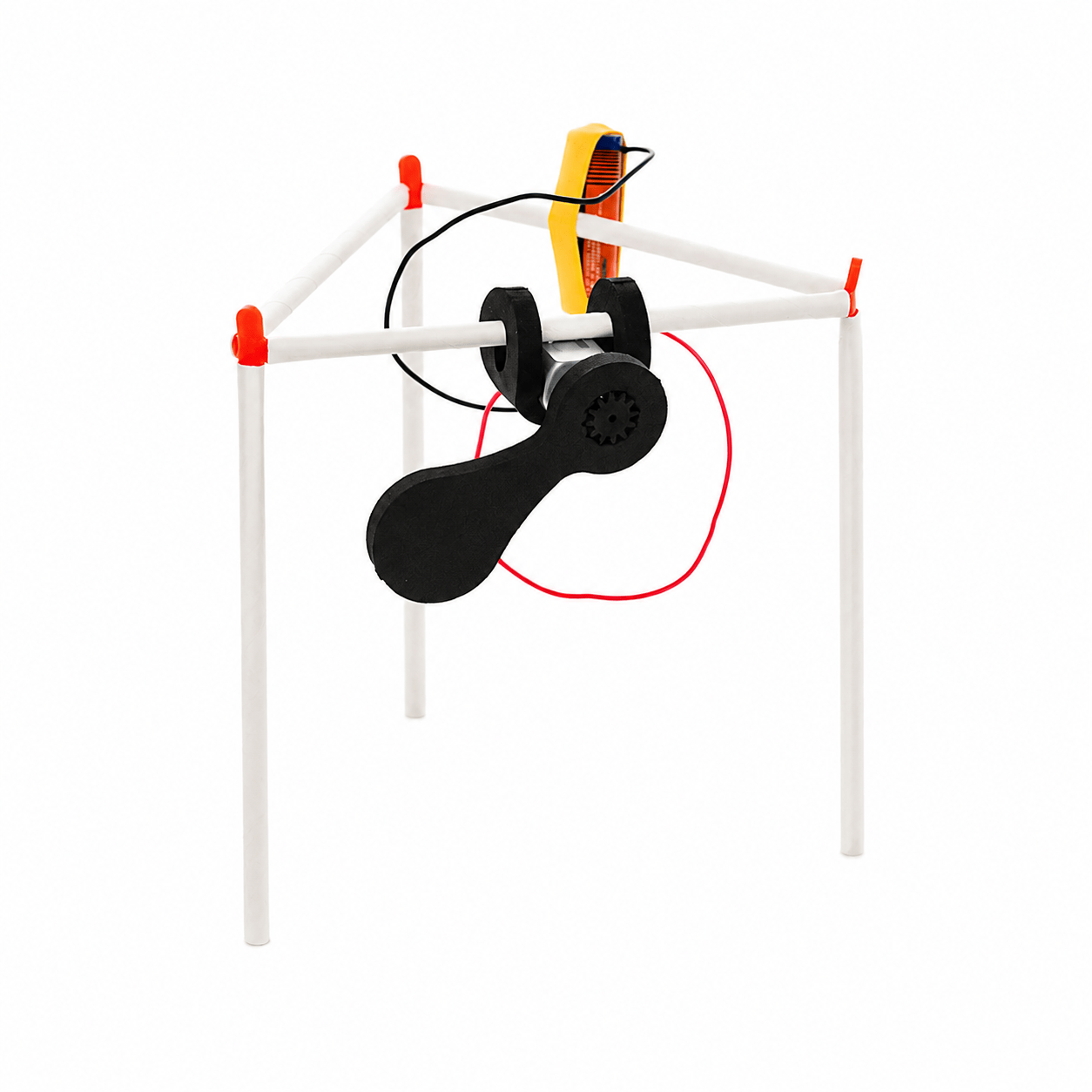
Strawbots has learners build a motorized straw-and-connector creature powered by a battery, a small hobby motor, and an offset foam weight. Spinning the weight creates mechanical vibration that makes the whole structure shake, shimmy, and skitter across the table. The big idea is circuits and unbalanced forces: FutureMakers' guide has learners trace the path electricity follows from battery to motor and back, then explain how an offset, spinning weight creates the unbalanced force that drives the motion. It runs 30 to 45 minutes and is screen-free. See the Strawbots guide for the full build.
What's included in the Strawbots kit?
Each Strawbots kit is self-contained: 12 paper drinking straws, 12 flexible connectors, one AA battery, and one hobby motor with wire leads. It also includes a foam motor harness, an unbalanced foam weight, a latex-free rubber band, an instruction sheet, and a resealable storage bag. FutureMakers' guide states plainly that no additional materials are required for the core build. Tape for reinforcing joints and scissors for the optional Straw Creatures extension are the only add-ons worth having on hand. See the full parts list.
Using it in a session
How long does a Strawbots session take?
A Strawbots session takes 30 to 45 minutes, a screen-free activity built from reusable components. That window covers wiring the circuit, building the straw body, and getting the Strawbot moving; the optional Straw Creatures decoration extension or the Mega Bot combination challenge both add time on top of the base build. Full build steps.
How many learners does one Strawbots pack serve, and how should I group them?
A Strawbots Small Group Pack serves 10 learners and a Class Pack serves 25, with each kit built as an individual 1:1 project. FutureMakers' guide adds one collaborative extension on top of that: Mega Bot. It combines two or more finished Strawbots into a single interconnected build once everyone has a working motor and circuit. Plan one kit per learner for the core build, then group learners for Mega Bot only after each has a working Strawbot. Build steps.
What does an educator need to prepare and supply for Strawbots?
Strawbots needs almost nothing supplied beyond the kit itself, since FutureMakers' guide describes it as self-contained. The one real caution worth planning around: the motor's wire leads are fragile and will break off if pulled, so remind learners to handle the wires gently while wiring the circuit. Optional tape for reinforcing loose joints and scissors for the Straw Creatures extension are the only add-ons worth having on hand. Prep takes about 5 to 10 minutes, per the product listing. Full prep list.
What does a first successful Strawbots build look like?
A first successful Strawbots build is a triangle-bodied straw structure with legs that vibrates and moves across the table on its own once the circuit is connected. FutureMakers' guide names this exact moment, the Strawbot beginning to shake and skitter, as the target before learners move to a design challenge or a decorated creature. A working Strawbot doesn't need to move in a straight line or move far, just move under its own power. See the guide's stand-alone goals.
What are the most common problems and fixes with Strawbots?
Three problems come up most with Strawbots. The motor won't spin: both wires need firm contact with the battery terminals under the rubber band, so try flipping the battery or re-stripping the wire ends. The offset weight falls off: press it firmly onto the motor gear and reinforce with tape if it keeps slipping. The Strawbot isn't moving even though the motor spins: adjust the leg angles, reposition the motor along the straw, or change the base shape from a triangle to a square. Full troubleshooting is in the Strawbots guide's troubleshooting section.
What extensions can I offer early finishers or older learners with Strawbots?
Early finishers can decorate their Strawbot as a Straw Creature using the printable Creature Creation Worksheet and craft materials. They can also take on a Design Challenge that changes leg angles, base shape, or weight placement to see how each choice changes the movement. Older or more ambitious learners can build a Mega Bot, combining two or more Strawbots into one interconnected build, or run a Circuit Exploration, experimenting with different wire placements. FutureMakers' guide frames productive struggle as part of the point. Extension instructions.
Standards and skills
What academic standards does Strawbots align to?
Strawbots' guide documents Next Generation Science Standards (NGSS) codes from kindergarten through middle school, including K-PS2-1, K-2-ETS1-2, 3-PS2-1, 3-5-ETS1-3, MS-PS3-5, and MS-ETS1-2. It also documents Common Core codes in both ELA and Math across the same grade bands; see the table below for the full list. The guide lists NGSS and Common Core codes. It doesn't list CASEL codes.
Where can I find the full Strawbots guide and video?
<script type="application/ld+json">{"@context": "https://schema.org", "@type": "FAQPage", "mainEntity": [{"@type": "Question", "name": "Which Strawbots pack should I buy?", "acceptedAnswer": {"@type": "Answer", "text": "For one learner, the Single Learner Pack costs $8.95. For a class or program, the Small Group Pack of 10 costs $69.50, or $6.95 per learner, and the Class Pack of 25 costs $122.00, or $4.88 per learner. Small Group and Class Pack orders both qualify for purchase orders and tax-exempt purchasing; check \"Our organization is tax-exempt\" in the quote builder and enter your tax ID number, or submit your tax ID number and a tax-exempt certificate through a free store account if buying directly. Note the base product's own Shopify listing uses the singular \"Strawbot,\" while both packs use the plural \"Strawbots,\" a naming quirk on FutureMakers' store, not a different product."}}, {"@type": "Question", "name": "Can I try Strawbots before I buy a class set?", "acceptedAnswer": {"@type": "Answer", "text": "Yes. FutureMakers offers a free sample program at kidsmakethingsbetter.com/samples , and you can ask for Strawbots by name when you request yours. A paid Single Learner Pack ($8.95) also lets you test the build yourself before ordering a class set."}}, {"@type": "Question", "name": "Can I use a purchase order or tax-exempt status to buy Strawbots?", "acceptedAnswer": {"@type": "Answer", "text": "Yes. Strawbots Small Group and Class Pack orders qualify for purchase orders on Net 30 terms and for tax-exempt purchasing, the same as every FutureMakers Spark. See the full how to buy FAQ for purchase order terms, vendor paperwork, and the tax-exempt steps."}}, {"@type": "Question", "name": "What do learners make with Strawbots and what's the big idea?", "acceptedAnswer": {"@type": "Answer", "text": "Strawbots has learners build a motorized straw-and-connector creature powered by a battery, a small hobby motor, and an offset foam weight. Spinning the weight creates mechanical vibration that makes the whole structure shake, shimmy, and skitter across the table. The big idea is circuits and unbalanced forces: FutureMakers' guide has learners trace the path electricity follows from battery to motor and back, then explain how an offset, spinning weight creates the unbalanced force that drives the motion. It runs 30 to 45 minutes and is screen-free. See the Strawbots guide for the full build."}}, {"@type": "Question", "name": "What's included in the Strawbots kit?", "acceptedAnswer": {"@type": "Answer", "text": "Each Strawbots kit is self-contained: 12 paper drinking straws, 8 flexible connectors, one AA battery, and one hobby motor with wire leads. It also includes a foam motor harness, an unbalanced foam weight, a latex-free rubber band, an instruction sheet, and a resealable storage bag. FutureMakers' guide states plainly that no additional materials are required for the core build. Tape for reinforcing joints and scissors for the optional Straw Creatures extension are the only add-ons worth having on hand. See the full parts list ."}}, {"@type": "Question", "name": "How long does a Strawbots session take?", "acceptedAnswer": {"@type": "Answer", "text": "A Strawbots session takes 30 to 45 minutes, a screen-free activity built from reusable components. That window covers wiring the circuit, building the straw body, and getting the Strawbot moving; the optional Straw Creatures decoration extension or the Mega Bot combination challenge both add time on top of the base build. Full build steps ."}}, {"@type": "Question", "name": "How many learners does one Strawbots pack serve, and how should I group them?", "acceptedAnswer": {"@type": "Answer", "text": "A Strawbots Small Group Pack serves 10 learners and a Class Pack serves 25, with each kit built as an individual 1:1 project. FutureMakers' guide adds one collaborative extension on top of that: Mega Bot. It combines two or more finished Strawbots into a single interconnected build once everyone has a working motor and circuit. Plan one kit per learner for the core build, then group learners for Mega Bot only after each has a working Strawbot. Build steps ."}}, {"@type": "Question", "name": "What does an educator need to prepare and supply for Strawbots?", "acceptedAnswer": {"@type": "Answer", "text": "Strawbots needs almost nothing supplied beyond the kit itself, since FutureMakers' guide describes it as self-contained. The one real caution worth planning around: the motor's wire leads are fragile and will break off if pulled, so remind learners to handle the wires gently while wiring the circuit. Optional tape for reinforcing loose joints and scissors for the Straw Creatures extension are the only add-ons worth having on hand. Prep takes about 5 to 10 minutes, per the product listing. Full prep list ."}}, {"@type": "Question", "name": "What does a first successful Strawbots build look like?", "acceptedAnswer": {"@type": "Answer", "text": "A first successful Strawbots build is a triangle-bodied straw structure with legs that vibrates and moves across the table on its own once the circuit is connected. FutureMakers' guide names this exact moment, the Strawbot beginning to shake and skitter, as the target before learners move to a design challenge or a decorated creature. A working Strawbot doesn't need to move in a straight line or move far, just move under its own power. See the guide's stand-alone goals ."}}, {"@type": "Question", "name": "What are the most common problems and fixes with Strawbots?", "acceptedAnswer": {"@type": "Answer", "text": "Three problems come up most with Strawbots. The motor won't spin: both wires need firm contact with the battery terminals under the rubber band, so try flipping the battery or re-stripping the wire ends. The offset weight falls off: press it firmly onto the motor gear and reinforce with tape if it keeps slipping. The Strawbot isn't moving even though the motor spins: adjust the leg angles, reposition the motor along the straw, or change the base shape from a triangle to a square. Full troubleshooting is in the Strawbots guide's troubleshooting section ."}}, {"@type": "Question", "name": "What extensions can I offer early finishers or older learners with Strawbots?", "acceptedAnswer": {"@type": "Answer", "text": "Early finishers can decorate their Strawbot as a Straw Creature using the printable Creature Creation Worksheet and craft materials. They can also take on a Design Challenge that changes leg angles, base shape, or weight placement to see how each choice changes the movement. Older or more ambitious learners can build a Mega Bot, combining two or more Strawbots into one interconnected build, or run a Circuit Exploration, experimenting with different wire placements. FutureMakers' guide frames productive struggle as part of the point. Extension instructions ."}}, {"@type": "Question", "name": "What academic standards does Strawbots align to?", "acceptedAnswer": {"@type": "Answer", "text": "Strawbots' guide documents Next Generation Science Standards (NGSS) codes from kindergarten through middle school, including K-PS2-1, K-2-ETS1-2, 3-PS2-1, 3-5-ETS1-3, MS-PS3-5, and MS-ETS1-2. It also documents Common Core codes in both ELA and Math across the same grade bands; see the table below for the full list. The guide lists NGSS and Common Core codes. It doesn't list CASEL codes."}}, {"@type": "Question", "name": "Where can I find the full Strawbots guide and video?", "acceptedAnswer": {"@type": "Answer", "text": "The complete Strawbots build guide, with every step photographed and troubleshooting for 5 common problems, is free at kidsmakethingsbetter.com/inst/strawbots . A companion coaching video walks through the same build; watch it on YouTube at Strawbots: Build Motorized Straw Machines | Hands-On STEM Activity . Both are free to view without an account; a free FutureMakers educator account also opens a slide deck and coaching tutorial through Coach with Sparks ."}}]}</script>