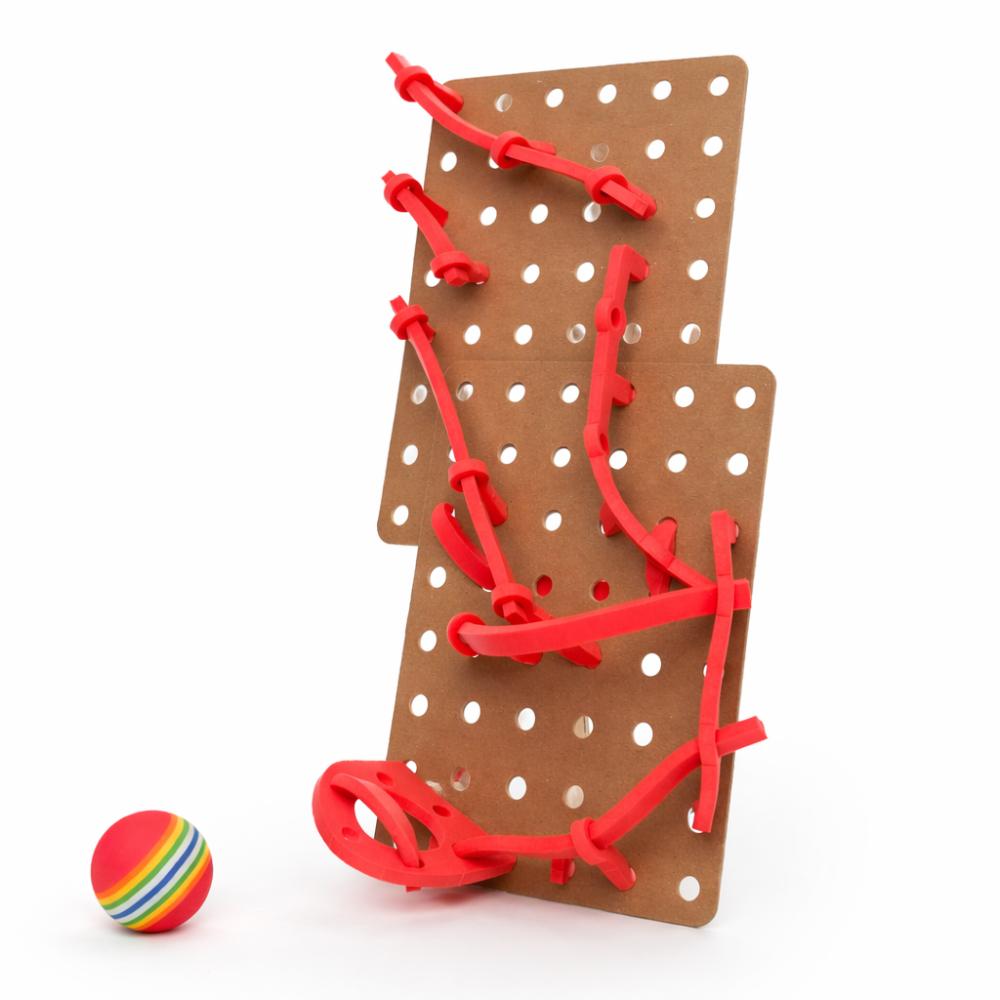
Mazes is a FutureMakers Spark where learners thread foam ramps through a cardboard wall board, working backward from a finish hoop, so gravity carries a ball down a custom path. Boards connect together for a cooperative build, which makes Mazes a natural fit for group settings from kindergarten classrooms through camps.
Last reviewed September 24, 2026
For one learner, the Single Learner Pack costs $8.95. For a class or program, the Small Group Pack of 10 costs $69.50, or $6.95 per learner, and the Class Pack of 25 costs $122.00, or $4.88 per learner. Small Group and Class Pack orders both qualify for purchase orders and tax-exempt purchasing; check "Our organization is tax-exempt" in the quote builder and enter your tax ID number, or submit your tax ID number and a tax-exempt certificate through a free store account if buying directly.
Yes. Small Group Packs and Class Packs come in fixed sizes of 10 and 25, but the $8.95 Single Learner Pack lets a program order any exact quantity below 10. This is the option FutureMakers points buyers to when a real order does not divide evenly into a full 10-pack.
Yes. Mazes Small Group and Class Pack orders qualify for purchase orders on Net 30 terms and for tax-exempt purchasing, the same as every FutureMakers Spark. See the full how to buy FAQ for purchase order terms, vendor paperwork, and the tax-exempt steps.
| Pack | Units | Price | Per learner |
|---|---|---|---|
| Single Learner Pack | 1 | $8.95 | $8.95 |
| Small Group Pack | 10 | $69.50 | $6.95 |
| Class Pack | 25 | $122.00 | $4.88 |
Mazes learners thread foam ramps through die-cut holes in a cardboard wall board so a lightweight ball rolls down a custom zig-zag path into a finish hoop. The build works backward: learners start by placing the hoop, then work up the board adding ramps, which the guide frames as reverse engineering. Gravity is the only force at work, and learners test and adjust after every ramp, since the guide expects early failures as part of the process. Two or more finished boards can connect into one longer shared path.
Mazes is designed for kindergarten through 8th grade. The guide itself differentiates its questions for K to 2, grades 3 to 5, and grades 6 to 8, so the same kit scales from a first ramp-and-ball experience up to a more analytical build for middle schoolers working out ramp angles and failure points.
Early finishers can build with both of their own boards to make a taller single-learner maze, or connect their board to a partner's so one hoop becomes the next board's starting point. Groups can combine four or six boards into a larger cooperative maze, leaning tall combined builds against a wall or bookshelf for stability. Learners who finish early can also cut custom ramps, stoppers, and extenders from spare foam sheets rather than using only the included pieces.
A Mazes session is 30 to 45 minutes, the Shopify Activity Time on all three listings. Building, testing, and connecting boards together happen in that window. The full guide is at kidsmakethingsbetter.com/inst/mazes.
Each learner starts with their own 2-board kit, so a Small Group Pack of 10 serves 10 learners and a Class Pack of 25 serves 25. Unlike most Sparks, Mazes is built to scale up: after the individual build, learners pair their boards, then combine into four-board or six-board whole-group mazes, which makes it one of the easier Sparks to turn into a shared group activity rather than 17 separate solo projects.
Nothing needs to be supplied for the core build; every ramp, stopper, board, and the ball are already in the kit. For partner or group builds, it helps to clear extra table space and have a wall or a stack of books ready, since a tall combined maze needs something to lean against beyond the single-board kickstand. Prep takes about 5 to 10 minutes, per the product listing.
A first success is a single board with at least three ramps where the ball rolls hands-free in a zig-zag path all the way into the hoop. FutureMakers' own guide describes this as the "zig, zag, zoom" test: three ramps at minimum, with the ball never needing a nudge once it starts rolling.
Three problems cover most Mazes troubleshooting. The ball rolls off a ramp: adjust the ramp's angle first, then add a stopper where it escaped. The ball bounces out of the hoop: add a stopper at the hoop opening to absorb the bounce. A combined maze keeps falling over: lean it against a wall or a stack of books, since the single-board kickstand is not enough for a tall combined build. Full troubleshooting is on the Mazes guide's troubleshooting section.
Mazes carries specific NGSS, Common Core ELA, and Common Core Math codes on its guide, from kindergarten through grade 8. NGSS codes cover motion, forces, and the full engineering design and testing cycle, matching the guide's own reverse-engineering and iterative-testing approach. The guide does not carry National Core Arts Standards or CASEL social-emotional competency codes. The full table of codes is below.
The full illustrated Mazes guide, with the build steps, standards table, and troubleshooting, is at kidsmakethingsbetter.com/inst/mazes. The companion video is on YouTube at Mazes: Build Rolling Ball Mazes. Both are free to view, and a free educator account opens the slide decks too, at Coach with Sparks.
Every code below appears on kidsmakethingsbetter.com/inst/mazes. No CASEL or arts-standards codes appear on the guide.
| Standard family | Code | What it covers |
|---|---|---|
| NGSS | K-PS2-1 | Motion and Stability: Forces and Interactions |
| NGSS | K-2-ETS1-2 | Develop a simple sketch, drawing, or physical model |
| NGSS | 3-PS2-1 | Forces and Interactions: Cause and Effect |
| NGSS | 3-5-ETS1-3 | Plan and carry out fair tests to identify failure points |
| NGSS | MS-ETS1-4 | Develop a model to generate data for iterative testing |
| NGSS | MS-ETS1-3 | Analyze data from iterative tests to improve a solution |
| Common Core ELA | RI.K-2.7 | Use illustrations and words to describe key ideas |
| Common Core ELA | SL.K-2.1 | Participate in collaborative conversations |
| Common Core ELA | RI.3-5.3 | Explain relationships between events, concepts, or steps |
| Common Core ELA | SL.3-5.1 | Engage effectively in collaborative discussions |
| Common Core ELA | RST.6-8.3 | Follow a multistep procedure carrying out experiments |
| Common Core ELA | SL.6-8.1 | Engage in collaborative discussions with diverse partners |
| Common Core Math | K.MD.A.1 | Describe measurable attributes of objects |
| Common Core Math | K.G.A.1 | Describe objects using shapes and relative positions |
| Common Core Math | 4.MD.C.5 | Recognize angles as geometric shapes |
| Common Core Math | 4.OA.C.5 | Generate a number or shape pattern that follows a rule |
| Common Core Math | 6.RP.A.3 | Use ratio and rate reasoning to solve real-world problems |
| Common Core Math | 6.EE.C.9 | Represent and analyze quantitative relationships |
Yes. County recreation and parks departments have bought Mazes in 10-packs as part of countywide orders that span many Sparks. See our after-school and summer programs answers page for how camps and rec departments buy across a full Spark catalogue at once.


